
Upstream Leased Assets Emissions

Category 8 is the category that disappears if you read it wrong. Whether a leased warehouse, fleet of vans, or floor of office space belongs here depends not on the asset at all, but on a decision the company made long before — how it drew the boundary of its own inventory. Change that one accounting choice and the same leased building moves from your Scope 2 into Category 8, with no physical change to anything.
Upstream leased assets is a boundary problem wearing the costume of a calculation, and the boundary has to be settled before a single factor is applied.
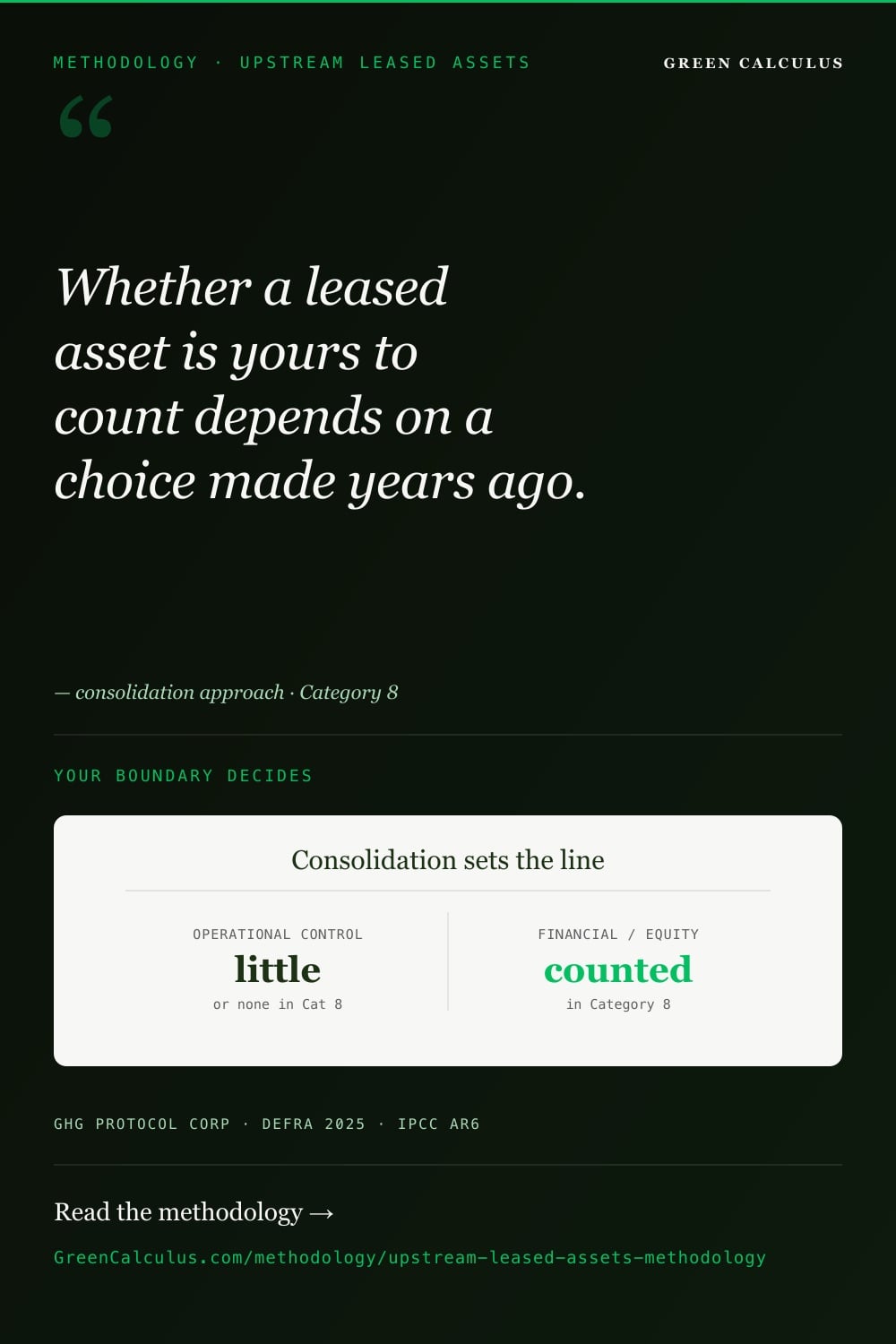
Scope 3 Category 8 covers emissions from assets a company leases in that are not already in its Scope 1 or 2. Whether an asset belongs here depends on the consolidation approach: operational-control reporters often have little in Category 8.
This page covers Scope 3 Category 8 — emissions from upstream leased assets, defined in the GHG Protocol Corporate Value Chain (Scope 3) Standard. The category is unusual: its scope is determined not by the asset but by the company’s chosen consolidation approach under the GHG Protocol Corporate Standard, which decides whether a leased asset is already inside the reporter’s Scope 1 and 2 or sits outside it in Category 8. This page covers that boundary gate first, then the asset-specific, lessor-specific, and average-data calculation methods, the DEFRA 2026 per-asset factors, the mirror relationship with downstream leased assets (Category 13), and three fixed worked examples — including one showing the same building moving between scopes when the consolidation approach changes. The leased-vehicle factors share their basis with the DEFRA vehicle methodology; the energy factors are the same grid factors used for Scope 2.
What Category 8 Captures — and What It Doesn’t
Category 8 covers emissions from the operation of assets a company leases in (as lessee) that are not already included in the company’s Scope 1 or Scope 2. The typical assets are leased buildings (their energy use), leased vehicles, and leased equipment. The operative phrase is “not already included”: Category 8 is a residual category, capturing only what the company’s own scope boundary leaves out. This is what makes it different from almost every other Scope 3 category, where the question is simply how to measure an activity. Here the prior question — is this activity already in my Scope 1 or 2? — decides whether the activity belongs in Category 8 at all.
What Category 8 does not cover: assets the company owns (those are Scope 1 and 2 directly), assets it leases out to others as lessor (that is downstream — Category 13), and the embodied or construction emissions of the leased asset (those, where in scope, sit in Category 2, capital goods). Category 8 is strictly the operational emissions — fuel and electricity — of leased-in assets during the reporting period.
Category 8 is a residual category. It captures the operational emissions of leased-in assets only to the extent those emissions are not already in the company’s Scope 1 or 2. The same leased asset can belong in Scope 1/2 for one reporter and in Category 8 for another — the deciding factor is the consolidation approach, not the asset.
Why this category is often empty
For a company that consolidates its inventory using the operational-control approach, most leased assets it operates are already captured in Scope 1 and 2. Under that approach, Category 8 is frequently small or empty, and a large Category 8 figure for an operational-control reporter is a signal worth checking — it may indicate assets that should have been in Scope 1/2. The category becomes material for companies using the financial-control or equity-share approach, which may operate leased assets that fall outside their Scope 1/2 boundary. The size of Category 8 is therefore diagnostic of the consolidation approach, not just of how much a company leases.
Provider directory
Need help keeping this up all year?
See who does this work. Every listing names the standards it works to, and paid placements are labelled. Including Pangolin Associates and The Carbon Trust.
Browse 6 carbon accounting & inventory providers →Do this work? A listing is US$390 a year. Get listed →
The Consolidation-Approach Gate
Before any factor is applied, the company must establish which leased assets are already inside its Scope 1 and 2. That is governed entirely by the consolidation approach chosen under the GHG Protocol Corporate Standard. The standard recognises three approaches, and each draws the leased-asset boundary differently.
| Consolidation approach | What the reporter counts as Scope 1/2 | Where leased-in operated assets land |
|---|---|---|
| Operational control | All assets the company operates, owned or leased | Scope 1/2 — so usually not Category 8 |
| Financial control | Assets over which the company has financial control (typically finance/capital leases) | Category 8 if operated under an operating lease without financial control |
| Equity share | Emissions in proportion to equity held in the operation | Category 8 for operated leased assets not on the equity-share boundary |
Operational control — the common case
Under operational control, the company accounts for the emissions of every asset it operates, regardless of who owns it. A leased van the company drives, a leased building the company runs — both are already in Scope 1 and 2. For such a reporter, Category 8 captures only leased assets it does not operate, which is a narrow set. This is why operational-control inventories often show a small or zero Category 8.
Financial control and equity share
Under financial control, the boundary follows financial control rather than operation. A company may operate a leased asset day to day without holding financial control of it — a typical operating lease — in which case that asset’s emissions are not in its Scope 1/2 and fall into Category 8. The equity-share approach draws the line by ownership stake, producing a similar effect: operated leased assets outside the equity boundary land in Category 8. For these reporters the category can be substantial.
Settle the consolidation approach before populating Category 8, and apply it consistently with Scope 1 and 2. The single most damaging Category 8 error is a boundary mismatch: counting a leased asset in both Scope 1/2 and Category 8 (double-count), or in neither (gap). Every asset in the inventory must sit in exactly one place, and the consolidation approach is what decides which.
1. Is the asset already in your Scope 1/2?
Apply your consolidation approach. Under operational control, any asset you operate — owned or leased — is already in Scope 1/2. If yes, it is not in Category 8. If no, continue.
2. Do you lease the asset in (as lessee)?
If you lease it out to others, that is downstream — Category 13, not Category 8. If you lease it in and operate it but it is outside your Scope 1/2 boundary, it belongs in Category 8. Continue.
3. Calculate the operational emissions
Apply the asset-specific, lessor-specific, or average-data method (§3) to the leased asset’s fuel and electricity use for the reporting period. Embodied/construction emissions are Category 2, not here.
The Calculation Methods
Once an asset is confirmed to belong in Category 8, the GHG Protocol recognises three methods for quantifying its operational emissions, in descending order of data quality. They differ in how the asset’s energy use is obtained, not in the factors applied to it.
| Method | Energy data source | Factor applied | Data quality |
|---|---|---|---|
| Asset-specific | Metered fuel and electricity for the specific leased asset | DEFRA fuel / grid factor | Highest |
| Lessor-specific | Energy or emissions data supplied directly by the lessor | Lessor’s reported factor or kWh × grid | High |
| Average-data | Floor area, asset count, or activity proxy × average intensity | Average kg CO₂e / m² or per asset | Lowest — fallback only |
Asset-specific — the default
The asset-specific method uses metered energy for the leased asset itself: kilowatt-hours of electricity, litres or kilowatt-hours of fuel, kilometres for a leased vehicle. Each energy stream is multiplied by its emission factor — the DEFRA grid factor for electricity, the DEFRA fuel factor for combustion, the per-km factor for a leased vehicle. It is the highest-quality method because the activity data is real and asset-specific, and it is feasible whenever the company holds the meter readings or fuel records for the asset it operates.
Lessor-specific — when the lessor reports
Where the lessor provides energy or emissions data for the leased asset — common in managed office space with landlord-reported utilities — the lessor-specific method uses that data directly. It is high quality when the lessor’s figures are themselves well-sourced, and it avoids the lessee having to estimate energy it does not directly meter. Confirm the basis of any lessor-supplied emissions figure (which factors, which year, which scopes) before adopting it.
Average-data — the fallback
When neither asset-specific nor lessor-specific data is available, the average-data method estimates emissions from a proxy — leased floor area times an average energy intensity, or asset count times an average per-asset figure. It is the lowest-quality method and should be a documented fallback. As with every Scope 3 category, an average-data estimate for an asset the company could meter understates achievable data quality and leaves nothing for a verifier to trace.
Average-data is a fallback, not a starting point. Estimating a leased building’s emissions from floor-area intensity when the company holds the actual meter readings both understates data quality and risks materially mis-stating the figure. Reach for it only after confirming asset-specific and lessor-specific data are genuinely unavailable, and disclose the figure as estimated.
Emission Factors for Leased Assets (DEFRA 2026)
GreenCalculus applies the DEFRA 2026 conversion factors for leased assets, surfaced live from the MasterBrain’s Category-8-tagged factor set. These factors are the same physical values DEFRA publishes for owned vehicles and grid electricity — the difference is the GHG Protocol category they are attributed to, not the number. Leased vehicles use per-kilometre factors; leased-building electricity uses the per-kilowatt-hour grid factor.
| Leased asset | DEFRA 2026 factor | Unit |
|---|---|---|
| Electricity (UK grid) | 0.131 | kg CO₂e / kWh |
| Car — average, diesel | 0.17265 | kg CO₂e / km |
| Car — average, petrol | 0.16152 | kg CO₂e / km |
| Van — average, diesel | 0.25716 | kg CO₂e / km |
| HGV — all, 0% laden, diesel | 0.66699 | kg CO₂e / km |
| HGV — all, average laden, diesel | 0.84482 | kg CO₂e / km |
Leased buildings and electricity
A leased building’s operational emissions are dominated by its energy use: electricity (the grid factor above) and any on-site combustion such as gas heating (the relevant DEFRA fuel factor). The calculation is the standard energy-times-factor chain — identical in mechanics to a Scope 2 calculation — with the only difference being that the result is attributed to Category 8 rather than Scope 2, because the consolidation approach placed the asset outside the reporter’s own scope boundary. For a non-UK leased building, use the destination country’s grid factor rather than the UK value.
Leased vehicles
A leased vehicle the company operates but does not count in Scope 1 uses the per-kilometre factor for its type and fuel, multiplied by distance driven in the reporting period. The DEFRA leased-vehicle factors mirror the owned-vehicle factors used in the vehicle methodology exactly — a leased diesel car and an owned diesel car of the same size emit the same per kilometre; only the scope attribution differs. Use the size- or class-specific factor where the vehicle is known, and the average only where it is not.
The leased-asset factors are deliberately the same numbers as the Scope 1 and 2 factors. This is correct, not a duplication error: the physics of operating the asset is identical whether you own or lease it. What changes is which line of the inventory the result lands on. Render and document the Category-8-tagged factor so the audit trail shows the emissions were attributed to Category 8 by design.
Category 8 vs Category 13 — The Upstream/Downstream Mirror
Leased assets appear twice in the Scope 3 framework, on opposite sides of the lease. Category 8 (upstream) is the lessee’s view — assets the company leases in. Category 13 (downstream) is the lessor’s view — assets the company leases out to others. The same physical asset is in one party’s Category 8 and the other party’s Category 13, and the calculation mechanics are identical; only the perspective and the attribution differ.
| Dimension | Category 8 — upstream leased assets | Category 13 — downstream leased assets |
|---|---|---|
| Reporter’s role | Lessee (leases the asset in) | Lessor (leases the asset out) |
| Whose asset | Operated by the reporter, owned by another | Owned by the reporter, operated by another |
| Factors used | DEFRA fuel / grid / per-km | Same DEFRA fuel / grid / per-km |
| Methods | Asset-specific / lessor-specific / average-data | Asset-specific / lessee-specific / average-data |
No separate Category-13 factor set
There is no distinct emission-factor dataset for downstream leased assets. The same energy and transport factors — fuel, grid, per-kilometre vehicle — serve both categories; the GHG Protocol category is an accounting re-attribution of the same underlying activity, not a new factor set. A reporter calculating its Category 13 figure uses identical factors to those on this page, applied from the lessor’s side. This is why a single, well-documented factor set covers both: the difference between Category 8 and Category 13 lives entirely in the boundary logic, not the numbers.
Worked Examples — Audit Records
Three audit-record snapshots. All values are fixed as audit records: they reconcile to their stated inputs and must continue to reconcile regardless of future DEFRA releases. The DEFRA factors used are the 2026-06-09 review-date values (matching the live MasterBrain on that date); a future factor revision will change the live tables above but must not change these worked examples. Figures are illustrative and do not represent any specific named company.
Example A — leased building electricity (asset-specific)
| Example A — leased UK office, metered electricity | Value |
|---|---|
| Leased asset | UK office floor, operating lease, no financial control |
| Consolidation approach | Financial control — so outside Scope 1/2 |
| Metered electricity, reporting year | 240,000 kWh |
| DEFRA UK grid factor (leased asset) | 0.131 kg CO₂e/kWh |
| Category 8 emissions (240,000 × 0.13096) | 31,430 kg CO₂e |
The building is operated by the reporter but, under the financial-control approach without financial control of this operating lease, sits outside Scope 2 — so its electricity lands in Category 8. The mechanics are identical to a Scope 2 calculation; only the attribution differs. An operational-control reporter operating the same floor would carry this 31,430 kg in Scope 2 instead, and Category 8 would be zero for this asset.
Example B — leased vehicle fleet (asset-specific)
| Example B — 10 leased diesel cars | Value |
|---|---|
| Leased vehicles | 10 average diesel cars |
| Annual distance per vehicle | 18,000 km |
| Fleet distance (10 × 18,000) | 180,000 km |
| DEFRA car average diesel factor (leased) | 0.17304 kg CO₂e/km |
| Category 8 emissions (180,000 × 0.17304) | 31,147.2 kg CO₂e |
The per-kilometre factor is the same value DEFRA publishes for owned diesel cars; the result is attributed to Category 8 because these vehicles are leased and fall outside the reporter’s Scope 1 boundary under its consolidation approach. Had the vehicles been owned, or leased under an operational-control boundary, the identical 31,147.2 kg would sit in Scope 1 instead.
Example C — the control-flip (same asset, different scope)
| Example C — same leased office, two consolidation approaches | Operational control | Financial control |
|---|---|---|
| Asset | Leased UK office (operated, operating lease) | Leased UK office (operated, operating lease) |
| Metered electricity | 240,000 kWh | 240,000 kWh |
| Emissions (240,000 × 0.13096) | 31,430 kg CO₂e | 31,430 kg CO₂e |
| Where the emissions land | Scope 2 | Category 8 |
| Category 8 contribution | 0 kg CO₂e | 31,430 kg CO₂e |
The asset, the energy, the factor, and the total emissions are identical in both columns — 31,430 kg CO₂e either way. The only thing that changes is the consolidation approach, and with it the line of the inventory the emissions are reported on. This is the defining property of Category 8: it is the same number sitting in a different place. The error to guard against is reporting it in both places at once (double-count) or in neither (gap) — the total across Scope 1, Scope 2 and Category 8 must be invariant to the boundary choice.
Reconcile every leased asset to exactly one scope. In Example C the 31,430 kg appears in Scope 2 or Category 8 — never both, never neither. When the consolidation approach moves an asset, move it out of the old scope as you move it into the new one. A leased asset counted in both Scope 1/2 and Category 8 inflates the total; one counted in neither understates it.
Edge Cases and Known Pitfalls
The consolidation approach decides the boundary
Whether a leased asset is in Scope 1/2 or Category 8 depends on the company’s consolidation approach, not the asset. Settle the approach first and apply it consistently across Scope 1, 2 and Category 8. Operational-control reporters often have little in Category 8.
Exactly one scope per asset
Every leased asset belongs in exactly one place. Counting it in both Scope 1/2 and Category 8 double-counts; counting it in neither leaves a gap. The total across scopes must be invariant to the boundary choice.
Upstream is not downstream
Category 8 is the lessee’s view (assets leased in). Assets leased out to others are the lessor’s view — Category 13. The same asset is in one party’s Cat 8 and the other’s Cat 13; do not report your leased-out assets in Category 8.
Operational emissions only
Category 8 covers the fuel and electricity of operating the leased asset. Its embodied and construction emissions, where in scope, sit in Category 2 (capital goods), not here. Do not fold construction into the operational figure.
Average-data is a fallback
Floor-area intensity or per-asset averages are the lowest-quality method and untraceable to source. Use them only after confirming asset-specific and lessor-specific data are genuinely unavailable, and disclose the figure as estimated.
Verify lessor-supplied figures
A lessor’s reported emissions may use different factors, a different year, or a different scope basis than your inventory. Confirm the basis before adopting a lessor figure, or it imports an inconsistency the headline number then carries silently.
Non-UK leased assets need local factors
The headline grid factor here is UK DEFRA. A leased building abroad uses its destination country’s grid factor, not the UK value. Applying the UK factor to a non-UK asset mis-states the result on a cleaner or dirtier grid.
Governance, Assurance, and Disclosure
Category 8 is assured against the consistency of the inventory boundary as much as the accuracy of the factors. An ISO 14064-1 verifier reads the consolidation approach first, then checks that leased assets are partitioned cleanly between Scope 1/2 and Category 8 with no double-count or gap. For companies in scope of CSRD ESRS E1, material leased-asset emissions are part of the Scope 3 disclosure, and the boundary logic behind them is part of what is assured.
Run the following pre-flight before submitting a Category 8 figure for assurance:
- Consolidation approach documented. The chosen approach (operational control, financial control, or equity share) is stated and applied identically across Scope 1, Scope 2 and Category 8.
- Boundary partition checked. Every leased asset sits in exactly one of Scope 1/2 or Category 8 — no asset in both, no asset in neither.
- Method documented per asset. Each leased asset is tagged asset-specific, lessor-specific, or average-data, with the energy data basis recorded behind it.
- Operational emissions only. Category 8 contains the fuel and electricity of operating the asset; embodied/construction emissions are in Category 2, not here.
- Upstream/downstream split correct. Leased-in assets are in Category 8; leased-out assets are in Category 13. No leased-out asset appears in Category 8.
- Lessor figures verified. Any lessor-supplied emissions data is confirmed for factor basis, year, and scope before adoption.
- Correct geography. Each leased asset uses the grid and fuel factors of its location, not a default UK value applied globally.
- DEFRA factor version recorded. The DEFRA release used is documented so the figure is reproducible against the right edition.
- Exclusions justified. Any leased asset omitted on materiality grounds carries an explicit justification rather than silent omission.
The three assurance findings most specific to Category 8 are an inconsistent consolidation approach (the leased-asset boundary not matching the Scope 1/2 boundary), double-counting a leased asset across Scope 1/2 and Category 8, and reporting leased-out assets in Category 8 instead of Category 13. Lock the consolidation approach and the asset partition in the methodology note before submission.
What the Calculator Handles vs What You Decide
A calculator automates the energy-times-factor arithmetic across a portfolio of leased assets. It cannot decide the boundary — which assets belong in Category 8 at all — because that depends on the company’s consolidation approach and lease terms.
The calculator handles
Applying the correct DEFRA grid, fuel, or per-km factor to each leased asset’s energy or distance; converting metered kWh, litres, or kilometres to kg CO₂e; summing leased assets into a Category 8 total; applying the destination-country grid factor for non-UK assets; and producing an audit trail showing each asset, its energy data, its factor, and its result.
You decide
Which consolidation approach the inventory uses; which leased assets fall inside Scope 1/2 versus Category 8; whether each asset uses asset-specific, lessor-specific, or average-data; whether a lessor-supplied figure is on a compatible basis; the split between upstream (Category 8) and downstream (Category 13); and how exclusions are justified.
Apply the DEFRA 2026 leased-asset factors across your portfolio, partition assets between Scope 1/2 and Category 8 by consolidation approach, and produce a reconciled Category 8 total with a full audit trail.
Standards Alignment
Four standards govern Category 8 and its disclosure consequences.
| Standard | Role for this methodology |
|---|---|
| GHG Protocol Scope 3 Standard | Defines Category 8, the asset-specific, lessor-specific and average-data methods, and the residual relationship to Scope 1/2. The methodological foundation of this page. |
| GHG Protocol Corporate Standard | Defines the consolidation approaches — operational control, financial control, equity share — that decide whether a leased asset is in Scope 1/2 or Category 8. The gate for the whole category. |
| UK DEFRA Emission Factors | Source of the per-km leased-vehicle factors and the per-kWh grid factor. Updates annually; the live values on this page track each release. |
| CSRD ESRS E1 | EU mandatory climate disclosure; in-scope companies disclose material Scope 3 categories including upstream leased assets where material. |
Frequently Asked Questions
Category 8 covers the operational emissions — fuel and electricity — of assets a company leases in, to the extent those emissions are not already counted in its Scope 1 or 2. Typical assets are leased buildings, vehicles, and equipment. It excludes owned assets, leased-out assets, and embodied/construction emissions.
Because it decides whether a leased asset is already inside the company’s Scope 1/2 or sits outside it in Category 8. Under operational control, assets the company operates — owned or leased — are in Scope 1/2, so Category 8 is often small. Under financial control or equity share, operated leased assets outside that boundary fall into Category 8.
Yes. The same leased building can be in an operational-control reporter’s Scope 2 and a financial-control reporter’s Category 8, with identical emissions either way. The asset, energy, and factor are the same; only the consolidation approach — and therefore the inventory line — differs.
Asset-specific wherever you hold the leased asset’s metered energy — it is the highest-quality method. Lessor-specific where the lessor reports the asset’s energy or emissions, after verifying the basis. Average-data, estimating from floor-area intensity or per-asset averages, is a documented fallback only.
Category 8 is the lessee’s view — assets leased in and operated by the reporter. Category 13 is the lessor’s view — assets owned by the reporter and leased out to others. The same physical asset is in one party’s Category 8 and the other’s Category 13, using identical factors; only the perspective differs.
No. Leased assets use the same DEFRA fuel, grid, and per-kilometre factors as owned assets — a leased diesel car and an owned diesel car emit the same per kilometre. The GHG Protocol category is an accounting attribution of the same underlying factor, not a separate dataset. There is likewise no distinct Category-13 factor set.
No. Category 8 covers only the operational emissions — fuel and electricity — of operating the leased asset during the reporting period. The embodied and construction emissions of the asset, where in scope, belong in Category 2 (capital goods), not Category 8.
That is normal for an operational-control reporter. Under operational control, leased assets the company operates are already in Scope 1 and 2, leaving little for Category 8. A large Category 8 figure for an operational-control reporter is worth checking — it may indicate assets that should have been captured in Scope 1/2.
Assign every leased asset to exactly one scope using a single, consistent consolidation approach. An asset counted in both Scope 1/2 and Category 8 inflates the total; one counted in neither understates it. The total across Scope 1, Scope 2, and Category 8 should be invariant to where the boundary falls.