
Scope 3 Cat 6 Hotel Stay Emissions Calculator — By Country and Hotel Class (DEFRA + Cornell HCMI)
Compute business-travel hotel emissions per room-night on DEFRA 2025 national-average factors or Cornell HCMI property-class benchmarks, in CO₂e on an AR5 GWP-100 basis.
The room-night is the unit, and the hotel class decides the factor family. This calculator computes the accommodation leg of Scope 3 Category 6 business travel. You enter room-nights — rooms multiplied by nights — and pick a hotel class per stay. The first class option, National average, draws a DEFRA 2025 per-country factor; for the ten countries Cornell benchmarks, property-class options appear below it, drawing a Cornell HCMI factor instead. There is no headcount field: the factor is per occupied room-night, not per guest.
Two factor families, chosen per stay line. DEFRA publishes a single national-average room-night factor for each of 39 countries — the right default when you know the country but not the property. Cornell’s Hotel Sustainability Benchmarking Index publishes measured factors by property class (economy through luxury) for ten countries — the sharper choice when you know the hotel’s class. A portfolio can mix the two; when it does, the calculator flags the blended methodology so the disclosure is transparent about it.
The factor is the property’s operational energy per room-night. Each room-night factor embeds the hotel’s operational energy — heating, cooling, lighting, hot water, and a share of common-area energy — allocated to one occupied room for one night. It is not a building life-cycle figure: it excludes embodied materials and construction. For the traveller’s employer, the whole room-night is Scope 3 Category 6; the hotel’s own energy is the hotel’s Scope 1 and 2, never the traveller’s Scope 2.
AR5 GWP-100, two derivations. DEFRA’s factors are weighted on the IPCC AR5 GWP-100 basis, the DEFRA convention. Cornell’s are measured energy intensities converted to CO₂e, with AR5 the assumed basis rather than one Cornell separately restates. Both families are reported as a single CO₂e aggregate, so there is no AR5-versus-AR6 choice to make and no radiative-forcing reconciliation of the kind the air calculator carries.
Audit mode exposes the full calculation chain + uncertainty band.
Add a line for each hotel stay. Pick the country, then the hotel class — the national average (DEFRA 2026) for any of 39 countries, or a specific class (Cornell HSBI 2024) for the ten countries it covers. Enter room-nights: rooms × nights. Two colleagues sharing one room for three nights is 3 room-nights, not six — the factor is per occupied room, so counting guests would double-count.
Roll up a full quarter or year of accommodation from a single CSV — a travel-management export, a folio summary, an expense extract. Parsing is fully client-side — your data never leaves your browser.
CSV schema (click to expand)
Required: country and room_nights (or nights). Optional: class (default average), label.
country accepts the country name or DEFRA slug (e.g. france, united_states, gbr; aliases: uk, usa, uae…). class is average (DEFRA national average — works for any of 39 countries) or, for the ten Cornell-covered countries (UK, US, Germany, Spain, France-excluded, India, Japan, Mexico, Canada, China, UAE), a class: general, economy, midscale, upper_midscale, upscale, upper_upscale, luxury (availability varies by country). room_nights = rooms × nights (per occupied room, not per guest). Unknown country/class rows are skipped with a note — there is no rest-of-world default.
Drop a CSV file here or .
Or paste CSV text below.
For a Cornell-covered country, see the same room-nights across every published hotel class — and the carbon saved by booking a lower class. The decision tool for travel-policy and preferred-property guidance.
Only the ten countries with Cornell HSBI class factors are listed.
Enter room-nights greater than zero.
Add a hotel stay above to calculate
Results appear instantly. Per-stay breakdown, class-level uncertainty bands, data-quality scoring, class-comparison, and a full audit trail with the exact DEFRA / Cornell factor keys all available after calculation.
Results are indicative, intended for screening and order-of-magnitude estimates. Factors are DEFRA 2026 (national average, 39 countries) and Cornell Hotel Sustainability Benchmarking Index 2024 (by class, 10 countries), expressed per occupied room-night on an average-data method (AR5 GWP-100). Hotel factors are per occupied room per night, not per guest — count rooms × nights, not heads. They cover in-room accommodation energy only; on-site food & beverage, spa, meetings, and airport transfers are out of scope. There is no rest-of-world default — for a country neither source publishes, choose the nearest covered proxy and document it. A portfolio that mixes DEFRA and Cornell factors blends two methodologies and vintages. For CDP, SECR, CSRD, or other regulatory submissions, validate factors against the primary DEFRA / Cornell datasets, confirm room-nights against folio / expense records, exclude regular commuting (Scope 3 Category 7), and document your full Scope 3 Category 6 inventory boundary.
A consultant spends forty nights a year in hotels across three continents. The company never paid an energy bill for any of those rooms, never set a thermostat — yet every kilowatt-hour those rooms drew is the company’s to report.
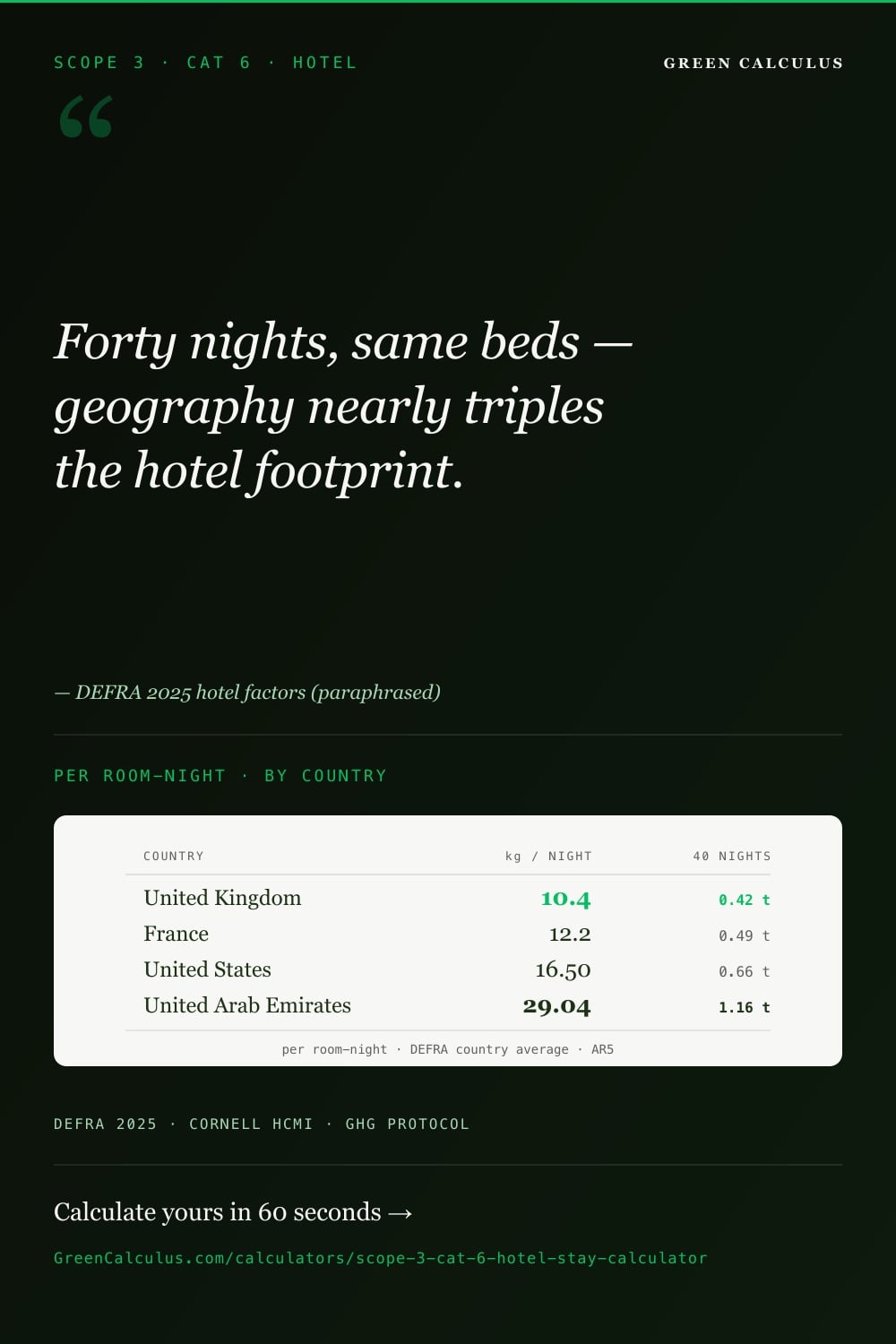
A hotel night in Dubai carries roughly six times the carbon of the same night in London, and most inventories never notice.
Hotel emissions are room-nights times a per-room-night factor: about 10.4 kg CO₂e in the UK, far higher in hot, fossil-grid countries. It is Scope 3 Category 6, counted per room not per guest, on an AR5 basis.

What the Hotel Stay calculator covers
This calculator computes the accommodation leg of Scope 3 Category 6 business travel: the emissions of the hotel rooms your employees occupy on business trips, wherever in the world they stay. You enter room-nights and choose a hotel class for each stay; the engine multiplies the room-nights by the matching per-room-night factor — DEFRA national-average or Cornell property-class — and sums them into a Category 6 total.
Why hotel nights are the reporting entity’s emissions
The hotel owns the building, buys the electricity, and burns the gas. So why does the footprint land on the travelling company’s inventory? Because Category 6 captures the emissions of services a company purchases for business travel, and a hotel night is exactly that — a purchased service whose delivery emits. The hotel reports its own energy as its Scope 1 and Scope 2; the company that sent the traveller reports the same nights as its Scope 3 Category 6. There is no double-count across entities — the two sit in different inventories under different scopes, which is how the GHG Protocol intends value-chain emissions to be shared.
A hotel night is Scope 3 Category 6 for the traveller’s employer, even though the hotel owns and powers the room. The hotel’s energy is the hotel’s own Scope 1 and 2; for the reporting company it is a purchased travel service, reported in full within Category 6. There is no Scope 2 component for the traveller’s employer — the room’s electricity belongs to the hotel, not the company that booked it.
What the factor includes
Each room-night factor is the hotel’s operational energy allocated to one occupied room for one night: heating, cooling, lighting, hot water, and a share of the common-area energy — corridors, lobby, kitchens, laundry. It is not a building life-cycle figure. Embodied carbon in the structure, the materials, and the construction sits outside the room-night factor; those belong to the building’s own life-cycle accounting, not to a traveller’s one-night stay. The number you compute here is the energy the property burned to host the room, nothing more and nothing less.
Stay boundary — what’s in, what’s a separate calculator
| Covered in this calculator | Out of scope — separate calculator or category |
|---|---|
| Hotel room-nights on business trips, by country (DEFRA) or property class (Cornell HCMI), per occupied room-night | The travel to the hotel — flights, road, and rail — each a separate Category 6 leg with its own calculator |
| The hotel’s operational energy per room-night — heating, cooling, lighting, hot water, common-area share | The hotel building’s embodied carbon and construction — building life-cycle accounting, not a room-night factor |
| International stays across the DEFRA 39-country set and the Cornell 10-country class set | Employee commuting and work-from-home — Scope 3 Category 7, not Category 6 (see the commuting methodology) |
| The room as the unit — rooms multiplied by nights, occupancy-irrelevant | Meals, in-room minibar, conference catering, and other on-site spend — outside the room-night factor; treat under the relevant spend category |
The room-night — the unit that trips people up
The most-misapplied point on hotel accounting is the unit. The factor is per occupied room-night, not per guest-night — and treating it as per-guest inflates every shared room by its headcount.
One room, two colleagues — counted once
Neither DEFRA nor Cornell publishes a per-guest factor. The room draws the same energy whether one person sleeps in it or two: the heating, the lighting, the hot water are the room’s, not the occupant’s. So two colleagues sharing a room for three nights is three room-nights, not six. The calculator enforces this structurally — there is no field to enter a headcount, because headcount does not enter the calculation. Multiplying a shared room by the number of people in it is the hotel equivalent of multiplying a shared car by its passengers, and it overstates the inventory the same way.
Do not multiply a room by the number of guests in it. Hotel factors are per occupied room-night — the room is the unit, and its energy does not change with headcount. Two people in one room for three nights is three room-nights. Counting it as six double-counts the stay, and an assurance provider will flag it.
Nights, room-nights, and stays
Three terms get conflated, and only one is the unit. A stay is a booking; a night is one calendar night of that booking; a room-night is one room occupied for one night. A traveller booking two rooms for five nights generates ten room-nights from a single stay. The activity figure the calculator wants is room-nights — so a booking system that records nights and a room count needs the two multiplied before the factor applies. Where travel data records only stays, or only a spend total, the room-night count has to be reconstructed before this calculator can give a defensible number.
Category 6 hotel emission (kg) = Σ (room-nightsstay × factorcountry | class)
The factor is DEFRA national-average or Cornell property-class, chosen per stay. The room is the unit; headcount does not enter.
Two factor families — DEFRA country average vs Cornell HCMI class
This is the page’s signature methodological point. Two published factor families sit behind the calculator, and which one you use is a per-stay choice that trades coverage against precision.
DEFRA national average — broad coverage, country granularity
DEFRA’s 2025 conversion factors carry a single hotel room-night figure for each of 39 countries — a national average across the country’s hotel stock. This is the default, and the right choice when you know where the traveller stayed but not the property’s class: it covers far more countries than Cornell, and it is the same DEFRA dataset that underpins UK corporate reporting elsewhere in the inventory. Its limitation is that it cannot distinguish an economy property from a luxury one in the same country — the national average blurs the two.
Cornell HCMI property class — finer, ten countries
Cornell’s Hotel Sustainability Benchmarking Index takes the other approach: measured energy intensities by property class — economy, midscale, upscale, luxury, and points between — for the ten countries it benchmarks. Where you know the hotel’s class, the Cornell factor is the sharper benchmark, because property class moves the room-night footprint substantially: a luxury hotel’s larger rooms, spa, pools, and service levels draw far more energy per room-night than an economy property’s. The trade is coverage: Cornell benchmarks ten countries, not 39, and not every class is published for every one of them.
Use the DEFRA national average when you know the country but not the property; use the Cornell HCMI class factor when you know the hotel’s class and it is one of the ten Cornell countries. DEFRA gives breadth — 39 countries; Cornell gives depth — class resolution within a country. The calculator offers both per stay, defaulting to DEFRA national average.
Mixing families — and the blended-methodology flag
A real travel portfolio rarely fits one family cleanly: some stays are in Cornell countries with a known class, others in countries Cornell does not cover. The calculator lets you choose per stay line, so a portfolio can carry DEFRA lines and Cornell lines together. When it does, the engine raises a flag that the total blends two methodologies and two source vintages — DEFRA 2025 and Cornell HSBI 2024. The blend is legitimate; what matters is disclosing it, so a reader of the inventory knows the Category 6 hotel figure rests on two derivations rather than one. The calculator surfaces this rather than hiding it.
Where the national average sits among the classes
The two families are not strangers. For the UK, the DEFRA national average of 10.4 kg CO₂e per room-night sits between Cornell’s upper-midscale (9.54) and its all-classes general figure (13.07) — exactly where a national average should land relative to a class ladder. The chart makes the relationship visible: the DEFRA average is a single point on a distribution that Cornell resolves into classes.
UK hotel room-night factors: DEFRA 2025 national average (10.4) against the Cornell HSBI 2024 class ladder, kg CO₂e per room-night, AR5 GWP-100. Bars scaled to UK Cornell luxury = 100%. The UK Cornell set publishes no economy or midscale segment. DEFRA / Cornell HSBI 2024 via MasterBrain v2026.203.
Why geography dominates the hotel footprint
Once the room-night unit and the factor family are settled, the single largest driver of a hotel footprint is where the hotel is. Country moves the number more than anything else in the calculation.
Grid intensity and climate load
A room-night factor is mostly energy, and a country’s energy carbon turns on two things: how its electricity is generated, and how hard the building has to work to stay comfortable. A hotel on a coal-heavy grid in a hot, humid climate runs air-conditioning around the clock on high-carbon power; a hotel on a low-carbon grid in a temperate climate draws far less, and what it draws is cleaner. The two effects compound. That is why the same room-night ranges from single digits in low-carbon, temperate countries to the high tens of kilograms in hot countries on fossil grids — a spread no class difference within a single country comes close to.
DEFRA 2025 national-average hotel room-night factors, kg CO₂e per room-night, AR5 GWP-100. Bars scaled to UAE = 100%. A UAE room-night is roughly nine times a Canadian one and six times a UK one — the country, not the property, dominates the result. DEFRA 2025 via MasterBrain v2026.203.
Country moves the hotel footprint more than property class does. A UAE room-night is roughly six times a UK one on the DEFRA national average — a far wider gap than luxury-versus-economy within a single country. For a travel inventory, getting the country right on every stay is the highest-value data step; resolving property class is the second-order refinement on top.
How the calculation works — room-nights to CO₂e
Every stay runs the same one-line calculation: room-nights multiplied by the chosen factor, summed into the Category 6 total. The only decision per stay is which factor — and that follows from what you know about the property.
Known country, unknown property
The common case: an expense line shows the country but not the hotel’s class. Use the DEFRA national average for that country — the default. The trap: leaving every stay on the UK average when the trips were to high-carbon countries.
Known class, Cornell country
The booking records the hotel and it is one of the ten Cornell countries. Pick the property class to draw the Cornell HCMI factor — sharper than the national average. The trap: forcing a class onto a country Cornell does not cover.
Mixed portfolio
Some stays in Cornell countries with a known class, others country-only. Choose per stay; the engine flags the blended methodology. The trap: blending DEFRA and Cornell silently and not disclosing it.
No published factor
A country neither family covers. The engine skips the line with an em-dash and a flag rather than inventing a number; pick the nearest covered country as a documented proxy. The trap: assuming a rest-of-world default exists — none does.
Reconstructing room-nights, and the no-default rule
Two practical steps sit around the multiplication. First, the activity figure must be room-nights: a travel record showing five nights across two rooms is ten room-nights, and a record showing only stays or only spend has to be resolved to a room-night count before the factor applies. Second, where neither family publishes a factor for the country, the calculator does not fall back to a global average — it surfaces the gap and asks you to choose a documented proxy. That is deliberate: with factors ranging from single digits to the high tens, any single rest-of-world default would be misleading, so the honest move is to flag the gap rather than paper over it.
The abatement levers for hotel travel are destination and duration, not just policy. Where a trip’s location is flexible, a meeting held in a low-carbon-grid country carries a fraction of the room-night footprint of the same meeting in a hot, fossil-grid one. Run your real room-nights through the calculator by country to see where the footprint concentrates before you set a travel or supplier-selection policy.
Worked example — 40 room-nights, country and class levers
This example runs the same forty room-nights twice over: once to show how much the country moves the figure on the DEFRA national average, once to show how much the property class moves it on the Cornell ladder. The two are kept separate because they come from different factor families — never combined into one total.
Lever one — country, on the DEFRA national average
Forty room-nights of business travel, computed on the DEFRA 2025 national-average factor for three destinations. The country is the only thing that changes.
| Country (DEFRA national average) | Factor (kg CO₂e/room-night) | × 40 room-nights | Total |
|---|---|---|---|
| United Kingdom | 10.4 | 416 kg | 0.42 tCO₂e |
| China | 53.5 | 2,140 kg | 2.14 tCO₂e |
| United Arab Emirates | 63.8 | 2,552 kg | 2.55 tCO₂e |
DEFRA 2025 national-average factors, AR5 GWP-100. Arithmetic: 40 × 10.4 = 416 kg ≈ 0.42 t; 40 × 53.5 = 2,140 kg ≈ 2.14 t; 40 × 63.8 = 2,552 kg ≈ 2.55 t. UAE ÷ UK = 63.8 ÷ 10.4 = 6.13×. DEFRA 2025 via MasterBrain v2026.203.
Lever two — property class, on the Cornell UK ladder
The same forty room-nights, all in the UK, computed on the Cornell HSBI class factors. Now the country is fixed and the property class is the variable.
| UK class (Cornell HCMI) | Factor (kg CO₂e/room-night) | × 40 room-nights | Total (band, t) |
|---|---|---|---|
| Upper-midscale | 9.5351 | 381.40 kg | 0.38 (0.083 – 1.323) |
| General (all classes) | 13.0715 | 522.86 kg | 0.52 (0.083 – 1.811) |
| Luxury | 29.0438 | 1,161.75 kg | 1.16 (0.710 – 1.811) |
Cornell HSBI 2024 UK class factors, kg CO₂e per room-night, AR5 assumed basis. Band = 5th-to-95th-percentile range across benchmarked properties, scaled to 40 room-nights. Arithmetic: 40 × 9.5351 = 381.40 kg; 40 × 13.0715 = 522.86 kg; 40 × 29.0438 = 1,161.75 kg. Cornell HSBI 2024 via MasterBrain v2026.203.
The two levers tell complementary stories. Across countries, the same forty room-nights swing from 0.42 to 2.55 tonnes — a six-fold range driven entirely by destination. Within the UK, moving from luxury to upper-midscale properties cuts the figure by two-thirds, saving 0.78 tonnes on the same forty nights. A real travel programme has both levers available: where to send people, and how they are accommodated when they get there.
Size both levers before setting a travel policy. Model your real room-nights by destination to see where the country effect concentrates, then, for your highest-volume Cornell countries, model the class mix. For most travel programmes the destination effect is the larger of the two — but the class lever is the one a hotel-booking policy can actually control directly.
Country and class comparison
The two tables below set the factors side by side — first across countries on the DEFRA national average, then across classes on the Cornell UK ladder. They are kept separate because they are different factor families and are not interchangeable: a DEFRA country average and a Cornell class factor answer different questions.
Across countries — DEFRA national average
| Country | Factor (kg CO₂e/room-night) | Versus UK |
|---|---|---|
| Canada | 7.4 | 0.71× |
| Brazil | 8.7 | 0.84× |
| United Kingdom | 10.4 | 1.0× (reference) |
| Belgium | 12.2 | 1.17× |
| Australia | 35 | 3.37× |
| China | 53.5 | 5.14× |
| United Arab Emirates | 63.8 | 6.13× |
DEFRA 2025 national-average hotel factors, AR5 GWP-100. Multiples are relative to the UK national average (10.4). A representative slice of the 39-country DEFRA set, not the full list. DEFRA 2025 via MasterBrain v2026.203.
Across classes — Cornell HCMI, United Kingdom
| UK class (Cornell HCMI) | Mean (kg CO₂e/room-night) | 5th percentile | 95th percentile |
|---|---|---|---|
| Upper-midscale | 9.5351 | 2.064 | 33.0792 |
| General (all classes) | 13.0715 | 2.064 | 45.2785 |
| Upscale | 15.3024 | 3.5323 | 38.137 |
| Upper-upscale | 16.4991 | 6.6085 | 38.7773 |
| Luxury | 29.0438 | 17.7497 | 45.2785 |
Cornell HSBI 2024 UK class factors, kg CO₂e per room-night, AR5 assumed basis. The 5th-to-95th-percentile band shows the spread within each class across benchmarked properties — the wide luxury band reflects how much individual properties vary. The UK Cornell set publishes no economy or midscale segment. Cornell HSBI 2024 via MasterBrain v2026.203.
Read the percentile band, not just the mean. A UK luxury property averages 29.04 kg per room-night but ranges from 17.75 to 45.28 across the benchmarked set — individual hotels vary widely within a class. The Cornell class mean is a benchmark, not a property-specific measurement; where a hotel publishes its own audited intensity, that is a higher-quality input than any class average.
Data quality and the activity-data hierarchy
Because the room-night factors are fixed and published, data quality on a hotel inventory is almost entirely about three things: how accurately you count room-nights, whether each stay is assigned to the right country, and whether you can resolve property class where a better factor family is available. The reporting expectation is to use the most specific room-night and location data available, and to reach for property-class factors where the volume justifies the effort.
| Tier | Room-night & property data | Typical source |
|---|---|---|
| Primary / property-specific | Actual room-nights with the hotel’s own audited energy intensity, or its Cornell class in a benchmarked country | Hotel sustainability reports, travel-management-company data with property detail |
| Primary activity + national factor | Actual room-nights with the country known, on the DEFRA national average | Travel-booking or expense systems with destination and night counts |
| Default / proxy | Room-nights reconstructed from stay counts or spend, on a national average or a documented country proxy | Finance-system accommodation spend, average-rate reconstruction |
The highest-value improvement for most hotel inventories is getting the country right on every stay, because country dominates the factor. The second is resolving property class in the high-volume Cornell countries, where the class lever is material and the data — the hotel name on a booking — is usually available. The honest disclosure names which stays rest on property-class or country-specific data and which on a reconstructed room-night count or a country proxy, and flags where a portfolio blends DEFRA and Cornell factors.
Audit checklist — what gets flagged in Cat 6 hotel assurance
Hotel accommodation is an error-prone Category 6 line, and the same findings recur. Each traces to a unit error, a boundary error, or an activity-data gap rather than to the arithmetic, which is rarely where hotel accounting goes wrong.
01 — Per-guest instead of per-room
Multiplying a shared room by the number of guests in it. Hotel factors are per occupied room-night — the room is the unit, headcount does not enter. Count rooms times nights, once.
02 — Hotel billed as Category 1 spend
Routing accommodation through spend-based Category 1 instead of Category 6. A hotel night is business travel, not a purchased good. Keep it in Category 6 on a room-night basis where the data allows.
03 — Wrong country on the stay
Applying a home-country factor to an overseas stay. Country dominates the factor — a UK average on a UAE stay understates it six-fold. Assign each stay to the country where the room actually was.
04 — DEFRA and Cornell blended silently
Mixing national-average and property-class factors across a portfolio without disclosing it. The blend is legitimate; the silence is the finding. Flag where the total combines two source families and vintages.
05 — Stays or spend not resolved to room-nights
Feeding stay counts or a spend total straight into a per-room-night factor. Reconstruct the room-night count first — rooms times nights — before the factor applies.
06 — Invented rest-of-world default
Applying a made-up global average to a country neither family covers. No rest-of-world default exists. Pick the nearest covered country as a documented proxy and disclose the substitution.
Reporting context — Scope 3, IFRS S2, CSRD E1, SECR
Category 6 hotel emissions feed the same disclosure regimes as the rest of the Scope 3 inventory. The rows below cover the disclosure surface a travel-reporting company navigates, and the common thread is that all of them want the activity basis and the factor source disclosed — which is why keeping the room-night count clean and the DEFRA-versus-Cornell choice transparent matters beyond the number itself.
| Framework | Role for Category 6 hotel emissions | Disclosure cadence |
|---|---|---|
| GHG Protocol Scope 3 Standard | The accounting standard. Defines Category 6 business travel, which includes hotel accommodation, and the activity-based method this calculator uses. | Same as the company’s reporting cycle |
| UK DEFRA Conversion Factors | The national-average factor source — per-country room-night factors on the AR5 GWP-100 basis, refreshed annually. | Annual refresh (each DEFRA release) |
| Cornell HCMI / HSBI | The property-class benchmark source — measured energy intensities by hotel class for ten countries, the sharper factor where property class is known. | Annual benchmarking index |
| IFRS S2 (ISSB) | The global disclosure baseline. Requires Scope 3 disclosure including business travel where material, with the calculation methodology disclosed. | Annual, aligned with financial statements |
| CSRD ESRS E1 (EU) | The EU climate standard. ESRS E1 carries Scope 3 business-travel emissions in CO₂e as part of the gross Scope 3 total. | Annual sustainability statement |
| UK SECR | UK Streamlined Energy and Carbon Reporting. Business travel is within voluntary Scope 3 scope; many reporters include hotel accommodation as part of a complete travel footprint. | Annual, with the directors’ report |
For the reporting mechanics, the paired hotel stay HCMI methodology sets out the room-night method, the two factor families, and the AR5 handling in full. Alongside it, the employee commuting and work-from-home methodology covers the Category 7 line that sits next to business travel, and the business travel car methodology covers the road leg of the same Category 6 trip.
Data sources, factors, and GWP basis
The factors — sources and structure
Two factor families sit behind the calculator. The national-average family is the DEFRA 2025 UK Government greenhouse gas conversion factors for hotel stays, carrying one room-night figure for each of 39 countries. The property-class family is the Cornell Hotel Sustainability Benchmarking Index 2024, carrying measured energy intensities by property class for ten countries, with a 5th-to-95th-percentile band around each class mean. Both express the factor as kg CO₂e per occupied room-night, and both cover the hotel’s operational energy only — not the building’s embodied carbon. The full DEFRA tables sit in the DEFRA emission factors reference and the business travel and freight logistics factors reference.
GWP basis — two derivations
The DEFRA factors are weighted on the IPCC AR5 GWP-100 basis, the DEFRA convention for its published factors. The Cornell factors are measured energy intensities converted to CO₂e, with AR5 the assumed basis rather than a figure Cornell separately restates. Both families report a single CO₂e aggregate with no per-gas split, so there is no AR5-versus-AR6 reweighting available and no toggle — unlike the air calculator, where radiative forcing makes the basis a live choice. For background on how the assessment-report bases differ, see the global warming potential definition. The honest framing is that the two families are differently derived — a national statistical average versus a measured property benchmark — and a blended total should be disclosed as such.
Versioning and update cadence
DEFRA refreshes its conversion factors annually and Cornell republishes its benchmarking index annually, so both families update on their own cadence; the MasterBrain version against which a result was computed is stamped on the output, so a figure computed against one vintage and the same figure recomputed against a later one are distinguishable in restatement work. The hotel stay HCMI methodology documents the room-night method and the two factor families in full.
What’s next — completing your Category 6 inventory
Hotel accommodation is one leg of business travel. A complete Category 6 picture draws on the air, road, and rail legs that get the traveller to the hotel, and a complete travel-and-commuting picture adds the Category 7 commuting line. The calculators below cover the rest of the surface.
Live
Hotel Stay
Room-nights by country (DEFRA) or property class (Cornell HCMI). The calculator on this page.
Live
Business Travel Air
Short-haul, long-haul, and domestic flights, with the radiative-forcing treatment that does not apply to hotels.
Live
Business Travel Rail
National, international, tram, and Underground, metered per passenger-kilometre.
Live
Business Travel Car
Grey-fleet, hire car, taxi, and motorbike, on DEFRA per-kilometre factors.
Live
GHG Inventory Aggregator
Roll Category 6 together with every other Scope 1, 2 and 3 source into one auditable corporate carbon footprint — the organisation-level inventory this category feeds into.
Live
Cat 7 Employee Commuting & WFH
Your workforce’s daily commute and home-working energy — the employee counterpart to business travel.
For the full methodological treatment — the room-night method, the two factor families, and the AR5 GWP handling — see the hotel stay HCMI methodology. For the adjacent boundaries, the business travel car methodology covers the road leg of the same Category 6 trip and the employee commuting and work-from-home methodology covers the Category 7 line that sits next to it. For company-owned vehicles used to reach the hotel, the Scope 1 Mobile Combustion calculator is the right home. Where the question is whether a vehicle or asset is the company’s to report at all, the operational control definition sets the boundary.
Frequently asked questions
Both, in different inventories. The hotel reports the room’s energy as its own Scope 1 and Scope 2. The company whose employee stayed there reports the same nights as its Scope 3 Category 6 business travel. There is no double-count across entities — the GHG Protocol shares value-chain emissions this way. For the travelling company there is no Scope 2 component; the room’s electricity is the hotel’s, not the company’s.
Per occupied room-night, not per guest. Neither DEFRA nor Cornell publishes a per-guest factor, because the room draws the same energy whether one person or two sleeps in it. Two colleagues sharing a room for three nights is three room-nights, not six. The calculator has no headcount field — headcount does not enter the calculation.
DEFRA publishes one national-average room-night factor for each of 39 countries — broad coverage, country granularity. Cornell HCMI publishes measured factors by property class — economy through luxury — for ten countries, which is sharper where you know the hotel’s class. Use DEFRA when you know the country but not the property; use Cornell when you know the class and it is a Cornell-covered country. The calculator offers both per stay, defaulting to DEFRA.
Because a room-night factor is mostly energy, and energy carbon turns on grid intensity and climate load. A hotel on a coal-heavy grid in a hot climate runs air-conditioning on high-carbon power; a hotel on a clean grid in a temperate climate draws less, and cleaner. On the DEFRA national average a UAE room-night is roughly six times a UK one — a far wider gap than any property-class difference within a single country.
No. The room-night factor is the property’s operational energy — heating, cooling, lighting, hot water, and a share of common-area energy — allocated to one occupied room for one night. It excludes embodied carbon in the building structure, materials, and construction, which belong to the building’s own life-cycle accounting, not to a traveller’s overnight stay.
As ten room-nights: rooms multiplied by nights. A room-night is one room occupied for one night, so two rooms across five nights is ten, from a single stay. The calculator wants the room-night count, so a booking system recording nights and a room count needs the two multiplied before the factor applies.
Yes, and a real portfolio usually has to — some stays are in Cornell countries with a known class, others in countries Cornell does not cover. The calculator lets you choose per stay and flags when a total blends the two families and their vintages, DEFRA 2025 and Cornell HSBI 2024. The blend is legitimate; what matters is disclosing it so a reader knows the figure rests on two derivations.
The calculator skips the line with an em-dash and a flag rather than inventing a number. There is no rest-of-world default — with factors ranging from single digits to the high tens of kilograms, any global average would be misleading. The defensible move is to pick the nearest covered country as a documented proxy and disclose the substitution.
AR5 GWP-100. DEFRA weights its factors on AR5, the DEFRA convention; Cornell’s measured intensities carry AR5 as the assumed basis. Both families report a single CO₂e aggregate with no per-gas split, so there is nothing to reweight between AR5 and AR6 and no toggle. This is unlike the air calculator, where radiative forcing makes the basis a live choice.
Yes. The room-night factor covers the room’s operational energy only. Meals, minibar, and conference catering are not in the room-night factor — they are separate on-site spend and belong under the relevant spend category, not the accommodation line. Keeping the room-night clean means the hotel figure reflects the room, not the wider trip.
Methodology notes and limitations
Scope and boundary. This calculator covers hotel accommodation for business travel under GHG Protocol Scope 3 Category 6. For the traveller’s employer the whole room-night is Category 6; the hotel’s own energy is the hotel’s Scope 1 and 2, and there is no Scope 2 component for the reporting company. The travel to and from the hotel — air, road, rail — is a separate Category 6 leg with its own calculator.
Two factor families. The factors implement two sources: the DEFRA 2025 national-average room-night factors for 39 countries, and the Cornell HSBI 2024 property-class factors for ten countries. Selection is per stay, defaulting to the DEFRA national average; the Cornell class options appear only for benchmarked countries. A portfolio may blend the two, and the calculator flags the blended methodology and vintage when it does.
The room-night unit. The activity unit is room-nights — rooms multiplied by nights — and the factor is per occupied room-night, not per guest. Headcount does not enter the calculation; two people in one room is one room-night per night. Applying a per-guest logic overstates shared rooms and is a recurring error.
Operational energy, not life-cycle. The factor embeds the hotel’s operational energy — heating, cooling, lighting, hot water, and a share of common-area energy — per occupied room-night. It excludes the building’s embodied carbon, construction, and on-site non-room spend such as meals and catering. The figure is the room’s energy, not the building’s life-cycle or the wider trip.
GWP basis. DEFRA factors are on the IPCC AR5 GWP-100 basis. Cornell factors are measured energy intensities with AR5 the assumed basis. Both report a single CO₂e aggregate with no per-gas split, so there is no AR5-versus-AR6 toggle and no radiative-forcing reconciliation. A blended total carries two differently-derived bases and should be disclosed accordingly.
No rest-of-world default. For a country neither family covers, the calculator surfaces the gap rather than applying a global average — none exists that would be meaningful across a range running from single digits to the high tens of kilograms per room-night. The user selects a documented country proxy and discloses the substitution.
The factor is fixed; accuracy lives in the activity data. Each factor is a single published value, so the result’s accuracy depends on the room-night count, the country assigned to each stay, and the property class where Cornell is used. The calculator takes the room-nights and classifications as entered and does not independently verify them; the user is responsible for the activity-data basis and for documenting the source, country, and class of each stay.
No assurance opinion. Results are estimates and do not constitute an assurance opinion. They should be reviewed by a qualified practitioner before use in IFRS S2 disclosures, CSRD ESRS E1 datapoints, UK SECR returns, or other regulatory submissions.