
IMO CII Rating Obligation Checker
The IMO Carbon Intensity Indicator rates a ship A to E on the year it has already sailed. The letter is calculated from the closed year’s aggregated voyages, verified after year-end, and only then assigned — so by the time an operator reads it, the fuel is burned and there is no recovery left in the year it describes. This checker asks eight questions about the estimate you steer by and the management chain around it, and tells you which limbs would stand up. It computes nothing and predicts no rating.
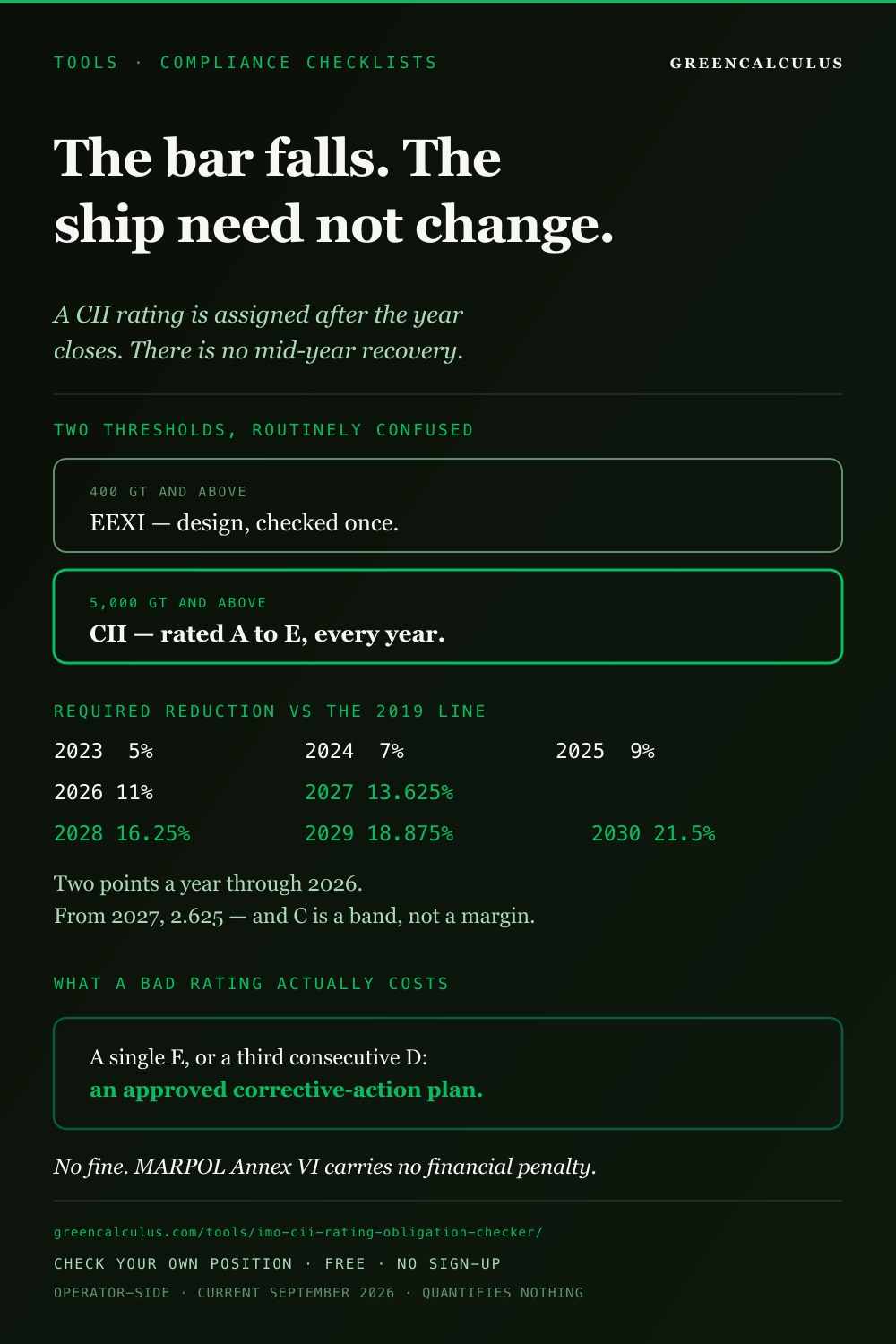
The CII rates ships of 5,000 GT and above, A to E, every year. C is the compliance band and the bar inside it falls annually — 21.5% below the 2019 reference line by 2030. A single E, or a third consecutive D, obliges an approved corrective-action plan.
Eight questions, about a minute. The CII rating is assigned after the year closes, from data you have already reported — so the only carbon intensity you can actually manage is the one you estimate for yourself while the year is still running. This checks that estimate, and the management chain around it, against the errors the measure actually produces. It computes nothing and predicts no rating.
- The estimate is applying a reduction factor from an earlier year, or a schedule that stops at 2026. Both produce a required CII that is too generous, and therefore a rating estimate that is better than the one that will be assigned — the direction of error that never prompts anybody to check. The step to watch is 2027: through 2026 Z rose in two-percentage-point increments, and from 2027 the annual increment becomes 2.625 points under MEPC.400(83), reaching 21.5% below the 2019 line by 2030. A schedule built before April 2025 does not contain those values at all, because they had deliberately been left open.
- A second consecutive D is one year from the corrective-action trigger, and the year that decides it is the one being sailed now. This is where the prospective-management argument stops being general: a third D attaches the duty automatically, it is settled by fuel already burned by the time the rating is assigned, and the only window in which it can be avoided is open right now and closes at year-end. What moves an attained CII inside a live year is narrow and well understood — speed, hull and propeller condition, weather routing, voyage planning — and all of it has to be applied continuously rather than decided in the fourth quarter.
- Part III is approved against a trajectory that has since been replaced. When the 2027–2030 reduction factors were adopted as MEPC.400(83), ships with an approved Part III were required to revise it to reflect the new and steeper trajectory — a change to the reduction factors cascades into every affected ship’s management plan, and this is the concrete instance of it. The plan documents the required CII for a three-year forward window, so a version built on the old schedule understates the bar for the years it covers, and the understatement grows each year rather than staying constant.
- Corrections or voyage adjustments are being claimed without DCS-linked evidence behind them, and the consequence is specific: they are rejected at verification, after the year has closed, and the rating lands worse than the one the operator has been steering by all year. The categories are prescribed rather than open — corrections adjust the CO₂ or the distance for recognised operations such as cargo heating, dynamic positioning, ice transit and hotel load in port, and voyage adjustments remove qualifying legs such as certain shipyard passages. A ship cannot invent its own. The evidence has to link to the DCS record, which means it has to be collected during the voyage rather than assembled afterwards.
What would change this verdict
- The required CII falls every year and the band structure moves down with it while the dd-vector multipliers stay fixed, so the same attained intensity earns a worse letter over time. A ship comfortably rated C on one year’s data can be D on the next year’s bar with no change in operation at all — which is why holding a rating is not the same as holding a position.
- The 2027 step is the sharpest instance of that. Through 2026 the reduction factor rose in two-percentage-point increments; from 2027 the annual increment becomes 2.625 points, reaching 21.5% below the 2019 reference line by 2030. Anything planned on the old slope understates every year from 2027 onward, and understates it more each year.
- The Phase 2 review of the short-term measure runs from spring 2026 to spring 2028, with the metric itself, the reference lines, the correction factors and the treatment of idle and port-waiting time all on the agenda. Nothing here anticipates its outcome, and anything that did would have an expiry date on it.
CII register — each limb, where you stand, and the rule
| Limb | Your position | The rule |
|---|---|---|
| Size against the two thresholds | 5,000 GT and aboveCII and EEXImet | Two thresholds, constantly conflated: EEXI applies at 400 GT and above, the CII rating and the DCS reporting it relies on at 5,000 GT and above |
| Ship type and its CII form | A deadweight ship type — the CII form is AERReference line existsmet | Bulk, tanker, container, gas, LNG, general cargo, reefer and combination carriers use AER on deadweight; ro-ro, vehicle carriers, ro-pax and non-conventional cruise ships use cgDist on gross tonnage. The types and size categories are set in MEPC.337(76) |
| The form your estimate uses | AER, on deadweightMatches the ship typemet | Applying AER to a ro-pax or cruise ship that should use cgDist, or the reverse, produces a meaningless intensity and an incorrect rating — the first of the named calculation errors |
| How the required CII is derived | A Z factor from an earlier year, or a schedule that stops at 2026Stale reduction factoropen | Required CII is the 2019 reference line reduced by that year’s Z factor. Z runs 5, 7, 9 and 11% for 2023 to 2026 under MEPC.338(76), then 13.625, 16.25, 18.875 and 21.5% for 2027 to 2030 under MEPC.400(83) |
| Most recent assigned rating | D, second consecutive yearOne year from the triggeropen | A ship rated E in a single year, or D for three consecutive years, must add an approved plan of corrective actions to its SEEMP setting out how it will reach the required index |
| Corrective-action plan | Not triggered, as far as we knowNot triggered | The plan must be approved by the Administration or a recognised organisation. MARPOL Annex VI carries no direct financial penalty — the consequence is the approval obligation, the documentary record and the commercial effect of a disclosed rating |
| SEEMP Part III | Approved, but not revised since the steeper factors were adoptedPredates the steeper factorsopen | Ships subject to the CII must carry an enhanced SEEMP including Part III, documenting the required CII for a three-year window and the implementation plan. It is auditable and verified against the operational carbon-intensity guidelines |
| G5 corrections and voyage adjustments | Claimed, without DCS-linked evidence behind themUnsupportedopen | The G5 categories are prescribed — cargo heating, dynamic positioning, ice transit, hotel load in port and defined voyage legs. A ship cannot invent its own adjustment, and each claim must be supported by verifiable DCS-linked evidence |
Why this verdict: The number being steered by is not this ship’s CII. The reduction factor comes from an earlier year or from a schedule that stops at 2026, so the required CII it produces is more generous than the one a verifier will apply. What makes this the worst finding on the register is not its size. It is that every other limb here is an inference from that number, so none of them can be read until it is corrected — a plan built on it, a corrective-action judgement made from it and an adjustment claimed against it are all describing a quantity nobody will ever be assessed on. And it is silent. A wrong CII estimate does not look wrong: it produces a plausible letter over a plausible number, it moves sensibly month to month, and nothing in the ship’s own data contradicts it. The rating assigned after the year closes is the first thing that does, and by then the fuel is burned. The correction is a lookup rather than a judgement. The ship-type-to-form mapping is fixed in MEPC.337(76), the reference-line parameters are in MEPC.353(78), and the reduction-factor schedule is MEPC.338(76) as amended by MEPC.400(83).
This register computes nothing. No attained CII, no required CII, no reference-line parameters, no reduction factor applied to anything, no band boundary and no predicted rating — the rating is supplied by you and assigned by a verifier. It also asserts no EU ETS or FuelEU Maritime duty. Those are separate instruments on separate legal bases and all three apply simultaneously where each is in scope; treating any one as a proxy for the others is itself a compliance error. Maritime coverage under the trading schemes is answered by the EU ETS & ETS2 Coverage Checker and the UK ETS Coverage Checker. And there is no fine: MARPOL Annex VI carries no direct financial penalty for a poor rating.
The reduction factors move by MEPC resolution rather than on a calendar — the 2027 to 2030 values were adopted in April 2025 and every affected ship’s management plan had to follow them — and the Phase 2 review of the whole short-term measure runs to spring 2028. We will email you when something this register applies changes — not otherwise.
This register applies MARPOL Annex VI regulation 28 and the G1–G5 operational carbon-intensity guidelines — MEPC.352–355(78) and MEPC.338(76) as amended by MEPC.400(83) — as our reviewed standards page records them. It reads nothing of yours and calculates nothing: no attained or required CII, no reference-line parameters, no band boundary and no predicted rating. It reports which limbs of your own estimate and management chain would stand up, not what a verifier will assign you.
What this verdict means
The checker returns one of nine positions. Two are clean, one is an exit, and the rest are ordered by how much of the rest of the register they invalidate rather than by how uncomfortable they sound.
Estimate unsound
The form contradicts the ship type, or the required CII comes from a stale reduction factor or the 2008 baseline. This tops the ramp because every other limb here is an inference from that number, so none of them can be read until it is corrected.
Corrective action attached
A single E, or a third consecutive D, has triggered the duty. Where an approved plan exists the duty is being discharged; where it does not, approval — not drafting — is what is owed.
No Part III
The enhanced SEEMP has been mandatory for ships subject to the CII since 1 January 2023. It is auditable, and it is the only place in the measure where a forward view is formally recorded.
Rated below the band
A first or second consecutive D. The rating describes a closed year; the bar for the year now being sailed has already fallen, so repeating last year is losing position rather than holding it.
Corrections unsupported
G5 adjustments claimed without evidence linked to the DCS record. They are rejected at verification, after the year has closed, and the rating lands worse than the one reported internally all year.
Estimate unreliable
No running estimate, or one resting on a limb nobody has confirmed — the size band, the form, the last assigned rating. Whatever cannot be estimated during a year cannot be managed in it.
Plan not revised
Part III is approved against a trajectory that has been replaced. When the 2027–2030 factors were adopted, ships holding an approved plan were required to revise it.
On trajectory · Not CII-rated
Either every limb holds as the bar stands this year, or the rating scheme does not reach this ship. Neither is permanent: the bar falls annually, and a vessel crossing 5,000 GT brings the whole framework with it.
Who the CII rates
Two thresholds, and they are not the same instrument
Two size thresholds bound the short-term measure and they are confused more often than anything else in it. They belong to two different instruments that measure two different things, and meeting one has never discharged the other.
| EEXI | CII | |
|---|---|---|
| Threshold | 400 GT and above | 5,000 GT and above |
| What it measures | Design efficiency as built or retrofitted | Operational carbon intensity in actual service |
| Frequency | One-time, re-assessed on major modification | Recalculated and re-rated every calendar year |
| Output | Pass or fail against a required index | An A–E rating on a tightening scale |
| Primary lever | Engine power limitation, efficiency devices, hull design | Speed, routing, hull condition, fuel choice, voyage planning |
So a 2,000 GT general cargo ship must meet EEXI and is not CII-rated; a 20,000 GT bulk carrier faces both. A vessel outside the defined CII ship types — certain specialised and offshore units — may still report to the Data Collection System without receiving a rating at all.
Ship type decides the CII form, and it is a lookup
Within the rated population the CII takes one of two forms, fixed by ship type in MEPC.337(76). Applying one where the other belongs produces a meaningless intensity and an incorrect rating — the first of the errors this checker tests for.
| Ship type | CII form | Capacity basis |
|---|---|---|
| Bulk carrier, tanker, container ship, gas carrier, LNG carrier, general cargo ship, refrigerated cargo carrier, combination carrier | AER | Deadweight |
| Ro-ro cargo ship, vehicle carrier, ro-ro passenger ship, cruise passenger ship with non-conventional propulsion | cgDist | Gross tonnage |
Gross tonnage is on the tonnage certificate rather than in any operational system, which is why it is more often unconfirmed than unknown. The last assigned rating is on the Statement of Compliance, held with the flag Administration or the recognised organisation that verified the DCS submission.
The bar moves under a ship that has not changed
The reduction-factor schedule, and the step at 2027
An attained CII means nothing on its own. It acquires meaning against the reference line — a curve fitted to the 2019 fleet for each ship type — reduced by that year’s reduction factor. That factor rises every year, so the required CII falls every year, and a ship must run cleaner simply to hold its letter.
| Year | Reduction factor vs the 2019 reference line | Source |
|---|---|---|
| 2023 | 5% | MEPC.338(76) |
| 2024 | 7% | MEPC.338(76) |
| 2025 | 9% | MEPC.338(76) |
| 2026 | 11% | MEPC.338(76) |
| 2027 | 13.625% | MEPC.400(83) |
| 2028 | 16.25% | MEPC.400(83) |
| 2029 | 18.875% | MEPC.400(83) |
| 2030 | 21.5% | MEPC.400(83) |
| Point | % reduction |
|---|---|
| 2023 | 5.00 % reduction |
| 2024 | 7.00 % reduction |
| 2025 | 9.00 % reduction |
| 2026 | 11.0 % reduction |
| 2027 | 13.6 % reduction |
| 2028 | 16.3 % reduction |
| 2029 | 18.9 % reduction |
| 2030 | 21.5 % reduction |
Through 2026 the factor rose in two-percentage-point increments. From 2027 the annual increment becomes 2.625 points. A ship sitting comfortably inside C on 2026 data has materially less margin in 2027 on identical operations — and the values for 2027 onward did not exist before April 2025, so any schedule built earlier stops at 11%.
Why a C can become a D with nothing changing on board
The required CII fixes the single point where a ship sits exactly on the C/D boundary. The rating guideline turns that point into five bands using multipliers derived from the 2019 fleet distribution. Those multipliers are fixed; the required value they are applied to falls every year. The whole band structure therefore shifts downward annually, and the same attained intensity that earned a C can earn a D two years later.
Which is why C is the compliance band and not a safe margin. Holding a rating is not the same as holding a position, and “we were C last year” describes a bar that has since moved.
The limbs this checker applies
The running estimate, because the rating arrives too late to act on
The cycle is annual and backward-looking. Data is collected through the reporting year, submitted to the DCS after year-end, verified, and only then turned into an attained CII and a letter. There is no mid-year recovery once the emissions are burned. Everything that actually moves the number — speed optimisation, hull and propeller condition, weather routing, voyage planning — works continuously through the live year and needs a running estimate to steer by. The data required is the same data already collected for the DCS.
The required CII, and the three ways it goes wrong quietly
A stale reduction factor, or a schedule that stops at 2026, produces a required CII that is too generous and therefore a rating estimate better than the one that will be assigned — the direction of error nobody checks. Measuring reduction against 2008 rather than the 2019 reference line confuses two different baselines: the 40%-by-2030 figure is the Strategy’s fleet-wide ambition versus 2008, while the ship-level factors are versus 2019. And where a ship type carries more than one size category, reading the wrong band yields a wrong required CII from an otherwise correct method.
SEEMP Part III and the corrective-action trigger
Ships subject to the CII must carry an enhanced SEEMP including Part III, the Ship Operational Carbon Intensity Plan, documenting the required CII for a three-year forward window and the implementation plan behind it. It is auditable and verified against the operational carbon-intensity guidelines. When the steeper 2027–2030 factors were adopted, ships holding an approved Part III were required to revise it — a change to the reduction factors cascading into every affected ship’s management plan.
A ship rated E in a single year, or D for three consecutive years, must develop a plan of corrective actions as part of its SEEMP, setting out how it will reach the required index at C or above, approved by the Administration or a recognised organisation. A draft held internally does not discharge it.
G5 corrections and voyage adjustments
The G5 guideline permits defined corrections and voyage adjustments so that a ship is not down-rated for fuel it had little operational choice about — cargo heating, dynamic positioning, ice transit, hotel load while a passenger ship sits in port, and qualifying legs such as certain shipyard passages. The categories are prescribed: a ship cannot invent its own, and each claim must be supported by verifiable evidence linked to the DCS record. Evidence assembled after the voyage is what fails.
Edge cases that change the answer
A compliant EEXI does not deliver a good CII. The design index is checked once; the rating is recalculated yearly. A technically efficient ship operated poorly can still rate D or E, and both obligations must be managed separately.
The AER does not reward carrying more cargo. Because the denominator is capacity rather than cargo carried, higher load factors and backhaul optimisation do not improve it. This is a known limitation formally on the review agenda, not a lever — and for the same reason the arithmetic that rewards sailing further is a recognised distortion rather than a strategy.
Idle and port-waiting fuel still counts. Fuel burned waiting for a berth is largely outside the operator’s control and enters the calculation today. Whether that should change is among the most actively debated points in the current review; it is nonetheless the rule now.
Reporting to the DCS is not CII compliance. Submitting fuel and distance data is necessary and not sufficient. The rating and the Part III obligations are separate downstream steps, and a vessel can owe the data without being rated on it.
MARPOL Annex VI carries no direct financial penalty for a poor rating. The consequence is the mandatory corrective-action obligation, the documentary record, and the commercial effects that follow a disclosed rating through charter parties, financing frameworks and port-incentive schemes. Those are real and in some cases larger than a fine would be, but describing them as a penalty misstates both what is owed and to whom.
What this checker does not decide
It quantifies nothing. No attained CII, no required CII, no reference-line parameters, no reduction factor applied to anything, no band boundary and no predicted letter. The rating is an input you supply and an output a verifier assigns. The reference-line parameters and the band multipliers live in MEPC.353(78) and MEPC.354(78) and are reproduced here nowhere.
It asserts no EU ETS or FuelEU Maritime duty. A ship calling at European ports faces the CII plus two distinct EU instruments, on separate legal bases and with separate reporting and compliance paths. All three apply simultaneously where each is in scope, and treating any one as a proxy for the others is itself a compliance error. Maritime coverage under the trading schemes is answered by the EU ETS & ETS2 Coverage Checker and the UK ETS Coverage Checker; the scheme itself is documented on our EU Emissions Trading System page.
It does not allocate a ship’s emissions to your cargo. The CII grades the ship for its operator. A shipper reporting purchased sea freight works under logistics-emissions methodologies instead — ISO 14083 and the GLEC Framework, tested by the GLEC & ISO 14083 Conformance Checker. If what you need is the emissions of a movement rather than the rating of the ship carrying it, the sea freight calculator quantifies the cargo’s share.
It explains nothing about how the indicator is built. How the reference line, the reduction factors and the A–E bands are constructed — and how the measure interacts with the IMO Net-Zero Framework — is set out on our IMO Carbon Intensity Indicator reference page. This checker applies them.
How we keep this current
Assessed against MARPOL Annex VI regulation 28 and the G1–G5 operational carbon-intensity guidelines — MEPC.352–355(78) and MEPC.338(76) as amended by MEPC.400(83) — on the corpus edition shown here: MB v2026.189 · updated 10 Sep 2026
Two things will move this page. The reduction factors change by MEPC resolution rather than on a calendar — the 2027–2030 values were adopted in April 2025 and every affected ship’s Part III had to follow them. And the Phase 2 review of the short-term measure runs from spring 2026 to spring 2028, with the metric itself, the reference lines, the correction factors and the treatment of idle time all on its agenda. Nothing here anticipates its outcome. Other tools in this hub are listed at compliance checklists.
Frequently Asked Questions
Not necessarily, and this is the commonest surprise in the measure. The required CII falls every year, and because the band multipliers are fixed while the required value moves, the whole band structure shifts down with it. Identical operations therefore earn a worse letter over time. The effect is sharpest across 2027, where the annual reduction increment rises from two percentage points to 2.625.
There isn’t one. MARPOL Annex VI carries no direct financial penalty for a poor rating. What follows a single E, or a third consecutive D, is a mandatory plan of corrective actions in the SEEMP approved by the Administration or a recognised organisation, plus the documentary record and the commercial consequences of a disclosed rating — charter, financing and port incentives. Those can cost more than a fine, but they are commercial rather than statutory.
No. The CII rating and the DCS reporting behind it apply at 5,000 GT and above. The EEXI design-efficiency requirement applies at 400 GT and above, so a 3,000 GT ship must meet EEXI and is not CII-rated. The two thresholds belong to two different instruments and are the most frequently conflated pair in the short-term measure.
No. The AER uses capacity — deadweight — rather than cargo carried, so higher load factors and backhaul optimisation do not move it. This is a recognised limitation of the metric and is formally on the review agenda; it is not a lever available to an operator today. What does move an attained CII is speed, hull and propeller condition, weather routing and voyage planning.
Reporting is necessary and not sufficient. The DCS submission is the data; the attained CII, the assigned rating and the SEEMP Part III obligations are separate downstream steps. A vessel outside the defined CII ship types can owe the data without being rated at all, and a rated ship can be fully up to date on reporting while holding no Part III.
The rating attaches to the ship and its owner, while speed and voyage selection are frequently controlled by the charterer. The measure does not itself resolve that split, which is why it is settled by contract instead — and why CII clauses have proliferated in charter parties. It is an acknowledged gap in the instrument rather than an oversight in your arrangements.
No. The CII counts only CO₂ from fuel combusted on board, so it says nothing about the upstream emissions of producing that fuel. A fuel that looks clean at the funnel may not be clean over its lifecycle. That question belongs to FuelEU Maritime and to the IMO Net-Zero Framework’s fuel standard, both of which work on a well-to-wake basis and are separate instruments from this one.
It may. The review runs from spring 2026 to spring 2028 and has the metric itself, the reference lines, the correction factors, the treatment of idle and port-waiting time, and alignment with the Net-Zero Framework on its agenda. This page states no outcome for it, because a verdict written today against a review that has not concluded would carry an expiry date. Everything above is the rule as it stands, with the resolution behind each figure named.