
The Most Energy-Efficient Mini Fridges (ENERGY STAR Data, 2026)
As an Amazon Associate I earn from qualifying purchases. The Amazon links on this page are affiliate links; buying through them does not change the price you pay. How we handle affiliate links.
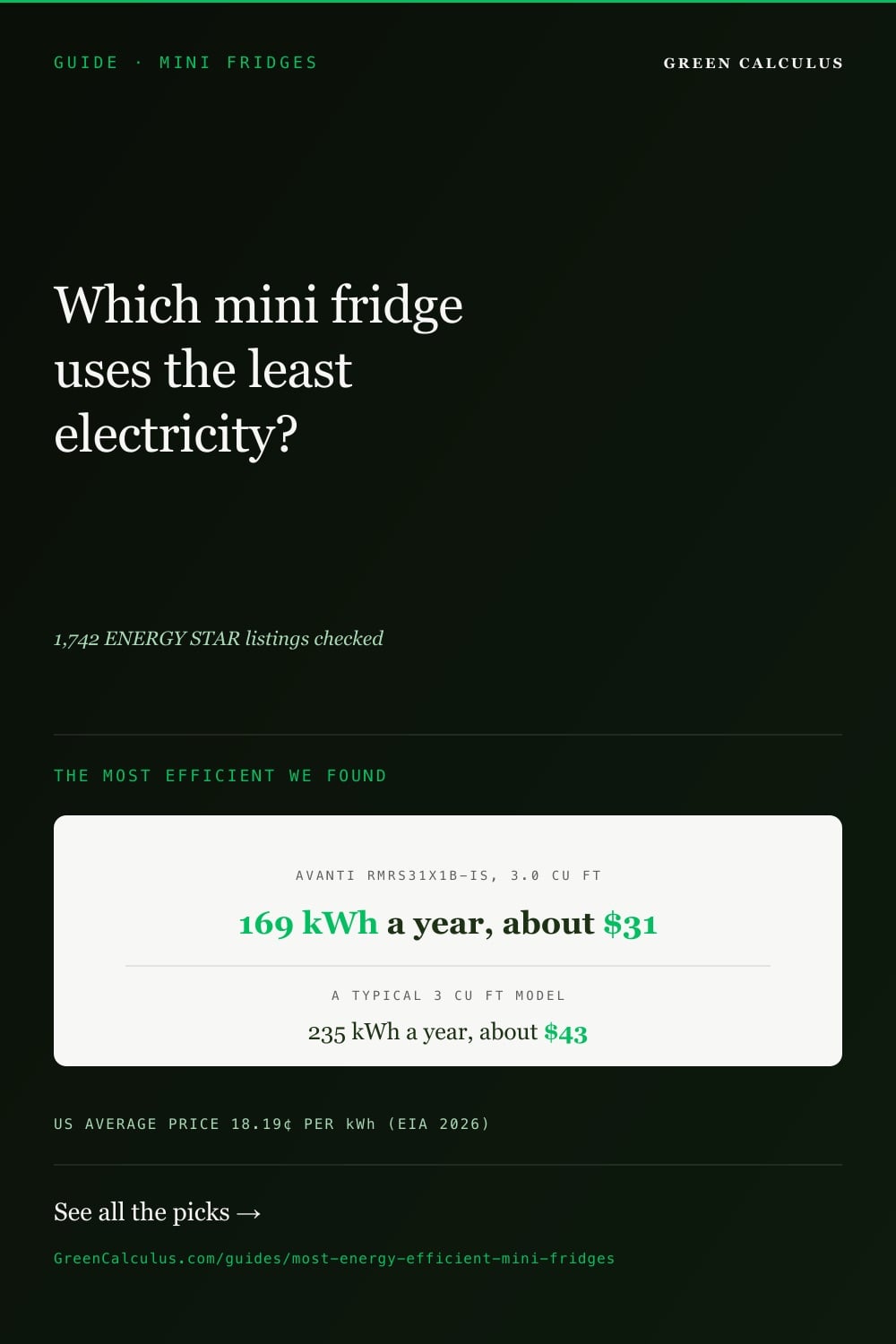
The most efficient mainstream mini fridge we could match on Amazon is the Avanti RMRS31X1B-IS (3.0 cu ft): 169 kWh a year, 30% below the US federal standard, about $31 a year in electricity at the US average price. For a fridge with a freezer compartment, the Whirlpool WH43S1E (4.3 cu ft) uses 228 kWh a year. Half of all ENERGY STAR certified compact fridges are only 11% or less below the federal standard, so the label alone does not mean a model is among the best.
- 208 kWh a year
- 25% below federal standard
- 169 kWh a year
- 30% below federal standard
- 228 kWh a year
- 22% below federal standard
We went through all 1,742 compact refrigerator listings in the ENERGY STAR product database and matched them against models you can buy on Amazon. A mini fridge costs little to run: most use 200 to 350 kWh a year, which is $36 to $64 at the US average residential price of 18.19 cents per kWh. Between models of the same size the gap is usually under $20 a year, and size and freezer type matter more than brand.
Our picks
Each of these is an exact model-number match between the Amazon listing and the ENERGY STAR record, so the figures below are the certified ones. Running cost is the annual kWh at 18.19 cents per kWh (EIA, US residential average, January to July 2026).
- 169 kWh a year
- 30% below federal standard
- No freezer, manual defrost
- 208 kWh a year
- 25% below federal standard
- No freezer
- 228 kWh a year
- 22% below federal standard
- Manual defrost
| Model | Size | kWh a year | Federal standard for its class | Cost a year |
|---|---|---|---|---|
| Avanti RMRS31X1B-IS | 3.0 cu ft | 169 | 243 kWh | $31 |
| Danby DAR022A1BDB | 2.2 cu ft | 208 | 279 kWh | $38 |
| Whirlpool WH43S1E | 4.3 cu ft | 228 | 291 kWh | $41 |
The Avanti is the clear energy winner: a typical certified 3 to 3.9 cu ft model uses 235 kWh a year ($43), so it saves about 66 kWh, or $12 a year. It has no freezer and needs defrosting by hand. Lower figures exist in the database, but they belong to built-in models from premium brands that cost far more than a typical mini fridge.
How much a mini fridge uses, by size
Energy use rises with size. The table shows the median (middle) certified model in each size band and the 10th percentile, the figure only the most efficient tenth beat.
| Total volume | Listings | Median use | Median cost a year | Most efficient 10% |
|---|---|---|---|---|
| Under 2 cu ft | 265 | 208 kWh | $38 | 200 kWh ($36) |
| 2 to 2.9 cu ft | 177 | 215 kWh | $39 | 205 kWh ($37) |
| 3 to 3.9 cu ft | 547 | 235 kWh | $43 | 199 kWh ($36) |
| 4 to 5.4 cu ft | 531 | 268 kWh | $49 | 219 kWh ($40) |
| 5.5 cu ft and up | 222 | 344 kWh | $63 | 244 kWh ($44) |
To work out the cost at your own rate, use the electricity cost calculator: enter the kWh a year from the yellow EnergyGuide label and your price per kWh.
Freezer compartments and defrost type
Among 3 to 3.9 cu ft models, the type of fridge makes a bigger difference than the brand:
| Type (DOE product class) | Listings | Median use | Cost a year |
|---|---|---|---|
| Fridge only, manual defrost (11A) | 243 | 218 kWh | $40 |
| Fridge only, automatic defrost (13A) | 142 | 259 kWh | $47 |
| Fridge-freezer, partial automatic defrost (12) | 155 | 320 kWh | $58 |
If you only need cold drinks and snacks, a fridge without a freezer uses less. Automatic defrost saves you the chore but uses more electricity. A model with a separate freezer section uses the most, so only choose one if you need to keep food frozen.
Need more freezer space than a fridge compartment? A separate chest freezer uses the least energy for its size; our guide to energy-efficient freezers shows the federal limit for each type and size and what it costs to run.
Check the exact model number
ENERGY STAR certifies by model number, and colour or retailer variants of the same fridge can carry different figures. In the database, some Frigidaire EFR115 colour variants are listed at 158 kWh a year and others at 206 kWh. Before you buy, compare the full model number on the listing or the EnergyGuide label with the ENERGY STAR product finder.
How these were chosen
We downloaded the ENERGY STAR certified residential refrigerators dataset (data.energystar.gov, dataset p5st-her9) on 6 October 2026 and kept the 1,742 listings of type Compact Refrigerator. We then searched Amazon for low-energy mainstream models and kept only listings whose model number matches a certified record exactly and that were in stock when checked. Annual kWh and the percentage below the federal standard are ENERGY STAR’s figures. Costs use the EIA Electric Power Monthly US residential average for January to July 2026, 18.19 cents per kWh. Listings counts include colour variants, so some models appear more than once.
Sources
- ENERGY STAR, Certified Residential Refrigerators data set (p5st-her9)
- ENERGY STAR, Refrigerators
- U.S. Energy Information Administration, Electric Power Monthly, Table 5.6.A: average residential electricity price by state
How we pick products for every buying guide: our buying guide standards.
Frequently asked questions
Half of ENERGY STAR certified compact fridges use 246 kWh a year or less. Small models under 2 cu ft typically use about 208 kWh and models of 5.5 cu ft and up about 344 kWh. At the US average price of 18.19 cents per kWh that is roughly $38 to $63 a year.
Of the mainstream models we could match exactly on Amazon, the Avanti RMRS31X1B-IS (3.0 cu ft) uses the least: 169 kWh a year, 30% below the federal standard. Some built-in models from premium brands use less but cost far more.
It helps, but check the numbers. Half of certified compact models are 11% or less below the federal standard, while the best are 25% to 30% below. Compare the kWh a year on the EnergyGuide label, not just the logo.
Yes. Among 3 to 3.9 cu ft models, fridge-freezers with a separate freezer section have a median of 320 kWh a year, against 218 kWh for fridge-only models with manual defrost.