
Home energy · US · Appliance cost & monthly bill
Electricity Cost Calculator
Work out what any appliance costs to run per hour, day, month and year, or what your monthly electricity bill comes to, at your state’s current price per kWh. It shows how the cost compares with an average home in your state and the carbon behind it.
What it calculates. In appliance mode, the electricity an appliance uses (watts × hours a day × days a week) and what it costs per hour, day, month and year. In bill mode, what a month’s kWh costs. Both modes compare the result with an average home in your state.
Price. Each state’s average residential price for January to July 2026 from the U.S. Energy Information Administration (Electric Power Monthly, Table 5.6.B). It is revenue divided by kWh sold, so it spreads delivery and fixed charges over every kWh and approximates a whole bill. Replace it with the price on your own bill under More options.
Average home. Each state’s average monthly use per residential customer in 2024 (EIA-861, Table 5A), priced at today’s rate. EIA’s own 2024 average bill is shown alongside for reference.
Carbon. kWh × your state’s EPA eGRID location-based emission factor.
What it leaves out. Tiered, seasonal and time-of-use rates; fixed monthly charges as a separate line; standby power; and the on-off cycling of appliances with a thermostat, which is why you enter the hours a device actually runs.
More options: your price per kWh
What an appliance costs to run per hour, day, month and year, or what your monthly bill comes to, at your state’s average price per kWh, with the carbon. Prices: EIA (2026). Average use and bills: EIA (2024). Grid carbon: EPA eGRID. Reads MasterBrain V3 live.
Pick your state and enter watts or your monthly kWh
Results show the cost per hour, day, month and year, how it compares with an average home in your state, the carbon, the audit trail and export.
Results are estimates. They use one average price per kWh for your state; your utility’s tariff may be tiered, seasonal or time-of-use, and may add fixed monthly charges that do not change with use. Appliances often draw less than their rated watts, or cycle on and off; a plug-in energy meter or your utility’s usage data gives the truest figure. State averages for monthly use include apartments and houses. Check every figure against your own bill.
Your electricity bill is just kWh times a price. The hard part is knowing either number. This calculator fills in both with your state’s figures and lets you replace them with your own.
It works for a single appliance, from a phone charger to a space heater, or for the whole bill.
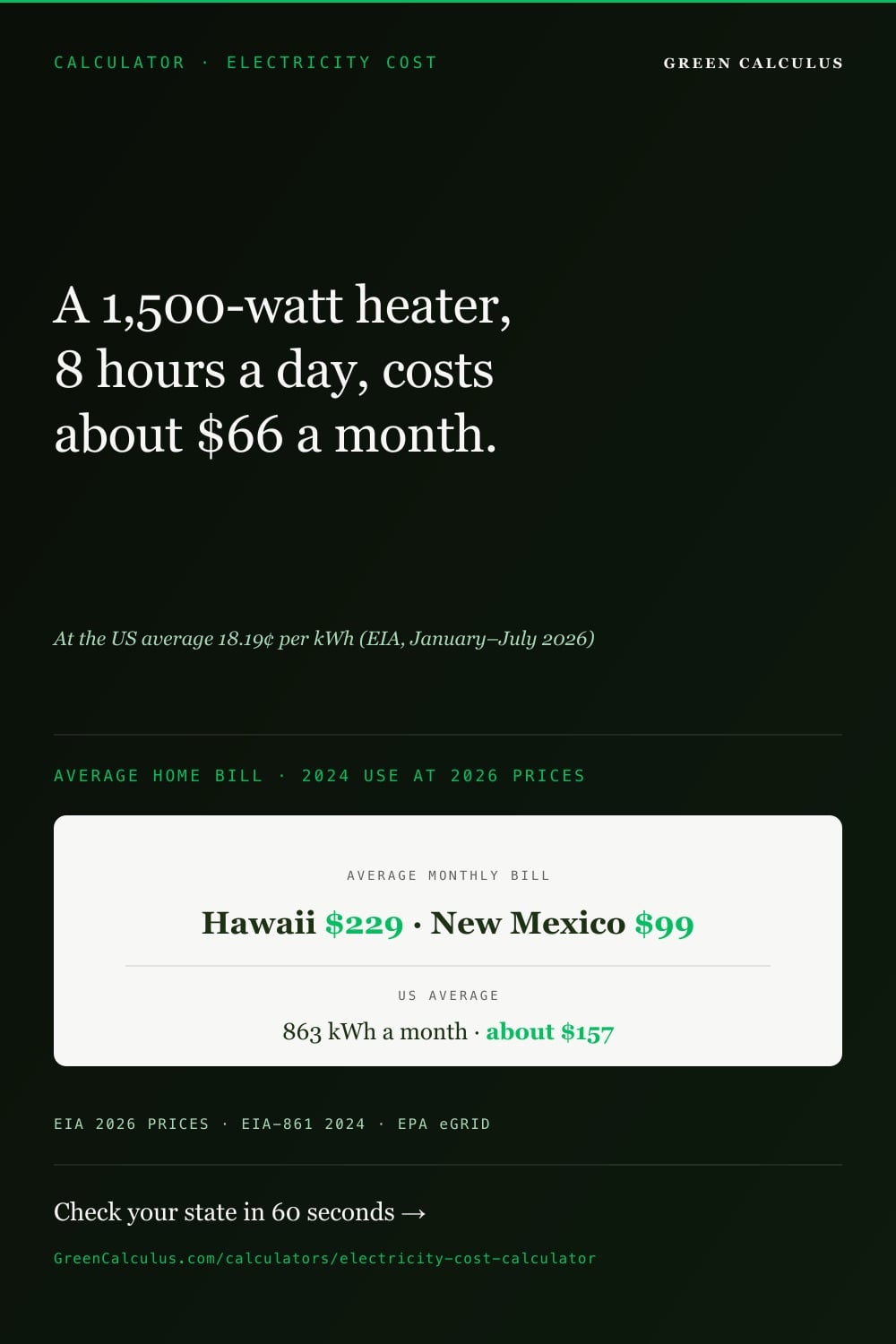
Cost = watts ÷ 1,000 × hours used × your price per kWh. At the US average residential price of 18.19¢ per kWh (January–July 2026), a 1,000-watt appliance costs about 18¢ an hour, and a 1,500-watt space heater running 8 hours a day about $66 a month. The average US home used 863 kWh a month in 2024, about $157 a month at today’s average price.
How to calculate electricity cost
Electricity is sold by the kilowatt-hour (kWh): 1,000 watts for one hour. So:
- kWh = watts ÷ 1,000 × hours. A 1,500-watt heater running for 2 hours uses 3 kWh.
- Cost = kWh × price per kWh. At 18.19¢ per kWh, 3 kWh costs about 55¢.
- Per month or year: multiply by the days you use it. The calculator uses days a week × 52 for a year and divides by 12 for a month.
The watts are on the appliance’s label or in its manual. Your price per kWh is on your bill: divide the total by the kWh used to get the all-in price, which is what this calculator uses.
Cooking is one of the smaller loads in a home: an electric range uses about 282 kWh a year on the Department of Energy’s measurements. To compare a gas, electric and induction range on running cost, price and the cost of switching, use the gas vs electric stove calculator.
What an appliance costs to run, by watts

At the US average residential price of 18.19¢ per kWh (January–July 2026), running 8 hours a day:
| Power | Per hour | Per month | Per year |
|---|---|---|---|
| 10 W | 0.2¢ | $0.44 | $5 |
| 60 W | 1.1¢ | $2.65 | $32 |
| 100 W | 1.8¢ | $4.41 | $53 |
| 500 W | 9.1¢ | $22.07 | $265 |
| 1,000 W | 18.2¢ | $44.14 | $530 |
| 1,500 W | 27.3¢ | $66.21 | $795 |
| 3,000 W | 54.6¢ | $132.42 | $1,589 |
Anything that makes heat with electricity, such as a space heater, a clothes dryer or an electric water heater, usually draws the most power, so it can dominate a bill. A device on a thermostat cycles on and off, so it runs fewer hours than it is switched on; a plug-in energy meter shows the real figure.
For a clothes dryer, our guide to ventless and heat pump dryers compares what each type costs to run in your state: a typical certified heat pump dryer uses well under half the electricity of a vented one.
Battery tools cost even less to run: our guide to electric snow blowers shows a full charge of a 21-inch model costs about 10 cents at the US average price.
Measure what your appliances really use
As an Amazon Associate I earn from qualifying purchases. The links below are affiliate links; buying through them does not change the price you pay or any number on this page. How we handle affiliate links.
Rated watts are a maximum. To see what a fridge, TV or space heater really uses, plug it into a meter for a day or a week, then enter the kWh in the calculator. These are widely sold meters, as listed on Amazon in October 2026; specifications are the makers’ own.
Plug-in meters work on ordinary 120-volt outlets, so they cannot measure 240-volt appliances such as an electric dryer, range or water heater. A whole-home monitor clips onto the circuits in your panel and should be installed by an electrician if you are not comfortable working there.
Average electricity bill by state
The table prices each state’s average monthly use per home in 2024 (EIA) at that state’s January–July 2026 average price. States are sorted by the resulting bill. A detached house often uses more than the state average, which includes apartments.
| State | Price per kWh | Average use a month | Average bill at today’s price |
|---|---|---|---|
| Hawaii | 46.28¢ | 495 kWh | $229 |
| Maryland | 21.30¢ | 929 kWh | $198 |
| Connecticut | 27.97¢ | 695 kWh | $194 |
| Alabama | 16.54¢ | 1,143 kWh | $189 |
| Texas | 16.06¢ | 1,096 kWh | $176 |
| Mississippi | 15.19¢ | 1,156 kWh | $176 |
| Virginia | 16.83¢ | 1,032 kWh | $174 |
| Pennsylvania | 21.04¢ | 817 kWh | $172 |
| Massachusetts | 30.14¢ | 570 kWh | $172 |
| Florida | 15.30¢ | 1,104 kWh | $169 |
| New York | 29.38¢ | 571 kWh | $168 |
| South Carolina | 15.93¢ | 1,050 kWh | $167 |
| California | 33.25¢ | 503 kWh | $167 |
| Arizona | 15.44¢ | 1,075 kWh | $166 |
| New Hampshire | 26.79¢ | 619 kWh | $166 |
| Rhode Island | 29.22¢ | 567 kWh | $166 |
| Georgia | 15.40¢ | 1,074 kWh | $165 |
| Maine | 29.99¢ | 550 kWh | $165 |
| Delaware | 17.86¢ | 911 kWh | $163 |
| Louisiana | 13.35¢ | 1,202 kWh | $160 |
| Tennessee | 13.87¢ | 1,154 kWh | $160 |
| New Jersey | 23.98¢ | 662 kWh | $159 |
| West Virginia | 15.47¢ | 1,027 kWh | $159 |
| Ohio | 18.70¢ | 846 kWh | $158 |
| District of Columbia | 24.66¢ | 639 kWh | $158 |
| Alaska | 27.09¢ | 578 kWh | $157 |
| Indiana | 17.04¢ | 901 kWh | $154 |
| North Carolina | 14.94¢ | 1,015 kWh | $152 |
| Kentucky | 14.27¢ | 1,046 kWh | $149 |
| Oklahoma | 13.58¢ | 1,079 kWh | $147 |
| South Dakota | 14.50¢ | 994 kWh | $144 |
| Arkansas | 13.61¢ | 1,048 kWh | $143 |
| Missouri | 13.96¢ | 1,001 kWh | $140 |
| Washington | 14.40¢ | 956 kWh | $138 |
| Vermont | 23.95¢ | 574 kWh | $137 |
| Oregon | 15.40¢ | 882 kWh | $136 |
| Illinois | 19.22¢ | 693 kWh | $133 |
| Kansas | 15.21¢ | 876 kWh | $133 |
| Michigan | 21.53¢ | 618 kWh | $133 |
| North Dakota | 12.36¢ | 1,029 kWh | $127 |
| Nevada | 13.53¢ | 930 kWh | $126 |
| Nebraska | 12.90¢ | 956 kWh | $123 |
| Wisconsin | 19.00¢ | 645 kWh | $123 |
| Idaho | 12.96¢ | 944 kWh | $122 |
| Wyoming | 13.95¢ | 863 kWh | $120 |
| Montana | 13.95¢ | 852 kWh | $119 |
| Iowa | 14.20¢ | 832 kWh | $118 |
| Minnesota | 16.25¢ | 712 kWh | $116 |
| Colorado | 16.72¢ | 674 kWh | $113 |
| Utah | 13.16¢ | 774 kWh | $102 |
| New Mexico | 15.08¢ | 654 kWh | $99 |
Price and use pull in opposite directions. Hawaii has the highest price (46.28¢) but the lowest use (495 kWh a month); Louisiana uses the most (1,202 kWh a month). North Dakota has the lowest price, 12.36¢.
Worked example: a space heater in Ohio
A 1,500-watt space heater running 8 hours a day, every day, in Ohio at 18.70¢ per kWh:
- Per day: 1.5 kW × 8 hours = 12 kWh, about $2.24.
- Per month: 12 kWh × 364 days ÷ 12 = 364 kWh, about $68.07.
- Per year: 4,368 kWh, about $817, and 2.1 tonnes of CO₂ on Ohio’s grid.
That is about 43% of an average Ohio home’s bill at today’s price ($158 a month). Heating a whole room this way is expensive; a heat pump delivers the same heat with far less electricity. See the heat pump installation cost calculator.
How to lower the bill
Start with the biggest users. Heating, cooling and hot water are among the largest electricity uses in a home, and each has an upgrade with a known cost and payback:
- Space heating: a heat pump instead of electric resistance heat. Heat pump installation cost calculator.
- Hot water: a heat pump water heater uses about a quarter of the electricity of a standard electric tank. Water heater cost calculator.
- Heating and cooling control: ENERGY STAR says certified smart thermostats save about 8% of heating and cooling bills on average. The best smart thermostats, by how you heat.
- The bill itself: rooftop solar offsets the kWh you buy. Solar panel calculator.
Then the building itself: an attic with little or no insulation leaks heat in winter and gains it in summer. The attic insulation calculator shows what insulating it would save.
Then check your tariff. If your utility offers a time-of-use rate, running the dryer, dishwasher or car charger off-peak can cut the price per kWh without using less. For an electric car, the EV charging cost calculator shows what home charging costs a year against gasoline.
Small appliances add up too. A mini fridge runs all year, and certified models of the same size differ by up to about 100 kWh a year: the guide to the most energy-efficient mini fridges compares them by size and type. Air purifiers often run all day too: see the most energy-efficient air purifiers.
A freezer runs all year too, and the type matters most: the federal limit for a 15 cu ft chest freezer is 300 kWh a year against 456 kWh for a frost-free upright of the same size. Our guide to energy-efficient freezers works it out for your type and size.
Data sources and updates
| Input | Source | Vintage |
|---|---|---|
| Price per kWh by state | EIA Electric Power Monthly, Table 5.6.B, residential | January–July 2026 |
| Average monthly use and bill by state | EIA Electric Sales, Revenue, and Average Price, Table 5A (forms EIA-861, 861S, 861U) | 2024 |
| Carbon | EPA eGRID state location-based factors | eGRID2023 |
Every figure is stored in the GreenCalculus MasterBrain with its exact source cell; the calculator reads the live values and shows each one under View calculation detail. Prices are refreshed when EIA publishes new monthly data.
Frequently asked questions
Divide its watts by 1,000 to get kilowatts, multiply by the hours it runs to get kWh, then multiply by your price per kWh. A 1,000-watt appliance running for one hour uses 1 kWh, which costs about 18 cents at the US average residential price of 18.19 cents per kWh (January to July 2026).
A 1,500-watt space heater uses 1.5 kWh an hour. At the US average price of 18.19 cents per kWh that is about 27 cents an hour, or about $66 a month if it runs 8 hours a day. In Ohio, at 18.70 cents, it is about $68 a month.
The average US residential customer used 863 kWh a month in 2024, and EIA puts the average 2024 bill at $142.26. At the January to July 2026 average price of 18.19 cents per kWh, the same use costs about $157 a month.
Pricing each state’s 2024 average use at its 2026 price, Hawaii has the highest average bill at about $229 a month, followed by Maryland ($198) and Connecticut ($194). New Mexico ($99) and Utah ($102) have the lowest.
A kilowatt-hour is the energy used by something drawing 1,000 watts for one hour. Utilities bill electricity by the kWh, so your bill is the kWh you used times your price per kWh, plus any fixed charges.
About $182 at the US average residential price of 18.19 cents per kWh (January to July 2026). It ranges from about $124 in North Dakota (12.36 cents) to about $463 in Hawaii (46.28 cents).
Prices come from the US Energy Information Administration’s Electric Power Monthly (January to July 2026), average monthly use and bills from EIA’s 2024 Electric Sales, Revenue and Average Price tables, and carbon from EPA eGRID. Every figure is stored in the GreenCalculus MasterBrain with its source cell.
Methodology notes and limitations
One average price. The default price is your state’s average revenue per kWh, which includes delivery and fixed charges. Your utility may charge a fixed monthly fee plus a lower energy rate, tiered rates or time-of-use rates; the price on your own bill is better.
Rated watts. Many appliances draw less than their rated watts, or cycle on and off. Enter the hours the device actually runs, or measure it with a plug-in energy meter.
State averages. Average monthly use is a 2024 average over all residential customers, including apartments.
Not financial advice. Check every figure against your own bill.