
The Most Energy-Efficient Air Purifiers (ENERGY STAR Data, 2026)
As an Amazon Associate I earn from qualifying purchases. The Amazon links on this page are affiliate links; buying through them does not change the price you pay. How we handle affiliate links.
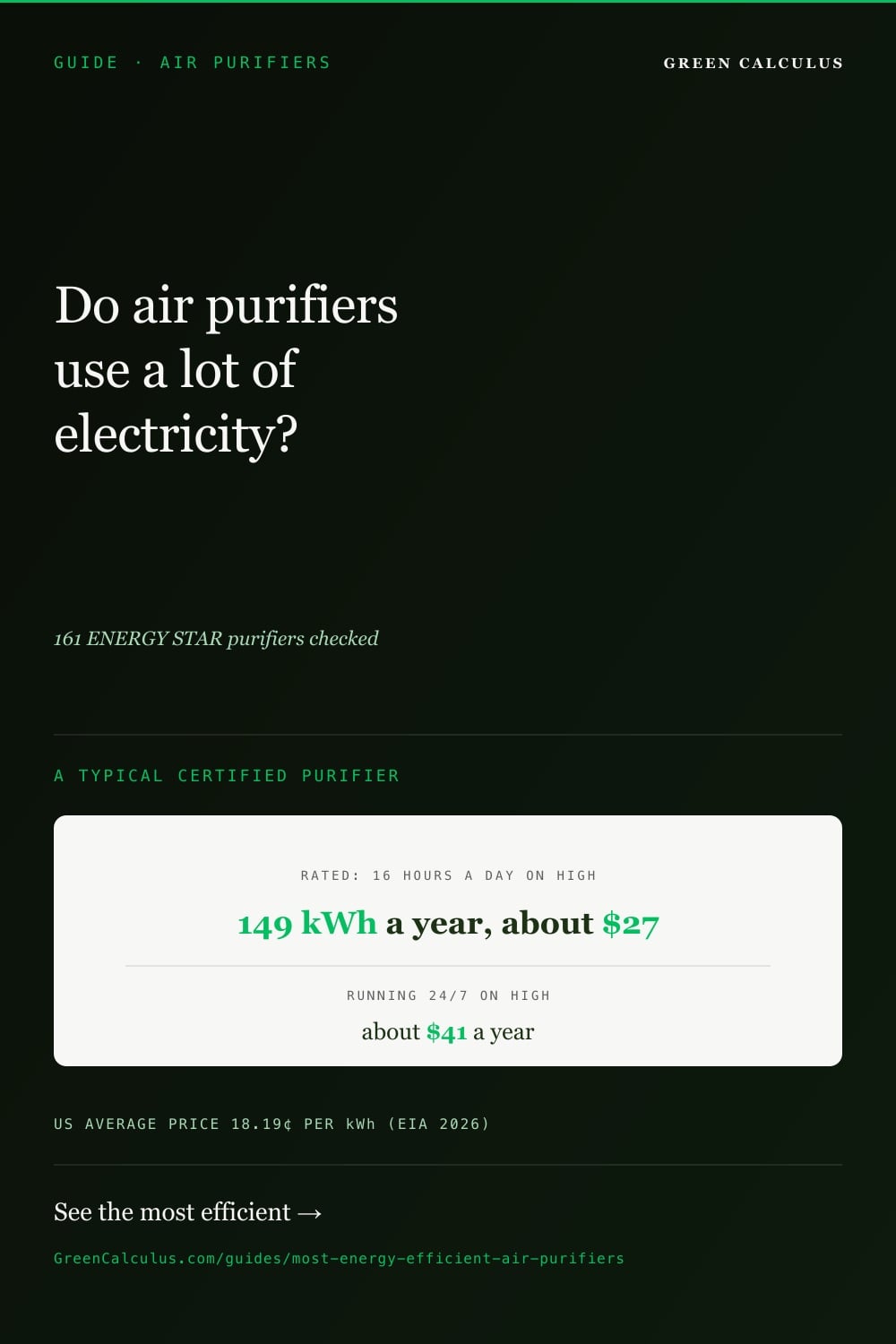
A typical ENERGY STAR air purifier uses about 149 kWh a year, roughly $27 at the US average electricity price, rated at full speed for 16 hours a day. The most efficient large-room models we could match on Amazon are the Blueair Blue 211i Max and the Coway Airmega ProX, both 10.2 CADR per watt against a median of 6.3. For a bedroom or medium room, the Blueair Blue 311i Max uses 193 kWh a year.
- 439 sq ft (ENERGY STAR)
- 8.4 CADR per watt
- 193 kWh a year
- 687 sq ft (ENERGY STAR)
- 10.2 CADR per watt
- 259 kWh a year
- 894 sq ft (ENERGY STAR)
- 10.2 CADR per watt
- 335 kWh a year
Air purifiers are cheap to run but they run for a long time, often all day and night. We went through the 247 listings in ENERGY STAR’s certified room air cleaner database (161 distinct products once the same model listed under several brand names is counted once) to show what they really use, how much it costs, and which models clean the most air per watt.
Our picks
Each pick is an exact model-number match between the Amazon listing and the ENERGY STAR record, so the figures are the certified ones. All four are filter-based purifiers. Costs use 18.19 cents per kWh (EIA, US residential average, January to July 2026).
- 687 sq ft (ENERGY STAR)
- 10.2 CADR per watt
- 259 kWh a year
- 894 sq ft (ENERGY STAR)
- 10.2 CADR per watt
- 335 kWh a year
- 439 sq ft (ENERGY STAR)
- 8.4 CADR per watt
- 193 kWh a year
- 395 sq ft (ENERGY STAR)
- 7.6 CADR per watt
- 197 kWh a year
| Model | ENERGY STAR room size | PM2.5 CADR | CADR per watt | Rated use a year | On high 24/7 |
|---|---|---|---|---|---|
| Blueair Blue 211i Max | 687 sq ft | 450 | 10.2 | 259 kWh ($47) | $71 |
| Coway Airmega ProX | 894 sq ft | 581 | 10.2 | 335 kWh ($61) | $91 |
| Blueair Blue 311i Max | 439 sq ft | 298 | 8.4 | 193 kWh ($35) | $53 |
| Coway Airmega Halo | 395 sq ft | 257 | 7.6 | 197 kWh ($36) | $54 |
The Blue 211i Max cleans a 687 sq ft room on 259 kWh a year; a typical certified purifier for 600 sq ft and up uses 389 kWh. The two Blueair and two Coway models above all clean more air per watt than the median certified purifier (6.3). The highest scores in the data, up to 26.2, belong to box-style purifiers from the Luggable range (listed under the brand Rainbow), which we did not find on Amazon.
Replacement filters
Electricity is not the only running cost. The filter is what cleans the air, and it has to be replaced. Filters are made for one model, so buy the maker’s filter for the exact purifier. Coway says the Airmega ProX filter set lasts up to a year, and a light on the unit tells you when it is due. Blueair says its app works out the Blue 211i Max filter’s life from your use and pollution levels and tells you to replace it within 9 months. Check the filter price before you choose a purifier, because you will keep buying it.
- Fits 211i Max only
- Replace within 9 months (Blueair)
- Fits Airmega ProX
- Lasts up to 1 year (Coway)
- Fits 311i Max only
- Not for the 311i+ Max
How much electricity does an air purifier use?
ENERGY STAR’s annual figure assumes the purifier runs at its highest fan speed for 16 hours a day and sits in standby for the other 8, the method set by the US Department of Energy’s test procedure. On that basis the median certified purifier uses 149 kWh a year, and the range runs from 30 to 490 kWh. Bigger rooms need more airflow, so use goes up with room size:
| ENERGY STAR room size | Products | Median rated use | Cost a year (rated) | Cost a year on high 24/7 |
|---|---|---|---|---|
| Up to 199 sq ft | 49 | 87 kWh | $16 | $24 |
| 200 to 399 sq ft | 58 | 150 kWh | $27 | $41 |
| 400 to 599 sq ft | 39 | 289 kWh | $53 | $79 |
| 600 sq ft and up | 15 | 389 kWh | $71 | $106 |
To use your own electricity price, put the kWh into the electricity cost calculator.
Running an air purifier 24/7
Running around the clock means 24 hours a day instead of the rated 16, half as much again. On the highest speed that is about 1.5 times the ENERGY STAR figure, or roughly $41 a year for the median model. Most people do not run a purifier flat out. Lower speeds and auto mode, which speeds up only when the sensor detects particles, use far less, so the rated figure is closer to a ceiling than a typical bill.
Room size: the box versus ENERGY STAR
The room sizes on Amazon listings are much bigger than ENERGY STAR’s. Blueair lists the Blue 311i Max for 2,107 sq ft, which its listing says is the area cleaned once an hour; ENERGY STAR rates it for 439 sq ft. Coway lists the Airmega ProX for up to 4,253 sq ft; ENERGY STAR says 894. In the ENERGY STAR data the room size is always about 1.55 times the smoke CADR, so it is a like-for-like figure across brands. Use it to size a purifier for the room you want to keep clean. For wildfire smoke the EPA has its own sizing rule: see the best air purifiers for wildfire smoke.
What CADR per watt means
CADR, the clean air delivery rate, is how many cubic feet of filtered air a purifier delivers each minute. ENERGY STAR’s efficiency score divides the PM2.5 CADR by the power used, so a higher number means more clean air for each watt. Half of certified models score 6.3 or less, and fewer than one in ten scores above 9.1. 49 of the 161 products also meet ENERGY STAR’s Most Efficient criteria.
How these were chosen
We downloaded the ENERGY STAR Certified Room Air Cleaners V3.0 dataset (data.energystar.gov, dataset gaa3-swy6) on 6 October 2026. Where the same product appears under several brand names with identical test results, we counted it once. We then checked popular Amazon listings and kept only those whose model number matches a certified record and that were in stock when checked. Annual kWh, CADR, efficiency and room size are ENERGY STAR’s figures. The 16-hour basis comes from the DOE air cleaner test procedure (88 FR 14014, 6 March 2023), which tests at the highest fan speed. The 24/7 costs are our estimate: the rated kWh times 24/16, ignoring the small standby share. Costs use the EIA Electric Power Monthly US residential average for January to July 2026, 18.19 cents per kWh.
Sources
- ENERGY STAR, Certified Room Air Cleaners V3.0 data set (gaa3-swy6)
- U.S. EPA, Guide to Air Cleaners in the Home
- U.S. Department of Energy, test procedure for air cleaners, 88 FR 14014 (Federal Register, 6 March 2023)
- U.S. Energy Information Administration, Electric Power Monthly, Table 5.6.A: average residential electricity price by state
How we pick products for every buying guide: our buying guide standards.
Frequently asked questions
No. The median ENERGY STAR certified air purifier uses 149 kWh a year, about $27 at the US average price of 18.19 cents per kWh. That rating assumes full speed for 16 hours a day, so most homes use less.
On the highest speed, about 1.5 times the ENERGY STAR annual figure: roughly $41 a year for the median certified model, from about $24 for small-room models to about $106 for models rated for 600 sq ft and up. Auto mode and lower speeds cost less.
Among large-room models we could match on Amazon, the Blueair Blue 211i Max and the Coway Airmega ProX both deliver 10.2 cubic feet per minute of clean air per watt, against a median of 6.3. The highest scores in the ENERGY STAR data, up to 26.2, belong to box-style purifiers from the Luggable range, which we did not find on Amazon.
Makers often quote the area a purifier can clean once an hour. ENERGY STAR’s room size is about 1.55 times the smoke CADR for every model, which allows several air changes an hour. Blueair lists the Blue 311i Max for 2,107 sq ft; ENERGY STAR rates it for 439 sq ft.