
Portable Power Stations: How Long They Run Your Devices, and Which to Buy
As an Amazon Associate I earn from qualifying purchases. The Amazon links on this page are affiliate links; buying through them does not change the price you pay. How we handle affiliate links.
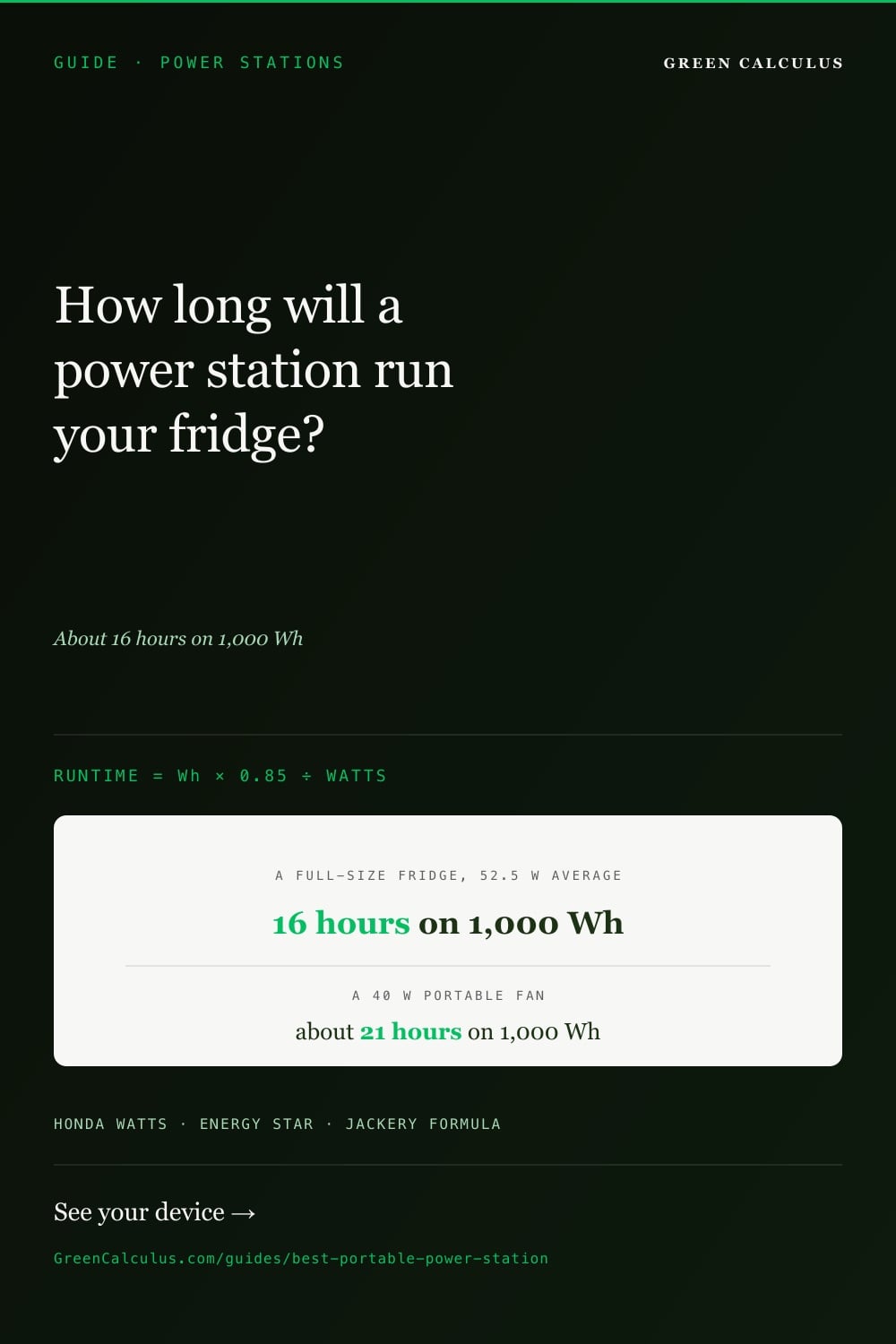
A power station’s runtime is its capacity in watt-hours times about 0.85 (Jackery’s planning formula for usable energy) divided by the device’s watts. A 1,000 Wh-class station runs a typical full-size fridge for about 17 hours (an ENERGY STAR fridge averages about 53 W because it cycles), a 40 W fan for about a day, and a 1,500 W window air conditioner for under an hour. Pick by both numbers: watt-hours for how long, watts for what it can start. For camping, the EcoFlow RIVER 3 Plus (286 Wh); for outages and RVs, the Jackery Explorer 1000 v2, Anker SOLIX C1000 or BLUETTI AC180 (about 1,000 to 1,150 Wh); for whole-home backup, the EcoFlow DELTA Pro 3 (4,096 Wh).
- 286 Wh
- 600 W (1,200 W surge)
- 1,070 Wh
- 1,500 W (3,000 W surge)
- 1,056 Wh
- 1,800 W (2,400 W surge)
- 4,096 Wh
- 4,000 W (6,000 W X-Boost)
Most power station reviews list features. What people actually want to know is simpler: will it run my fridge, my CPAP, my sump pump, and for how long? This guide answers that with Honda’s appliance wattage guide, ENERGY STAR’s fridge data and Jackery’s runtime formula, checks each station’s capacity and output against its own listing, and explains why a power station is the safer choice indoors.
How long will it run? Device by device
Runtime is capacity × 0.85 ÷ the device’s watts. Appliance watts are from Honda’s generator wattage guide; the fridge uses the ENERGY STAR median for full-size fridges (460 kWh a year across 2,922 models, about 53 W on average) because a fridge’s compressor cycles on and off. A station can only power a device if its rated watts cover the running watts and its surge watts cover the starting watts.
| Device | Running / starting (Honda) | EcoFlow RIVER 3 Plus (286 Wh) | Anker SOLIX C1000 (1,056 Wh) | Jackery Explorer 1000 v2 (1,070 Wh) | BLUETTI AC180 (1,152 Wh) | EcoFlow DELTA Pro 3 (4,096 Wh) |
|---|---|---|---|---|---|---|
| Full-size refrigerator (average draw) | 192 W / 1,200 W | 4.6 h | 17 h | 17 h | 19 h | 2.8 days |
| RV refrigerator | 180 W / 600 W | 1.4 h | 5.0 h | 5.1 h | 5.4 h | 19 h |
| Portable fan | 40 W / 120 W | 6.1 h | 22 h | 23 h | 24 h | 3.6 days |
| LCD computer monitor | 30 W / 30 W | 8.1 h | 30 h | 30 h | 33 h | 4.8 days |
| 46-inch flat-screen TV | 190 W / 190 W | 1.3 h | 4.7 h | 4.8 h | 5.2 h | 18 h |
| Slow cooker | 270 W / 270 W | 0.9 h | 3.3 h | 3.4 h | 3.6 h | 13 h |
| Coffee maker (4-cup) | 600 W / 600 W | 0.4 h | 1.5 h | 1.5 h | 1.6 h | 5.8 h |
| Microwave (650 W) | 1,000 W / 1,000 W | can’t start or run it | 0.9 h | 0.9 h | 1.0 h | 3.5 h |
| Sump pump (1/3 hp) | 800 W / 1,300 W | can’t start or run it | 1.1 h | 1.1 h | 1.2 h | 4.4 h |
| Furnace fan (1/3 hp) | 700 W / 1,400 W | can’t start or run it | 1.3 h | 1.3 h | 1.4 h | 5.0 h |
| Window AC (10,000 BTU) | 1,500 W / 2,200 W | can’t start or run it | 0.6 h | 0.6 h | 0.7 h | 2.3 h |
Real runtimes vary with the device’s settings, temperature and the station’s inverter. For any device not listed, check the watts on its label or use the picker at the top.
Watt-hours, watts and surge
- Watt-hours (Wh) are the size of the battery: how long it lasts. Jackery’s formula counts about 85% of the rated Wh as usable, because the inverter and electronics use some.
- Rated watts (W) are the most it can power continuously. A 600 W station cannot run a 1,000 W microwave at all.
- Surge or peak watts cover the brief start-up kick of motors: Honda lists a fridge at 192 W running but 1,200 W starting, and a 1/3 hp sump pump at 800 W running and 1,300 W starting.
- Battery chemistry: every station here uses lithium iron phosphate (LFP). Makers rate them for thousands of cycles: Jackery says over 70% capacity after 4,000 cycles, Anker 3,000 cycles, EcoFlow 3,000 cycles for the RIVER 3 Plus and 4,000 cycles to 80% for the DELTA 3 Plus.
What size for camping
Add up what you will run and for how long: watts × hours ÷ 0.85 is the capacity you need. A 40 W fan for 8 hours needs about 376 Wh, more than a 286 Wh station holds; lights and phone charging need far less. A small station suits a weekend of phones, lights and a fan for part of the night; a 1,000 Wh-class station runs a fridge or cooler overnight. For a CPAP, check the watts on its power supply or in its manual, since use depends on the humidifier and pressure.
What a “solar generator” is
A “solar generator” is a power station sold with, or charged by, portable solar panels: the station stores the energy, the panels refill it. How fast depends on the station’s solar input limit and the sun. EcoFlow says the RIVER 3 Plus charges in about 5 hours with 220 W of solar input; BLUETTI lists 500 W of solar input for the AC180. Solar output depends on the sun, the weather and the panel’s angle, so allow for longer in real conditions.
Power station or gas generator?
A gas generator runs as long as you have fuel and suits big loads, but its exhaust contains carbon monoxide. The Consumer Product Safety Commission says CO poisoning from gasoline-powered portable generators can kill in minutes, and that nearly 100 people in the US die each year from it. Run a generator only outdoors, far from doors, windows and vents. A battery power station has no exhaust, so it can be used indoors, and refilling a 1,000 Wh station from the wall costs about 19 cents at the US average electricity price. To size a generator instead, use our generator and power station size calculator.
Our picks
Capacity, output and battery claims below are from each product’s own Amazon listing, checked on 7 October 2026.
| Best for | Pick | Key spec | Amazon |
|---|---|---|---|
| Camping and travel | EcoFlow RIVER 3 Plus | 286 Wh | Check price |
| Outages and RVs | Jackery Explorer 1000 v2 | 1,070 Wh | Check price |
| Most output for the size | Anker SOLIX C1000 | 1,056 Wh | Check price |
| 1,800 W, 4,000 cycles | EcoFlow DELTA 3 Plus | 1,024 Wh | Check price |
| Largest 1 kWh-class battery | BLUETTI AC180 | 1,152 Wh | Check price |
| Whole-home backup | EcoFlow DELTA Pro 3 | 4,096 Wh | Check price |
- 286 Wh
- 600 W (1,200 W surge)
- 1,070 Wh
- 1,500 W (3,000 W surge)
- 1,056 Wh
- 1,800 W (2,400 W surge)
- 1,024 Wh
- 1,800 W
- 1,152 Wh
- 1,800 W (2,700 W peak)
- 4,096 Wh
- 4,000 W (6,000 W X-Boost)
How these were chosen
We picked lithium iron phosphate stations from established brands at three sizes (about 300 Wh, about 1,000 Wh and about 4,000 Wh) whose Amazon listings state their capacity and output, and that were in stock on 7 October 2026. Runtimes use Jackery’s published planning formula (working time = Wh × 0.85 ÷ device watts), Honda’s generator wattage guide for running and starting watts, and the ENERGY STAR certified refrigerator dataset (data.energystar.gov, p5st-her9) for the average fridge draw. Refill costs use the EIA US residential average for January to July 2026, 18.19 cents per kWh, before charging losses. Carbon monoxide figures: CPSC, 30 January 2026.
Sources
- Jackery Help Center, How long can I use my Jackery portable power station
- Honda Power Equipment, generator wattage estimation guide
- ENERGY STAR, Certified Residential Refrigerators data set (p5st-her9)
- U.S. Consumer Product Safety Commission, release 26-237 on carbon monoxide and fires during power outages (30 January 2026)
- U.S. Energy Information Administration, Electric Power Monthly, Table 5.6.A: average residential electricity price by state
How we pick products for every buying guide: our buying guide standards.
Frequently asked questions
About capacity x 0.85 divided by the fridge’s average draw. A typical ENERGY STAR full-size fridge averages about 53 W, so a 1,000 Wh-class station runs it for about 17 hours. The station must also handle the fridge’s start-up surge: Honda lists 1,200 W starting watts for a fridge.
Multiply each device’s watts by the hours you will run it, add them up and divide by 0.85. A 40 W fan for 8 hours needs about 376 Wh. Phones and lights need much less; a fridge or cooler overnight needs a 1,000 Wh-class station.
Yes. A solar generator is a portable power station charged by solar panels, often sold as a bundle. The station stores the energy and powers your devices; the panels refill it, as fast as the station’s solar input limit and the sun allow.
Yes. A battery power station has no exhaust, unlike a gas generator. CPSC says carbon monoxide from portable generators can kill in minutes and kills nearly 100 people in the US each year, so generators must run outdoors, far from doors, windows and vents.