
The Best Air Purifiers for Wildfire Smoke, Sized the EPA Way
As an Amazon Associate I earn from qualifying purchases. The Amazon links on this page are affiliate links; buying through them does not change the price you pay. How we handle affiliate links.
For wildfire smoke, the EPA says to choose a portable air cleaner whose smoke CADR is at least two-thirds of the room’s area in square feet, certified by the California Air Resources Board (CARB), and to run it continuously on the highest setting. For a bedroom up to 424 sq ft, the Blueair Blue 311i Max (smoke CADR 283) qualifies; for a living area up to 664 sq ft, the Blueair Blue 211i Max (443); up to 865 sq ft, the Coway Airmega ProX (577). Running 24/7 on high costs about $53 to $91 a year at the US average electricity price.
- Smoke CADR 283
- 193 kWh a year (ENERGY STAR)
- Smoke CADR 443
- 259 kWh a year (ENERGY STAR)
- Smoke CADR 577
- 335 kWh a year (ENERGY STAR)
When wildfire smoke reaches your area, the EPA’s advice is to make one room a cleaner air room and filter it hard. The number that matters is the smoke CADR, the clean air delivery rate for smoke, which every ENERGY STAR purifier is tested for. We checked all 161 ENERGY STAR certified purifiers against the EPA’s sizing rule: most are fine for a bedroom, and only 12 are big enough for a 600 sq ft open-plan space.
What size air purifier for smoke
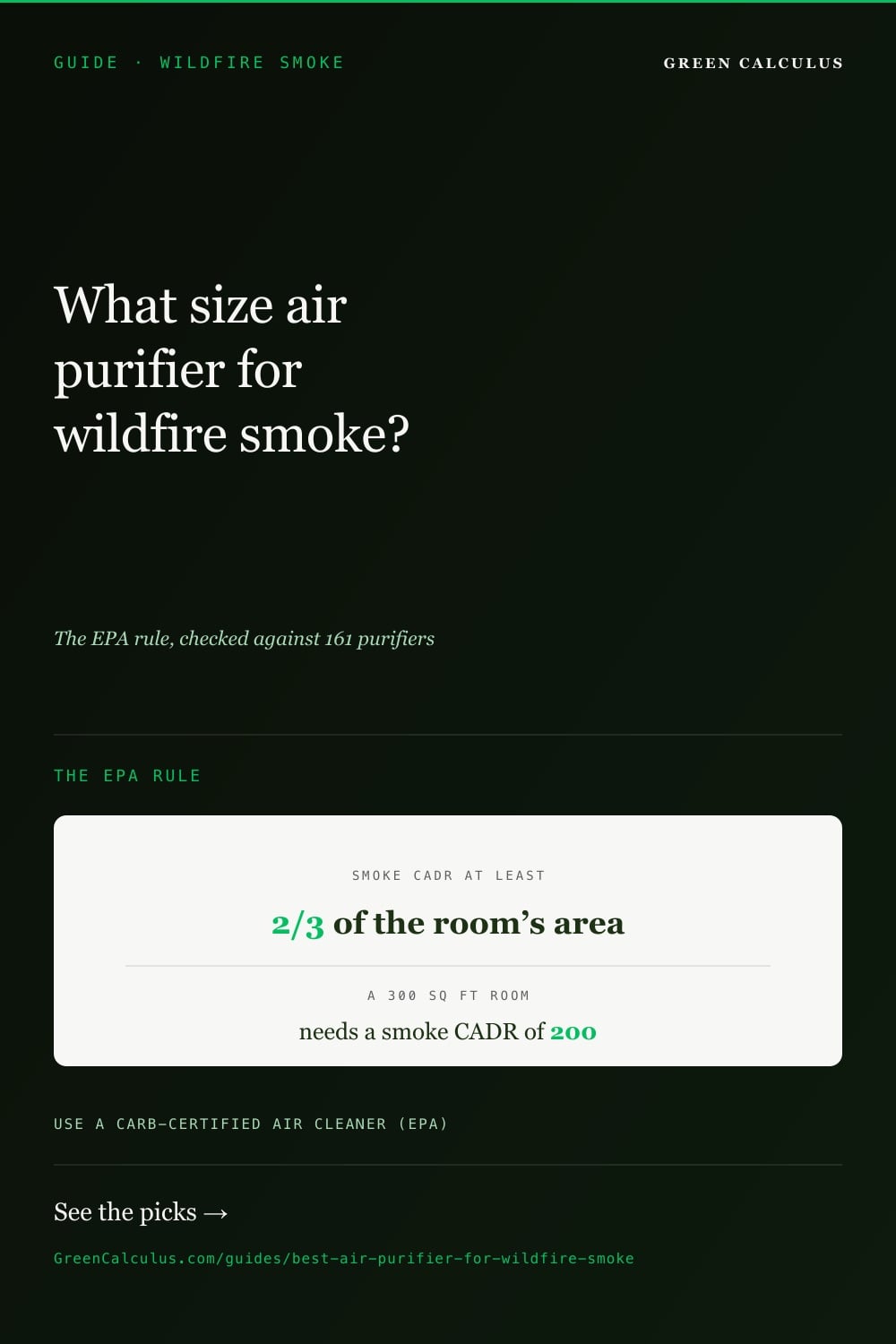
The EPA’s rule: choose an air cleaner with a smoke CADR of at least two-thirds of the room’s area in square feet. A 300 sq ft room needs a smoke CADR of 200 or more. If your ceilings are higher than 8 feet, the EPA says to consider one sized for a larger area. Here is how many of the 161 ENERGY STAR certified purifiers are big enough for common rooms:
| Room | Smoke CADR needed (EPA) | Certified purifiers big enough |
|---|---|---|
| A small bedroom (150 sq ft) | 100 | 128 of 161 |
| A large bedroom (250 sq ft) | 167 | 81 of 161 |
| A 20 x 20 ft living room (400 sq ft) | 267 | 52 of 161 |
| An open-plan living area (600 sq ft) | 400 | 12 of 161 |
The median certified purifier has a smoke CADR of 168, enough for a room of about 250 sq ft. The room size printed on the box is often far larger than this rule allows, because makers quote the area a purifier can clean once an hour. Use the smoke CADR.
Our picks
Each pick is an exact model-number match between the Amazon listing and its ENERGY STAR record, and each is on CARB’s list of certified air cleaning devices.
- Smoke CADR 283
- 193 kWh a year (ENERGY STAR)
- Smoke CADR 255
- Rooms up to 382 sq ft
- Smoke CADR 443
- 259 kWh a year (ENERGY STAR)
- Smoke CADR 577
- 335 kWh a year (ENERGY STAR)
Ozone and CARB certification
Some air cleaners make ozone, a lung irritant. The EPA says to use only CARB-certified air cleaners, because they produce little or no ozone, and to avoid devices that make ozone on purpose. CARB lists each certified model as mechanical (a filter only) or electronic, and electronic models must stay under an ozone limit of 0.050 ppm (50 ppb). Both Coway picks are listed as mechanical, and ENERGY STAR records 0 ppb ozone for them. Both Blueair picks are listed as electronic, and ENERGY STAR records 2 ppb of ozone for them. If you would rather have no electronic stage at all, choose a Coway.
What it costs to run all day
During smoke, the EPA advises running the air cleaner continuously on the highest fan setting. ENERGY STAR rates energy use at 16 hours a day on high, so running around the clock uses about 1.5 times the rated figure:
| Model | Smoke CADR | Room (EPA rule) | CARB listing | A year at 24/7 on high |
|---|---|---|---|---|
| Blueair Blue 311i Max | 283 | 424 sq ft | Electronic | $53 |
| Coway Airmega Halo | 255 | 382 sq ft | Mechanical | $54 |
| Blueair Blue 211i Max | 443 | 664 sq ft | Electronic | $71 |
| Coway Airmega ProX | 577 | 865 sq ft | Mechanical | $91 |
Costs use the US average of 18.19 cents per kWh. Smoke rarely lasts all year, so a week or two of smoke costs a few dollars. The picker at the top uses your state’s price; for any other appliance, use the electricity cost calculator.
Filters during smoke season
Smoke loads filters faster: the EPA’s research on DIY air cleaners notes that filters need replacing more often during smoke events. Blueair sells a SmokeBlock version of its filters with extra activated carbon for smoke odors and gases; for the Blue 311i Max it lasts about 6 months on average, Blueair says. Coway says the Airmega ProX filter set lasts up to a year.
- Fits 311i Max
- About 6 months (Blueair)
- Fits Airmega ProX
- Up to 1 year (Coway)
The cheaper option: a box fan air cleaner
EPA research found that a do-it-yourself air cleaner, a box fan with a MERV 13 filter attached, is a cost-effective way to reduce smoke. Its findings for doing it well: use a newer box fan with added safety features (2012 or later, with a UL or ETL safety mark); a cardboard shroud improves it at no cost; thicker filters (4 inches rather than 1) and more filters (two to five) work better. The EPA does not recommend building one with a fan made before 2012; if one is used, it should not run unattended or while people sleep. Follow the fan maker’s instructions and keep working smoke detectors in the home.
- 20 in
- 3 speeds
- 20 × 20 × 1 in
- 4 filters
- 20 × 20 × 1 in
- 2 filters
How these were chosen
We used the ENERGY STAR Certified Room Air Cleaners V3.0 dataset (data.energystar.gov, dataset gaa3-swy6), downloaded 6 October 2026, counting each product once where it appears under several brand names (161 products). Room sizes on this page apply the EPA’s rule to each model’s smoke CADR: the largest room is 1.5 times the smoke CADR. We checked each pick against CARB’s list of certified air cleaning devices on 6 October 2026, and kept only Amazon listings whose model number matches a certified record and that were in stock when checked. Sizing, ozone and running advice: EPA, Indoor Air Filtration and How to Create a Cleaner Air Room at Home; DIY findings: EPA, Research on DIY Air Cleaners to Reduce Wildfire Smoke Indoors. Costs: rated kWh times 1.5 (24 hours instead of 16, per the DOE test procedure), at the EIA US residential average for January to July 2026.
Sources
- U.S. EPA, Guide to Air Cleaners in the Home
- U.S. EPA, Create a Clean Room to Protect Indoor Air Quality During a Wildfire
- U.S. EPA, Wildfires and Indoor Air Quality
- U.S. EPA, Research on DIY Air Cleaners to Reduce Wildfire Smoke Indoors
- California Air Resources Board, List of CARB-Certified Air Cleaning Devices
- ENERGY STAR, Certified Room Air Cleaners V3.0 data set (gaa3-swy6)
- U.S. Energy Information Administration, Electric Power Monthly, Table 5.6.A: average residential electricity price by state
How we pick products for every buying guide: our buying guide standards.
Frequently asked questions
The EPA says its smoke CADR should be at least two-thirds of the room’s area in square feet. A 300 sq ft room needs a smoke CADR of at least 200; a 400 sq ft room needs 267. With ceilings above 8 feet, the EPA says to consider one sized for a larger area.
Yes. The EPA says mechanical air cleaners and filters, especially higher-efficiency filters, effectively trap smoke particles, and it recommends a portable air cleaner in a cleaner air room during smoke events, run continuously on the highest setting.
The EPA advises using only CARB-certified air cleaners, which produce little or no ozone, and avoiding devices that make ozone on purpose. CARB limits electronic air cleaners to 50 ppb of ozone. If you want no electronic stage, choose one CARB lists as mechanical.
EPA research found a box fan with a MERV 13 filter is a cost-effective way to reduce smoke indoors. Use a 2012-or-newer fan with a UL or ETL mark; a cardboard shroud and thicker or extra filters improve it. The EPA does not recommend one built with a fan made before 2012.