
Data Center Energy Consumption: How Much Electricity Data Centers Use

US data centers used 192 terawatt-hours of electricity in 2024, 4.7% of everything the country consumed. Lawrence Berkeley National Laboratory now expects that to more than triple by 2030, and its June 2026 update raised the estimate again. This page gives the newest figures for the US, the world, Europe and the largest operators, explains what drives them, and lets you work out the electricity, cost and emissions of any data center.
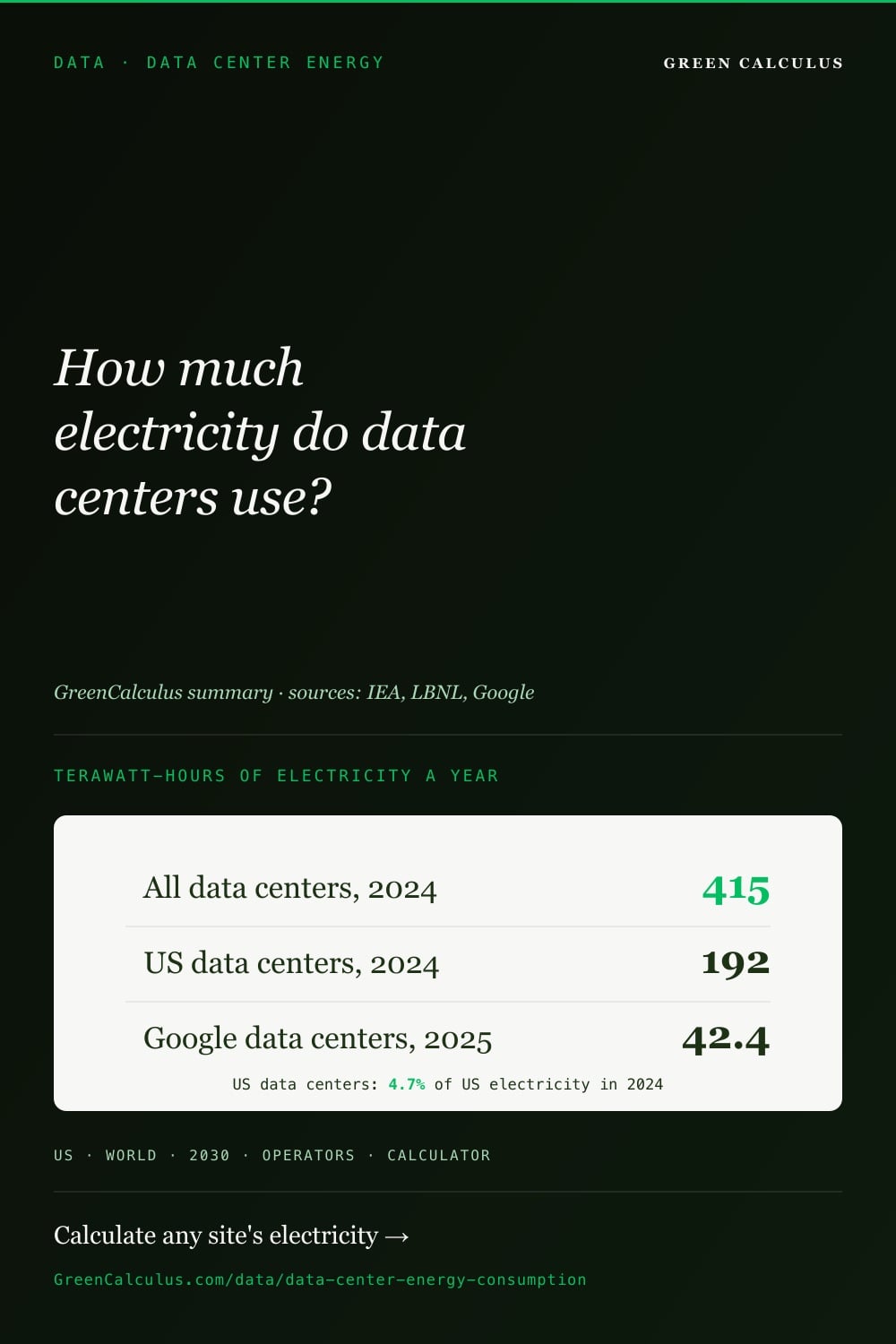
Data centers used about 415 TWh of electricity worldwide in 2024, around 1.5% of global electricity, according to the IEA, and about 485 TWh in 2025. In the US they used 192 TWh in 2024 (4.7%), and Lawrence Berkeley National Laboratory projects 521 to 843 TWh by 2030, 9.5% to 15.3% of US electricity. A single large data center with a 100 MW grid connection, drawing half of it on average, uses about 438 GWh a year, as much as some 35,000 Virginia homes.
Data center electricity calculator
Enter a site’s grid connection, its average IT load or its yearly energy, and pick a US state or a country. The calculator gives the yearly electricity, the cost at the state’s average commercial or industrial price, the location-based CO2e and the number of homes it equals, and places the site next to the largest users.
Enter the data center’s size above to calculate its electricity use
Results show the yearly energy, cost and CO₂, the homes it equals, and how it compares with the largest operators and countries.
Indicative estimate of a data center’s yearly electricity use, cost and location-based CO₂e. Average power comes from the grid connection × its average use (about 50% per Lawrence Berkeley National Laboratory, 2025), from the average IT load × PUE, or from your yearly energy. US prices are each state’s average commercial or industrial price for January to July 2026 (EIA Electric Power Monthly, Table 5.6.B); large sites often pay negotiated rates. Emissions use the location-based grid factor (EPA eGRID 2023 for US states, the national factor for the countries listed, or your own); renewable contracts change market-based, not location-based, emissions. The homes comparison uses the state’s average household electricity use (EIA-861, 2024). Not included: backup generator fuel, construction and the servers’ embodied emissions.
How much electricity US data centers use
Lawrence Berkeley National Laboratory (LBNL) builds the standard US estimate from the equipment actually shipped: servers, storage, network gear and the cooling around them. Its 2025 Update, published in June 2026, puts US data center electricity at 192 TWh in 2024, 4.7% of total US electricity consumption, about as much as 18.5 million average US homes use in a year. Cryptocurrency mining is not included.
That is at the low end of the range in LBNL’s 2024 report, because fewer AI chips were shipped in 2023 and 2024 than first thought. The forecast went the other way: the Reference Case now reaches 464 TWh in 2028 and 649 TWh in 2030. Industry estimates broadly agree on the history, from roughly 60 to 80 TWh around 2017 to 150 to 200 TWh by 2023.
Data centers worldwide
The International Energy Agency estimates that data centers used around 415 TWh in 2024, about 1.5% of the world’s electricity, after growing 12% a year for five years. Its April 2026 update reported that demand rose 17% in 2025, to about 485 TWh according to Our World in Data, which cites the IEA; about a third of that, 155 TWh, was in data centers focused on AI. The IEA’s Base Case reaches around 945 TWh by 2030, just under 3% of global electricity, with the US and China accounting for most of the growth.
| Region | Year | Electricity | Share of total | Source |
|---|---|---|---|---|
| World | 2024 | 415 | 1.5% | IEA |
| World | 2025 | 485 | 1.5% | IEA via Our World in Data |
| United States | 2024 | 192 | 4.7% | LBNL |
| European Union | 2024 | 68 | – | European Commission |
| Ireland | 2025 | 7.7 | 23% | CSO |
How much power does a data center use?
Data centers are usually described by their grid connection in megawatts, but they do not draw that much all the time. LBNL estimates that US data centers use about 50% of their interconnection capacity on average, because they keep spare capacity for redundancy and maintenance.
A data center with a 100 MW grid connection in Virginia, drawing 50% on average, uses 50 MW × 8,760 hours = 438,000 MWh (438 GWh) a year, about 1.2 GWh a day. A Virginia household uses 12,389 kWh a year on average (EIA, 2024), so the site uses as much as about 35,000 homes. At Virginia’s average commercial price for January to July 2026, 11.21 cents per kWh, the electricity costs about $49 million; at the state’s grid intensity of 245 g CO2e per kWh it emits about 107,000 tonnes of CO2e, location-based.
Sizes vary widely. A small enterprise server room may draw tens of kilowatts, while a single hyperscale campus can have a connection of several hundred megawatts. LBNL’s Reference Case implies about 148 GW of interconnection capacity for US data centers by 2030, adding 17.4 GW a year.
Google, Microsoft and Meta
The three operators that publish their electricity show how fast the growth is:
| Operator | What it covers | Earlier | Latest |
|---|---|---|---|
| Data centers | 17.4 (2021) | 42.4 (2025) | |
| Microsoft | Whole company, mostly data centers | 10.8 (FY20) | 37.0 (FY25) |
| Meta | Data centers | 7.0 (2020) | 18.1 (2024) |
Google’s data centers used 38% more electricity in 2025 than in 2024. Microsoft’s fiscal years run from July to June. All three buy renewable electricity contracts to match their use, which lowers their market-based emissions; the physical grid that supplies each site sets the location-based figure.
Europe and Ireland
Data centers in the EU used 68 TWh in 2024, and the European Commission expects 114 TWh by 2030, 3.2% of EU electricity demand. Ireland is the extreme case: its data centers used 7,663 GWh in 2025, 23% of all metered electricity, more than urban households (18%), according to the Central Statistics Office. Ten years earlier, in 2015, their share was 5%.
Projections to 2030
Every major projection has data center electricity roughly doubling or more by 2030, but they differ on how much. LBNL’s seven US scenarios for 2030:
| Scenario | TWh | Share of US electricity |
|---|---|---|
| Compounded uncertainty, low | 521 | 9.5% |
| Consolidated deployment | 578 | 10.5% |
| Low accelerator lifetime | 590 | 10.7% |
| Reference Case | 649 | 11.8% |
| High ASIC | 664 | 12.1% |
| High inference energy | 782 | 14.2% |
| Compounded uncertainty, high | 843 | 15.3% |
The biggest swing comes from how hard AI servers run: assuming higher idle power and utilisation for inference raises the 2030 figure by more than 20%. LBNL’s Reference Case is above the IEA’s 2025 projection for the US, about 430 TWh, and close to McKinsey’s and EPRI’s ranges. If NERC’s grid forecast holds, data centers would account for a third of US electricity load growth from 2024 to 2030.
Why data centers use so much electricity
Most of the electricity runs the IT equipment: servers, storage and networks. The rest goes to cooling, power conversion and lighting, and the ratio between the two is the power usage effectiveness (PUE). At a PUE of 1.3, about 23% of the electricity never reaches the servers. The growth since 2020 is mostly AI: GPU servers draw far more power per rack than conventional ones, and inference, answering prompts, now runs around the clock.
Electricity also brings water with it, both for cooling and at the power stations; see data center water usage and, per prompt, how much water AI uses. For the carbon side of AI, see the carbon footprint of AI.
Provenance and data access
| Figures | Source |
|---|---|
| US 2024, 2028 and 2030 scenarios; 50% utilisation; 148 GW | Smith, Hubbard, Newkirk et al., United States Data Center Energy Usage Report: 2025 Update, Lawrence Berkeley National Laboratory (18 June 2026), doi:10.71468/P1RP4F, CC BY 4.0. |
| World 2024 and 2030 | IEA (2025), Energy and AI. |
| World 2025, AI-focused | IEA (2026), Key Questions on Energy and AI (16 April 2026), figures as reported by Our World in Data; growth of 17% from the IEA’s press release. |
| EU 2024 and 2030 | European Commission, COM(2026) 500 final (21 September 2026). |
| Ireland | Central Statistics Office, Data Centres Metered Electricity Consumption 2025. |
| Operators | Google 2026 Environmental Report; Microsoft 2026 Environmental Data Fact Sheet; Meta 2025 Environmental Data Index. |
| Prices and households | EIA Electric Power Monthly, Table 5.6.B (January to July 2026); EIA-861 Table 5A (2024). In MasterBrain as section energy_prices. |
| Grid intensity | EPA eGRID 2023 (US states); national location-based factors in MasterBrain section grid. |
All 33 estimates are in the open dataset Data Center Electricity Use (CSV and JSON, CC BY 4.0, DOI 10.5281/zenodo.23307541; source on GitHub). The prices and grid factors are served by the open factor API:
/wp-json/greencalculus/v1/factors?key_prefix=energy_prices.usa.electricity.— residential, commercial and industrial prices by state/wp-json/greencalculus/v1/factors?key_prefix=grid.usa.state.— eGRID 2023 by state
Frequently asked questions
About 415 TWh of electricity worldwide in 2024, around 1.5% of global electricity (IEA), and about 485 TWh in 2025. US data centers used 192 TWh in 2024, 4.7% of US electricity, according to Lawrence Berkeley National Laboratory.
It depends on size. A large site with a 100 MW grid connection that draws half of it on average uses about 438 GWh a year, as much as some 35,000 Virginia homes. Small enterprise server rooms use a tiny fraction of that; the largest hyperscale campuses use several times more.
About 1.5% worldwide (IEA, 2024 and 2025), 4.7% in the US (LBNL, 2024) and 23% in Ireland (CSO, 2025). The EU’s data centers used 68 TWh in 2024, and the European Commission expects 3.2% of EU electricity demand by 2030.
Lawrence Berkeley National Laboratory projects 521 to 843 TWh for US data centers in 2030, with a Reference Case of 649 TWh (11.8% of US electricity). The IEA’s Base Case is around 945 TWh worldwide, just under 3% of global electricity.
About a third. The IEA estimates that AI-focused data centers used 155 TWh of the roughly 485 TWh used by all data centers in 2025, as reported by Our World in Data, and that their use is set to triple by 2030.
They run servers, storage and network equipment around the clock and must remove the heat it produces, so cooling and power conversion add to the IT load. AI servers built on GPUs draw much more power than conventional servers, which drives most of the recent growth.
Version history
- 1.0 (12 October 2026): first published.