
Heating and cooling · US · Heat pump sizing
Heat Pump Size Calculator: What Size Heat Pump Do I Need?
Find the heat pump size your home needs from your fuel bills or your home’s details and your county’s design temperature. See which certified models deliver enough heat on your coldest days, how many hours a year you would need backup heat, and whether the size on your quote fits.
What it calculates. Your home’s heat loss at your county’s design temperature, the smallest heat pump size whose certified models deliver it, the balance point, the share of a typical year’s heat the heat pump covers and the hours of backup heat, for every size.
Climate. County design temperatures from EPA ENERGY STAR, and the hours at each temperature in a typical year from NREL’s county weather files (1991–2005).
Sizing rules. NEEP’s guide to sizing heat pumps in cold climates, and the Department of Energy’s sizing notes, including the ACCA Manual S cooling limits.
Heat pumps. Heat output at 5, 17 and 47 °F of 12,833 outdoor models on the ENERGY STAR certified list (29 October 2026). Fuel use and prices: EIA.
Loading design temperatures…
The heat pump
Check a quote (optional)
Or type the size on the quote.
More options: cooling load, design temperature, prices
Works out your home's heating load at your county's design temperature, finds the smallest size whose certified models deliver it, and counts the hours a year each size needs backup heat. Design temperatures: EPA ENERGY STAR. Weather: NREL county typical year. Sizing rules: NEEP and DOE. Models: ENERGY STAR certified list. Prices: EIA. Use: EIA RECS 2020.
Pick your county and enter a year of fuel use
Results show the size you need in tons, the certified models that reach it, how many hours a year you would need backup heat, and whether a quoted size fits.
This is a first estimate, not a Manual J load calculation. Fuel bills reflect one year's weather and habits, and a home-details estimate leaves out floors, ducts and many construction details. A model's heat output is read from its lowest-capacity certified pairing; the AHRI certificate and the manufacturer's extended performance data for the exact indoor and outdoor pairing are the authority. Ask your installer for a room-by-room Manual J and a Manual S equipment selection before you buy.
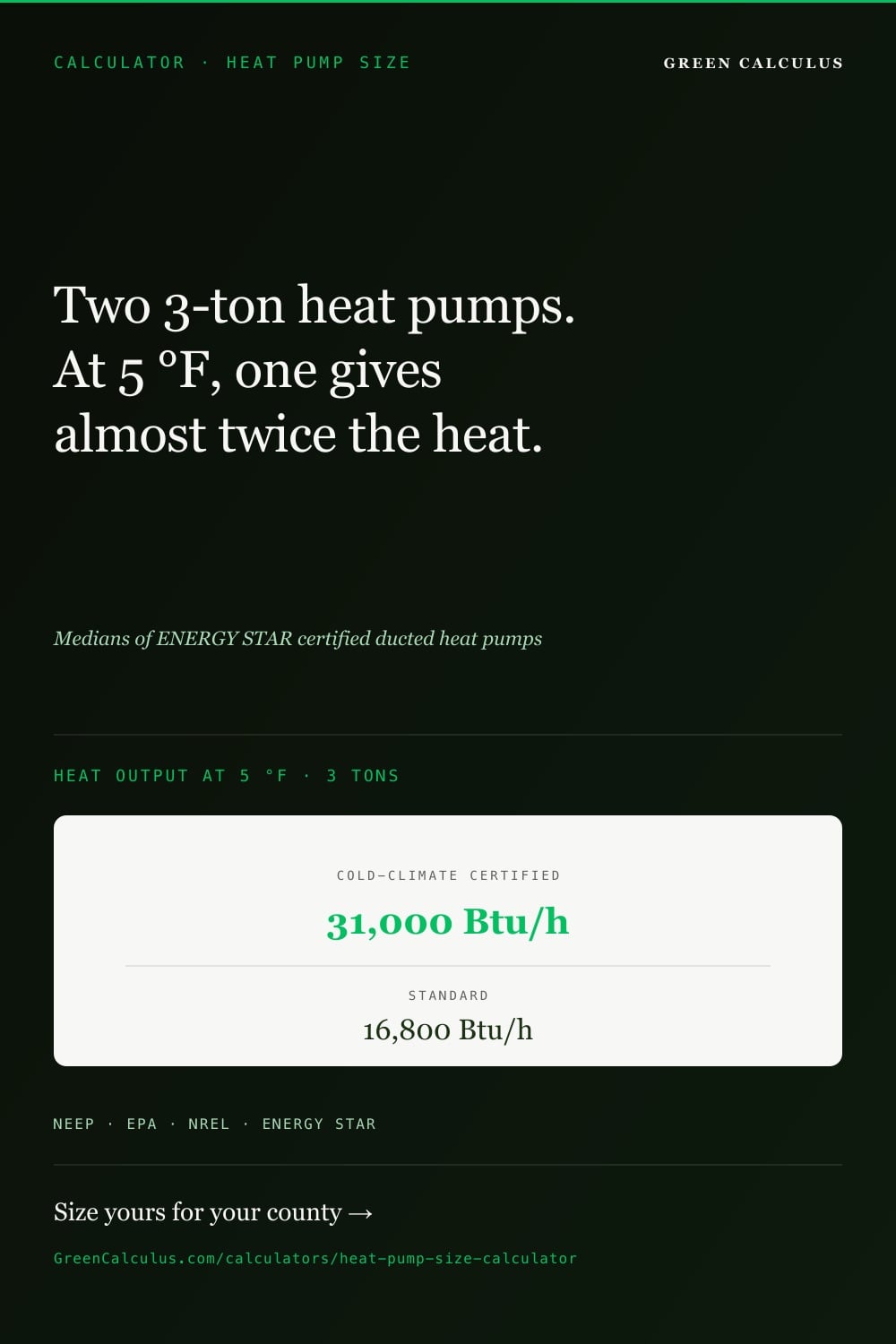
Heat pumps are sold in tons, a cooling rating, but on the coldest nights of the year what matters is how much heat the unit still puts out. Two 3-ton heat pumps can differ by almost half: the median cold-climate model on the ENERGY STAR list delivers about 31,000 Btu/h at 5 °F, the median standard model about 16,800.
This calculator sizes from your home’s heat loss at your county’s design temperature, the way NEEP and the Department of Energy describe, and checks it against the certified figures of real models, not a square-foot rule.
To heat a home on its own, a heat pump should deliver 100–115% of the home’s heat loss at the local design temperature; with a furnace or electric strips kept for the coldest hours, 75–85% (NEEP). For a 2,000 sq ft, two-storey house with average insulation, that is a 2-ton cold-climate heat pump in Seattle or Dallas, 3 tons in Columbus or Boston, 3.5 tons in Chicago or Denver and 4 tons in Minneapolis. Check the output at your design temperature, not the tons: the median 3-ton cold-climate model delivers about 31,000 Btu/h at 5 °F, the median standard 3-ton model about 16,800.
What size heat pump do I need? Sizes by city

The same house in twelve places: 2,000 sq ft over two storeys, 8 ft ceilings, average insulation and air sealing. The size is the smallest at which the typical ENERGY STAR cold-climate ducted heat pump reaches 100% of the heat loss at the county’s design temperature (or 75% with backup).
| City (county) | Design temperature | Heat loss at design | Size, all the heat | Backup hours a year | Size with backup | Backup hours a year |
|---|---|---|---|---|---|---|
| Minneapolis (Hennepin) | −8 °F | 36,400 Btu/h | 4 tons | 36 | 3 tons | 421 |
| Chicago (Cook) | 2 °F | 31,800 Btu/h | 3.5 tons | 109 | 2.5 tons | 351 |
| Portland, Maine (Cumberland) | 2 °F | 31,800 Btu/h | 3.5 tons | 55 | 2.5 tons | 313 |
| Denver | 3 °F | 31,300 Btu/h | 3.5 tons | 90 | 2.5 tons | 218 |
| Buffalo (Erie) | 7 °F | 29,400 Btu/h | 3 tons | 17 | 2.5 tons | 171 |
| Columbus (Franklin) | 9 °F | 28,500 Btu/h | 3 tons | 33 | 2.5 tons | 109 |
| Pittsburgh (Allegheny) | 9 °F | 28,500 Btu/h | 3 tons | 7 | 2.5 tons | 43 |
| Boston (Suffolk) | 12 °F | 27,100 Btu/h | 3 tons | 12 | 2.5 tons | 366 |
| Raleigh (Wake) | 23 °F | 21,900 Btu/h | 2.5 tons | 45 | 2 tons | 160 |
| Atlanta (Fulton) | 25 °F | 21,000 Btu/h | 2.5 tons | 139 | 2 tons | 252 |
| Dallas | 26 °F | 20,500 Btu/h | 2 tons | 42 | 2 tons | 42 |
| Seattle (King) | 27 °F | 20,100 Btu/h | 2 tons | 6 | 1.5 tons | 135 |
GreenCalculus calculation, 30 October 2026. Design temperatures: EPA ENERGY STAR Design Temperature Limit Reference Guide (99% heating). Heat loss: walls, ceiling, windows (15% of floor area) and air leakage (0.5 air changes an hour) at 70 °F indoors, with GreenCalculus typical values for average insulation. Backup hours: hours in the county’s typical weather year (NREL) when heat loss exceeds the typical model’s output; a design temperature is set so that about 1% of hours (88 a year) are colder. Your home will differ: use your own bills in the calculator.
Tons follow the climate, not the floor area. The Minneapolis house needs twice the heat-pump size of the Seattle one, and the difference is almost all design temperature: 35 °F colder.
Sizing from your fuel bills
A year of fuel bills measures what your home actually loses, insulation, leaks and all. The calculator takes your yearly gas, propane, oil or electric heating use, removes the part that heats water or cooks (twelve times a summer month), and multiplies by your furnace’s efficiency to get the heat delivered. It then spreads that heat over every hour below 60 °F in your county’s typical year, each hour weighted by how far below 60 °F it is, which gives your heat loss per degree. Times the gap between 60 °F and your design temperature, that is your heat loss at design.
Worked example (the calculator’s default). The average gas-heated home in Ohio used 62.3 million Btu of gas for space heating (EIA, 2020): about 623 therms. At 80% furnace efficiency that is 49.8 million Btu of heat. Franklin County (Columbus) has 101,270 degree-hours below 60 °F in a typical year, so the home loses about 492 Btu/h for each degree, and 25,100 Btu/h at the 9 °F design temperature. The smallest size where most certified cold-climate ducted units reach that is 2.5 tons: 181 of 314 models do. The typical one covers 99% of the year’s heat, with about 65 hours of backup. Keep the furnace for the coldest hours and a 2-ton unit does, with about 510 hours of backup.
The 60 °F starting point comes from the Department of Energy’s sizing notes: above about 60 °F, sunshine and the heat from people and appliances keep a typical house warm. The bill method is a GreenCalculus calculation; no standard publishes one, and a cold or mild year, a wood stove or a thermostat turned down at night will move it. Use a full year, and the summer figure if the same fuel heats your water.
The sizing rules
| Rule | Figure | Source |
|---|---|---|
| Heat pump heats the home on its own | Output at design temperature 100–115% of heat loss | NEEP sizing guide |
| Heat pump with supplemental heat | 75–85% of heat loss, with just enough backup for the rest | NEEP sizing guide |
| Multi-zone outdoor unit | Avoid more than 120% of the heating design load | NEEP sizing guide |
| Cooling, most climates | 0.90–1.15 × the cooling load | ACCA Manual S, as given by DOE |
| Cooling, heating-dominated climates (HDD65 ÷ CDD50 above 2.0) | 0.90 × the cooling load up to the load + 15,000 Btu/h | ACCA Manual S, as given by DOE |
| Load calculation | Follow the procedure; do not pad the loads (they have safety factors built in) | NEEP sizing guide |
NEEP, Guide to Sizing & Selecting Air-Source Heat Pumps in Cold Climates (revised 8 April 2020). DOE Building Science Education Solution Center, Cold Climate Heat Pump Sizing, level 3 lecture notes. HDD65: heating degree days base 65 °F; CDD50: cooling degree days base 50 °F.
Heat output in cold weather, by size
A heat pump’s output falls as it gets colder outside, and how fast depends on the model. The tonnage on the quote is its cooling capacity. These are the medians of ENERGY STAR certified ducted heat pumps at each size:
| Size | Cold-climate: at 47 °F | at 17 °F | at 5 °F | Standard: at 47 °F | at 17 °F | at 5 °F |
|---|---|---|---|---|---|---|
| 1.5 tons | 19,000 | 14,400 | 16,500 | 17,500 | 10,500 | 8,200 |
| 2 tons | 24,000 | 19,200 | 19,500 | 22,600 | 14,200 | 10,900 |
| 2.5 tons | 32,000 | 23,200 | 25,200 | 28,400 | 17,400 | 13,500 |
| 3 tons | 36,000 | 27,400 | 31,000 | 34,000 | 21,400 | 16,800 |
| 3.5 tons | 45,000 | 38,500 | 33,200 | 39,000 | 24,800 | 19,300 |
| 4 tons | 48,000 | 35,200 | 42,000 | 46,000 | 30,000 | 23,600 |
| 5 tons | 57,000 | 40,500 | 40,000 | 55,500 | 35,600 | 28,600 |
Btu/h. Medians of each outdoor model’s lowest certified pairing, ducted split and packaged heat pumps, ENERGY STAR certified list of 29 October 2026 (cold-climate: 2,502 models; standard: 1,660). Size = cooling capacity to the nearest half ton. The 47 °F figure is the nominal heating capacity; the 5 °F and 17 °F figures come from different test points, which is why many variable-speed cold-climate units list more at 5 °F than at 17 °F. ENERGY STAR’s cold-climate label needs at least 70% of the 47 °F output at 5 °F.
A standard heat pump keeps about half its 47 °F output at 5 °F; a cold-climate one keeps about 70 to 85%. At 5 °F the median cold-climate 3-ton unit delivers more heat than the median standard 5-ton one: 31,000 against 28,600 Btu/h.
Balance point and backup heat
Draw the home’s heat loss as a line that falls to zero at 60 °F, and the heat pump’s output as a second line that falls as it gets colder. Where they cross is the balance point: below it the heat pump cannot keep up on its own, and backup heat (electric strips, or the furnace) makes up the gap. The calculator draws both lines for your home and counts the hours below the balance point in your county’s typical year, and how much backup heat they need.
A balance point a few degrees below the design temperature means the heat pump carries the house almost all winter. A balance point well above it is fine too if you keep the furnace: in the Columbus example, a 2-ton unit has its balance point at about 23 °F and still covers 96% of the year’s heat, because few hours are that cold.
Should you keep the furnace?
Keeping a gas furnace for backup (a dual-fuel system) lets a smaller heat pump do most of the work. Whether the furnace is also the cheaper heat on cold days depends on prices. The break-even COP is the heat pump efficiency at which both cost the same per unit of heat:
| State | Gas | Electricity | Break-even COP |
|---|---|---|---|
| Illinois | $1.07/therm | 19.2¢/kWh | 4.2 |
| New York | $1.70/therm | 29.4¢/kWh | 4.0 |
| Maine | $1.82/therm | 30.0¢/kWh | 3.9 |
| Colorado | $1.05/therm | 16.7¢/kWh | 3.7 |
| Minnesota | $1.04/therm | 16.3¢/kWh | 3.7 |
| Pennsylvania | $1.45/therm | 21.0¢/kWh | 3.4 |
| Ohio | $1.30/therm | 18.7¢/kWh | 3.4 |
| Massachusetts | $2.43/therm | 30.1¢/kWh | 2.9 |
| North Carolina | $1.58/therm | 14.9¢/kWh | 2.2 |
| Washington | $1.61/therm | 14.4¢/kWh | 2.1 |
| Texas | $1.91/therm | 16.1¢/kWh | 2.0 |
| Georgia | $1.98/therm | 15.4¢/kWh | 1.8 |
State average residential prices (EIA: gas 2025, electricity January–July 2026; gas converted from $ per thousand cubic feet with each state’s own heat content for the same year, also from EIA), 80% furnace efficiency. Break-even COP = electricity price per million Btu ÷ (gas price per million Btu ÷ 0.80). The median certified cold-climate ducted heat pump has a seasonal COP of about 2.5 to 2.7 (HSPF2 ÷ 3.412) and a COP of about 1.8 to 2.0 at 5 °F.
Where the break-even COP is near 2, as in Georgia, Texas, Washington or North Carolina, a heat pump heats more cheaply than gas for most of the winter. Where it is above 3, as in Illinois, New York or Ohio at these prices, gas is the cheaper heat for much of the season, and the case for a heat pump rests on cooling, carbon or a cheaper electricity rate. The calculator works this out with your own prices.
Sizing for cooling too
A heat pump sized for heat can be too big for summer. The Department of Energy’s sizing notes give the ACCA Manual S limits: cooling capacity between 90% and 115% of the cooling load, or up to the load plus 15,000 Btu/h where heating dominates (heating degree days base 65 °F more than twice the cooling degree days base 50 °F). By that test Minneapolis is heating-dominated (3.2) and Columbus is not (1.5). Where a heat-sized unit is too big for cooling, NEEP suggests a variable-speed model with a low minimum speed, or one with a higher ratio of heating to cooling output. Enter a cooling load from a Manual J under More options to check.
Ductless mini-splits
Switch the calculator to ductless to size a single outdoor unit against ENERGY STAR certified mini-splits. NEEP’s guide adds two cautions: avoid multi-zone outdoor units sized above 120% of the heating design load, and avoid oversizing the indoor heads for small rooms, which then cycle on and off. For one head per room, size each head to that room’s load from a room-by-room Manual J.
How the calculator works
It finds your county’s 99% heating design temperature and its typical year of hourly temperatures, then works out your heat loss from your bills or from your home’s walls, ceiling, windows and air leakage. For every size it takes the ENERGY STAR certified heat pumps of that size (cold-climate only, or all), reads each model’s output at your design temperature from its certified figures at 5, 17 and 47 °F, and finds the model in the middle. The recommended size is the smallest whose middle model reaches NEEP’s target. For each size it then runs your county’s typical year hour by hour to find the balance point, the share of heat the heat pump supplies and the backup hours. Every step is shown under View calculation detail, and audit mode lists every source and figure.
Data sources and updates
| Input | Source | Checked |
|---|---|---|
| Sizing targets | NEEP, Guide to Sizing & Selecting Air-Source Heat Pumps in Cold Climates (rev. 8 April 2020) | 30 Oct 2026 |
| Load line, balance point, Manual S limits | DOE Building Science Education Solution Center, Cold Climate Heat Pump Sizing, level 3 | 30 Oct 2026 |
| County design temperatures | EPA, ENERGY STAR Design Temperature Limit Reference Guide (rev. 1 September 2018), 3,145 counties | 12 Oct 2026 |
| Hours at each temperature | NREL, End-Use Load Profiles for the US Building Stock, ResStock county TMY3 weather (typical year 1991–2005, CC BY 4.0), 3,130 counties | 30 Oct 2026 |
| Heat pump output at 5, 17 and 47 °F | ENERGY STAR Certified Air-Source Heat Pumps: 12,833 outdoor models | 29 Oct 2026 |
| Heating fuel use by state | EIA Residential Energy Consumption Survey (RECS) | 2020 |
| Prices by state | EIA: gas, 2025 annual average; electricity, January–July 2026; propane and heating oil, winter 2025–26 weekly average | Oct 2026 |
| Fuel heat content | Natural gas: EIA heat content of gas delivered to consumers, each state, same year as the price. Propane and heating oil: EPA GHG Emission Factors Hub | 2025 |
The certified-model list and the sizing guidance are refreshed on the GreenCalculus update schedule; fuel use, prices and heat content are stored in the GreenCalculus MasterBrain with their exact source and read live by the calculator.
Frequently asked questions
It depends far more on your climate and insulation than on the floor area. A 2,000 sq ft, two-storey house with average insulation loses about 20,000 Btu/h on Seattle’s or Dallas’s coldest days and about 36,000 Btu/h in Minneapolis, so it needs a 2-ton cold-climate heat pump in the first two and a 4-ton one in Minneapolis. Your fuel bills give a better figure for your own house.
For whichever needs more, within limits. NEEP’s guide sizes for heating in cold climates: 100–115% of the heat loss at the design temperature to heat alone, or 75–85% with backup. Manual S, as given by the Department of Energy, keeps cooling capacity within 115% of the cooling load, or within the load plus 15,000 Btu/h where heating dominates. If both cannot be met, a variable-speed unit with a low minimum speed, or a smaller unit with backup heat, is the usual answer.
Yes, up to a point. NEEP warns that gross oversizing leads to excessive cycling and low efficiency, and that load calculations already include safety factors and should not be padded. A variable-speed unit tolerates some oversizing because it can slow down, which is why NEEP’s upper limit for heating alone is 115% rather than 100%.
The outdoor temperature at which the heat pump’s output equals the home’s heat loss. Above it the heat pump does all the heating; below it backup heat makes up the difference. The calculator finds yours from the heat pump’s certified output and your home’s heat loss line, which reaches zero at 60 °F.
Where design temperatures are in single figures or below, it usually lets you buy a smaller unit and use less backup heat. The median cold-climate 3-ton ducted heat pump on the ENERGY STAR list delivers about 31,000 Btu/h at 5 °F, against about 16,800 for the median standard 3-ton model. In mild climates such as Atlanta or Seattle a standard unit can be enough.
A heat pump sized to cover all the heat at your design temperature still needs backup in the roughly 1% of hours that are colder than it, often a few dozen hours a year. Sized for 75–85% with backup, a few hundred hours is typical: 351 for the 2,000 sq ft Chicago house with a 2.5-ton unit. The calculator counts them for your county.
Methodology notes and limitations
Not a Manual J. The heat loss is a first estimate. The home-details method uses typical values and leaves out floors, basements and ducts; the bill method reflects one year’s weather and habits. Ask your installer for a room-by-room Manual J and a Manual S equipment selection.
Certified figures. Each model’s output is read from its lowest-capacity certified pairing, in straight lines between 5, 17 and 47 °F. The list has no figure below 5 °F, so for colder design temperatures the output there is estimated and flagged; ask for the manufacturer’s extended performance table. Size tiers follow cooling capacity to the nearest half ton.
Typical year. Hours at each temperature come from NREL’s typical year for the county (1991–2005), not any one winter.
Not included. Installed prices, duct losses, minimum-speed output (not on the ENERGY STAR list), humidity and multi-zone pairing.