
Heating and cooling · US · SEER2, HSPF2, EER2 and COP
SEER2 Calculator: SEER to SEER2, HSPF2 and COP
Convert an air conditioner or heat pump rating between the old and the 2023 test, using the Department of Energy’s own figures for your type of system. See where it stands against the federal minimum in your state and ENERGY STAR, look up a certified model, and what a more efficient unit saves a year.
What it calculates. Your unit’s rating in every form (SEER, SEER2, EER2, HSPF, HSPF2, seasonal COP), how it compares with the federal minimum for your state and with ENERGY STAR, and a year’s electricity cost for your unit, a new one, the minimum and the typical and top certified heat pumps.
Conversions. The Department of Energy’s pairs of old and new ratings for each type of system, from the rule that set the 2023 standards (82 FR 1786, Tables V-29 to V-31). Minimums from 10 CFR 430.32(c). ENERGY STAR levels from Heat Pumps Version 6.2.
Certified models. 12,833 outdoor heat pump models from the ENERGY STAR certified list (snapshot 29 October 2026).
Running cost. 2026 state electricity prices from EIA, and the cooling and heating energy of the average home in your state from EIA’s 2020 household survey.
Or type the ratings from your unit's label or your quote below.
Your unit's ratings
Compare with a new unit (optional)
More options: your electricity price and use
Converts SEER, HSPF and EER to SEER2, HSPF2 and EER2 with DOE's ratio for your system type, shows the seasonal COP, places the rating against the federal minimum, ENERGY STAR and every certified heat pump, and prices a year of cooling and heating. Ratios: DOE, 82 FR 1786. Minimums: 10 CFR 430.32(c). Certified units: ENERGY STAR. Prices: EIA. Use: EIA RECS 2020.
Type the rating on your unit
Results show the rating in every unit, where it stands against the federal minimum and certified heat pumps, what a year of cooling and heating costs, and what a better unit is worth paying.
A converted rating is an estimate: DOE published one ratio per product class, and the real change for a given model depends on its fan and the indoor unit it is paired with. The AHRI certificate for your exact pairing is the authority. Running costs are estimates for a typical home in your state at today's average price; your own bills are a better guide. HSPF2 is rated for one climate (DOE Region IV); in colder places a heat pump's seasonal efficiency is lower. Check every figure against your quotes and bills.
Since 1 January 2023, central air conditioners and heat pumps sold in the US are rated with SEER2 and HSPF2 instead of SEER and HSPF. The equipment did not get worse: the test changed, mainly by assuming much more resistance from the ductwork, so the same unit now earns a lower number.
That makes old and new quotes hard to compare. This calculator converts between them with the Department of Energy’s own figures for each type of system, not one rule of thumb, and tells you what the difference is worth on your bills.
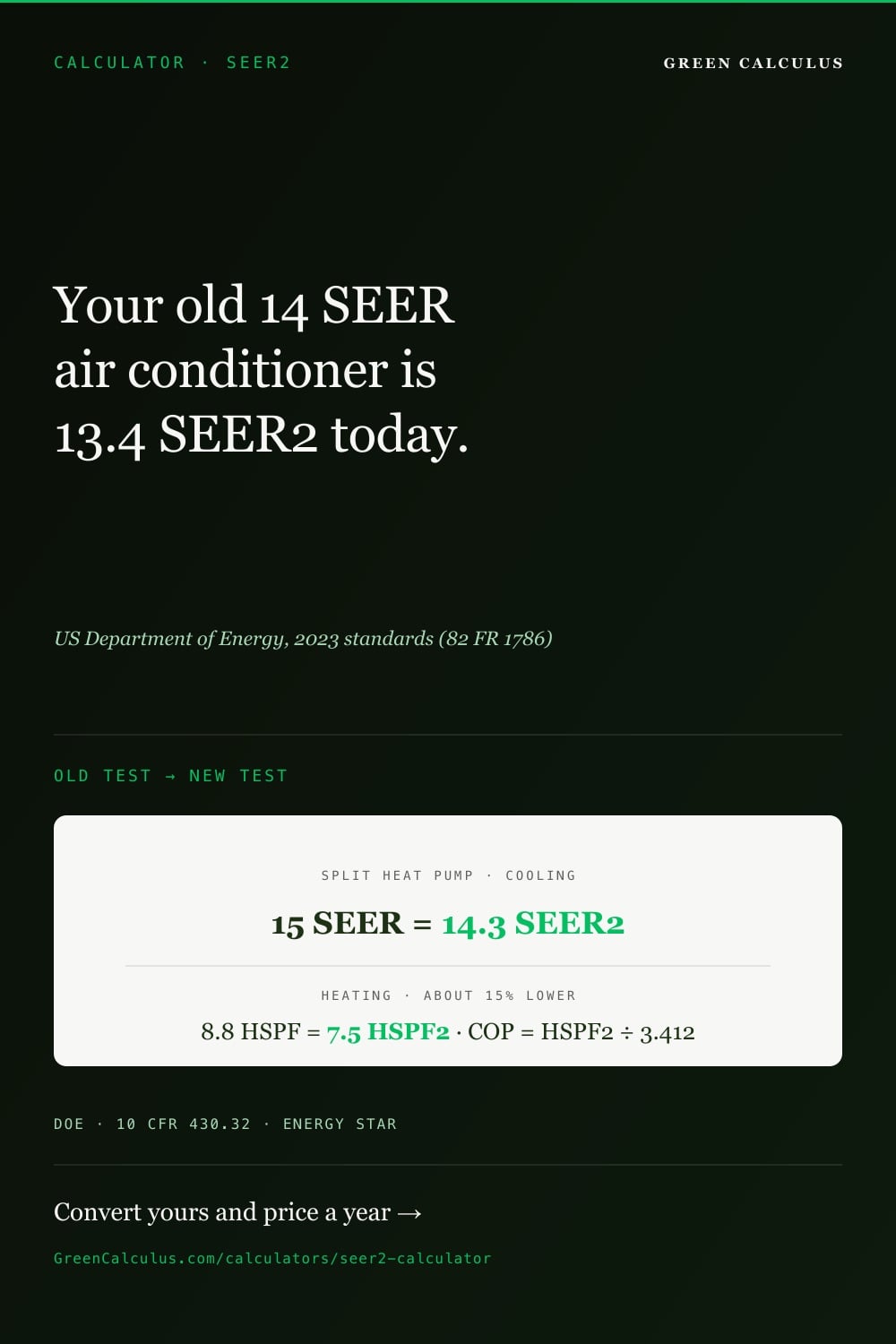
For most central systems, SEER2 is about 4.5% lower than SEER: the Department of Energy’s 2023 standards treat 14 SEER as 13.4 SEER2 for a split air conditioner and 15 SEER as 14.3 SEER2 for a split heat pump. HSPF2 is about 15% lower than HSPF (8.8 HSPF = 7.5 HSPF2). Seasonal heating COP is HSPF2 ÷ 3.412, so 7.5 HSPF2 is a COP of 2.2. In North Carolina, replacing a 14 SEER, 8.2 HSPF heat pump with a 17 SEER2, 8.5 HSPF2 one cuts the average home’s electricity bill for heating and cooling from about $1,048 to $846 a year at 2026 prices.
SEER to SEER2 conversion table

SEER2 for the same unit, using the Department of Energy’s pair for each type of system: 14 SEER = 13.4 SEER2 for split and packaged air conditioners and packaged heat pumps, and 15 SEER = 14.3 SEER2 for split heat pumps.
| SEER | Split air conditioner | Split heat pump | Packaged unit |
|---|---|---|---|
| 13 | 12.4 | 12.4 | 12.4 |
| 14 | 13.4 | 13.3 | 13.4 |
| 15 | 14.4 | 14.3 | 14.4 |
| 16 | 15.3 | 15.3 | 15.3 |
| 17 | 16.3 | 16.2 | 16.3 |
| 18 | 17.2 | 17.2 | 17.2 |
| 19 | 18.2 | 18.1 | 18.2 |
| 20 | 19.1 | 19.1 | 19.1 |
| 21 | 20.1 | 20.0 | 20.1 |
| 22 | 21.1 | 21.0 | 21.1 |
Scaled from the Department of Energy’s pair for each class (82 FR 1786, Table V-29). The pairs were set at the minimum levels; above them the ratio is the best available estimate, and a manufacturer’s own SEER2 rating for a model always wins. Small-duct, high-velocity systems keep the same number (12 SEER = 12 SEER2).
HSPF to HSPF2 and COP
The heating rating fell further than the cooling one. In setting the 2023 standards the Department of Energy described “the 15% reduction from HSPF to HSPF2” it observed for split and packaged heat pumps. Seasonal COP is HSPF2 divided by 3.412, the number of Btu in a watt-hour.
| HSPF | HSPF2, split heat pump | HSPF2, packaged heat pump | Seasonal COP (split) |
|---|---|---|---|
| 7.7 | 6.6 | 6.4 | 1.92 |
| 8.0 | 6.8 | 6.7 | 2.00 |
| 8.2 | 7.0 | 6.9 | 2.05 |
| 8.5 | 7.2 | 7.1 | 2.12 |
| 9.0 | 7.7 | 7.5 | 2.25 |
| 9.5 | 8.1 | 8.0 | 2.37 |
| 10.0 | 8.5 | 8.4 | 2.50 |
| 10.5 | 8.9 | 8.8 | 2.62 |
| 11.0 | 9.4 | 9.2 | 2.75 |
| 12.0 | 10.2 | 10.1 | 3.00 |
Split: 8.8 HSPF = 7.5 HSPF2. Packaged: 8.0 HSPF = 6.7 HSPF2 (82 FR 1786, Table V-29). Seasonal COP is an average over the heating season; at 5 °F a heat pump’s COP is lower (see cold weather).
The Department of Energy’s figures by type of system
When it moved the 2023 standards to the new test, the Department of Energy translated each old minimum into the new metric, class by class. These pairs are the only official equivalences, and they differ by type of system, which is why one multiplier for every unit is not quite right.
| Type of system | Cooling: old → new | Heating: old → new |
|---|---|---|
| Split air conditioner | 14 SEER → 13.4 SEER2 | — |
| Split air conditioner, Southeast | 15 SEER → 14.3 SEER2 | — |
| Split air conditioner, 45,000 Btu/h or more, Southeast | 14.5 SEER → 13.8 SEER2 | — |
| Split heat pump | 15 SEER → 14.3 SEER2 | 8.8 HSPF → 7.5 HSPF2 |
| Packaged air conditioner | 14 SEER → 13.4 SEER2 | — |
| Packaged heat pump | 14 SEER → 13.4 SEER2 | 8.0 HSPF → 6.7 HSPF2 |
| Small-duct, high-velocity | 12 SEER → 12 SEER2 | 7.2 HSPF → 6.1 HSPF2 |
| Space-constrained air conditioner | 12 SEER → 11.7 SEER2 | — |
| Space-constrained heat pump | 12 SEER → 11.9 SEER2 | 7.4 HSPF → 6.3 HSPF2 |
| EER, split air conditioner, Southwest | 12.2 EER → 11.7 EER2 | — |
| EER, packaged air conditioner, Southwest | 11.0 EER → 10.6 EER2 | — |
Source: DOE direct final rule, 82 FR 1786 (6 January 2017), Tables V-29 and V-30. Ductless mini-split heat pumps are split heat pumps under the federal classes.
SEER2 minimums by state
Heat pumps have one national minimum: 14.3 SEER2 and 7.5 HSPF2 for a split system, 13.4 SEER2 and 6.7 HSPF2 for a packaged one. Central air conditioners have regional minimums, and an outdoor unit that has any certified combination below the level for a region cannot be installed there.
| Region | Split air conditioner under 45,000 Btu/h | Split air conditioner 45,000 Btu/h or more | Packaged air conditioner |
|---|---|---|---|
| North (all other states) | 13.4 SEER2 | 13.4 SEER2 | 13.4 SEER2 |
| Southeast | 14.3 SEER2 | 13.8 SEER2 | 13.4 SEER2 |
| Southwest | 14.3 SEER2 and 11.7 EER2 (9.8 EER2 at 15.2 SEER2 or more) | 13.8 SEER2 and 11.2 EER2 (9.8 EER2 at 15.2 SEER2 or more) | 13.4 SEER2 and 10.6 EER2 |
Southeast: Alabama, Arkansas, Delaware, Florida, Georgia, Hawaii, Kentucky, Louisiana, Maryland, Mississippi, North Carolina, Oklahoma, South Carolina, Tennessee, Texas, Virginia, Puerto Rico, the District of Columbia and the US territories. Southwest: Arizona, California, Nevada and New Mexico. Source: 10 CFR 430.32(c)(5) and (c)(6), eCFR up to date as of 28 October 2026; the regional levels apply to units installed on or after 1 January 2023.
What changed in 2023
The new ratings come from a new federal test, Appendix M1, used for every central air conditioner and heat pump made from 1 January 2023. The biggest change is the duct resistance the test assumes. The old test set the minimum external static pressure at 0.10 to 0.20 inches of water, depending on the unit’s capacity; the new one sets 0.50 inches for a conventional ducted system, closer to real ductwork, so the indoor fan works harder and the rating falls. Low-static, mid-static, manufactured-housing and small-duct, high-velocity systems are tested at other values.
HSPF2 is still rated for the Department of Energy’s climate Region IV, a moderate heating climate, so it says less about a heat pump in a cold one than the 5 °F data below. The test procedure already includes a further test, Appendix M2, with metrics called SCORE and SHORE, but it applies only once the Department of Energy sets standards in those metrics; we found no such rule in the Federal Register as of 30 October 2026.
What is a good SEER2 rating?
| Level | Split heat pump | Split air conditioner |
|---|---|---|
| Federal minimum | 14.3 SEER2 · 7.5 HSPF2 | 13.4 SEER2 (14.3 in the Southeast and Southwest) |
| ENERGY STAR | 15.2 SEER2 · 11.0 EER2 · 7.8 HSPF2 | No longer certified (ended 2 February 2026) |
| ENERGY STAR cold-climate | 8.1 HSPF2 (ducted), 8.5 (ductless) | — |
| Typical cold-climate certified model | 16.5 SEER2 · 9.0 HSPF2 | — |
| Top 10% of cold-climate certified models | 19.0 SEER2 · 9.95 HSPF2 | — |
ENERGY STAR Heat Pumps Version 6.2 (Rev. February 2026), Tables 1 and 2; the “typical” and “top 10%” rows are the median and 90th percentile of 2,744 ENERGY STAR cold-climate ducted split heat pump outdoor models (each model’s lowest certified pairing, list of 29 October 2026). ENERGY STAR ended its central air conditioner label on 2 February 2026.
Ductless mini-splits rate much higher: the median certified cold-climate mini-split is 21.5 SEER2 and 10.0 HSPF2. Whether a higher rating is worth paying for depends on how much you heat and cool and your electricity price, which is what the calculator’s “worth paying” table shows. In the North Carolina example above, going from a 14 SEER, 8.2 HSPF heat pump to a 17 SEER2, 8.5 HSPF2 one saves about $203 a year, about $3,039 over 15 years at today’s price.
EER2: the hot-day rating
SEER2 averages efficiency over a cooling season; EER2 measures it at one hot condition, 95 °F outdoors. EER2 matters most in the Southwest, where air conditioners must meet an EER2 minimum as well. A higher SEER2 does not mean a much higher EER2. Among ENERGY STAR ducted split heat pumps, the median EER2 barely moves as SEER2 rises:
| SEER2 | Models | Median EER2 |
|---|---|---|
| 15 to 15.9 | 1,769 | 11.7 |
| 16 to 16.9 | 1,118 | 11.0 |
| 17 to 17.9 | 584 | 11.1 |
| 18 to 18.9 | 505 | 11.2 |
| 19 to 19.9 | 198 | 11.8 |
| 20 to 20.9 | 100 | 12.0 |
| 21 to 21.9 | 52 | 12.5 |
GreenCalculus analysis of the ENERGY STAR certified air-source heat pump list (29 October 2026), ducted split outdoor models, lowest certified pairing of each. There is no fixed formula from SEER to EER: variable-speed units earn high SEER2 at part load without being much better at full load, so check the EER2 on the certificate. The calculator converts EER to EER2 with the Department of Energy’s pair (12.2 EER = 11.7 EER2).
Heat pumps in cold weather
Two numbers on the certificate tell you how a heat pump copes with cold: how much of its heating capacity it keeps at 5 °F, and its COP at 5 °F. ENERGY STAR’s cold-climate label needs at least 70% of the 47 °F capacity and a COP of at least 1.75 at 5 °F.
| ENERGY STAR ducted split heat pumps | Outdoor models | Capacity kept at 5 °F | COP at 5 °F |
|---|---|---|---|
| Cold-climate certified | 2,744 | 82% | 1.92 |
| Other certified | 1,587 | 50% | 2.1 |
Medians of each model’s lowest certified pairing, ENERGY STAR certified list of 29 October 2026. A unit that keeps only half its capacity at 5 °F has to lean on backup electric resistance heat (COP 1) on cold days, so the capacity figure matters as much as the COP. Search your model in the calculator to see its own figures.
To see what size heat pump keeps up in your county on the coldest days, and how many hours backup heat would run, use the heat pump size calculator.
How the calculator works
It converts your rating with the Department of Energy’s pair for your type of system: SEER2 = SEER × (new ÷ old), and the same for HSPF and EER. Seasonal COP is HSPF2 ÷ 3.412 and cooling COP is SEER2 ÷ 3.412. For the running cost it starts from the electricity the average home in your state uses for air conditioning (with the indoor fan, for ducted systems) and the heat the average gas-heated home needs, from EIA’s 2020 household survey. Cooling electricity scales with SEER2 and heating electricity is the heat divided by HSPF2, priced at your state’s 2026 average. Enter your own yearly use under More options for a closer figure. Every step is shown under View calculation detail.
Data sources and updates
| Input | Source | Checked |
|---|---|---|
| Old-to-new rating pairs by class | DOE, 82 FR 1786 (6 Jan 2017), Tables V-29 to V-31 | 30 Oct 2026 |
| Federal and regional minimums | 10 CFR 430.32(c) | eCFR as of 28 Oct 2026 |
| Test changes (external static pressure) | DOE, 82 FR 1426 (5 Jan 2017), section III.C.1 | 30 Oct 2026 |
| ENERGY STAR levels | Heat Pumps Version 6.2 (Rev. February 2026) | 30 Oct 2026 |
| Certified models, 5 °F data, EER2 | ENERGY STAR Certified Air-Source Heat Pumps: 288,059 certified pairings, 12,833 outdoor models, 286 brands | 29 Oct 2026 |
| Electricity prices by state | EIA state residential prices | 2026 |
| Cooling and heating energy by state | EIA Residential Energy Consumption Survey (RECS) | 2020 |
The rules and the certified-model list are refreshed on the GreenCalculus update schedule; prices and household energy are stored in the GreenCalculus MasterBrain with their exact source and read live by the calculator.
Frequently asked questions
Multiply by the Department of Energy’s ratio for your type of system: 13.4 ÷ 14 (about 0.957) for split and packaged air conditioners and packaged heat pumps, and 14.3 ÷ 15 (about 0.953) for split heat pumps. So 16 SEER is about 15.3 SEER2 for either. A small-duct, high-velocity system keeps the same number. If the manufacturer lists a SEER2 rating for the model, use that.
For a split or packaged air conditioner, yes: the Department of Energy translated the old 14 SEER minimum into 13.4 SEER2 for the 2023 standards. For a split heat pump, 14 SEER is about 13.3 SEER2, because DOE’s pair for that class is 15 SEER = 14.3 SEER2.
The federal minimum is 13.4 SEER2 for a split air conditioner in the North, 14.3 in the Southeast and Southwest, and 14.3 for a split heat pump everywhere. ENERGY STAR heat pumps need 15.2 SEER2. The median ENERGY STAR cold-climate ducted split heat pump is 16.5 SEER2, and the top 10% reach 19 or more.
Divide by 3.412, the number of Btu in a watt-hour. 7.5 HSPF2 is a seasonal COP of 2.2 and 9 HSPF2 is 2.64. That is an average over the heating season; a heat pump’s COP at 5 °F is lower, about 1.9 to 2.1 for the median ENERGY STAR ducted split heat pump.
The 2023 test assumes much more duct resistance (0.50 inches of water for a conventional ducted system, against 0.10 to 0.20 before) and changes how heating is measured. The Department of Energy observed about a 15% reduction from HSPF to HSPF2 for split and packaged heat pumps: 8.8 HSPF became 7.5 HSPF2.
It depends on how much you heat and cool and your electricity price. For the average North Carolina home, a 17 SEER2, 8.5 HSPF2 heat pump costs about $846 a year to run against $1,048 for a 14 SEER, 8.2 HSPF one at 2026 prices, a saving of about $203 a year, or $3,039 over 15 years. Compare that with the difference between your quotes.
Methodology notes and limitations
Conversions are estimates. The Department of Energy’s pairs were set at the minimum levels. Above them, scaling by the same ratio is the best available estimate; a unit’s own certified SEER2 or HSPF2 always wins.
Ratings depend on the pairing. A heat pump’s rating is for an outdoor unit with a specific indoor coil or air handler. The model search shows the lowest certified pairing of each outdoor unit; your installed pairing may rate higher.
Average homes. Cooling and heating energy are 2020 averages for your state, and the heat a home needs is taken from the average gas-heated home at 80% furnace efficiency, a GreenCalculus assumption. Your own bills are a better guide.
Not included. Installed prices, backup resistance heat, duct losses, time-of-use rates and future price changes.