
Humidifiers for a Baby’s Room: Cool Mist, a Safe Setup and Which to Buy
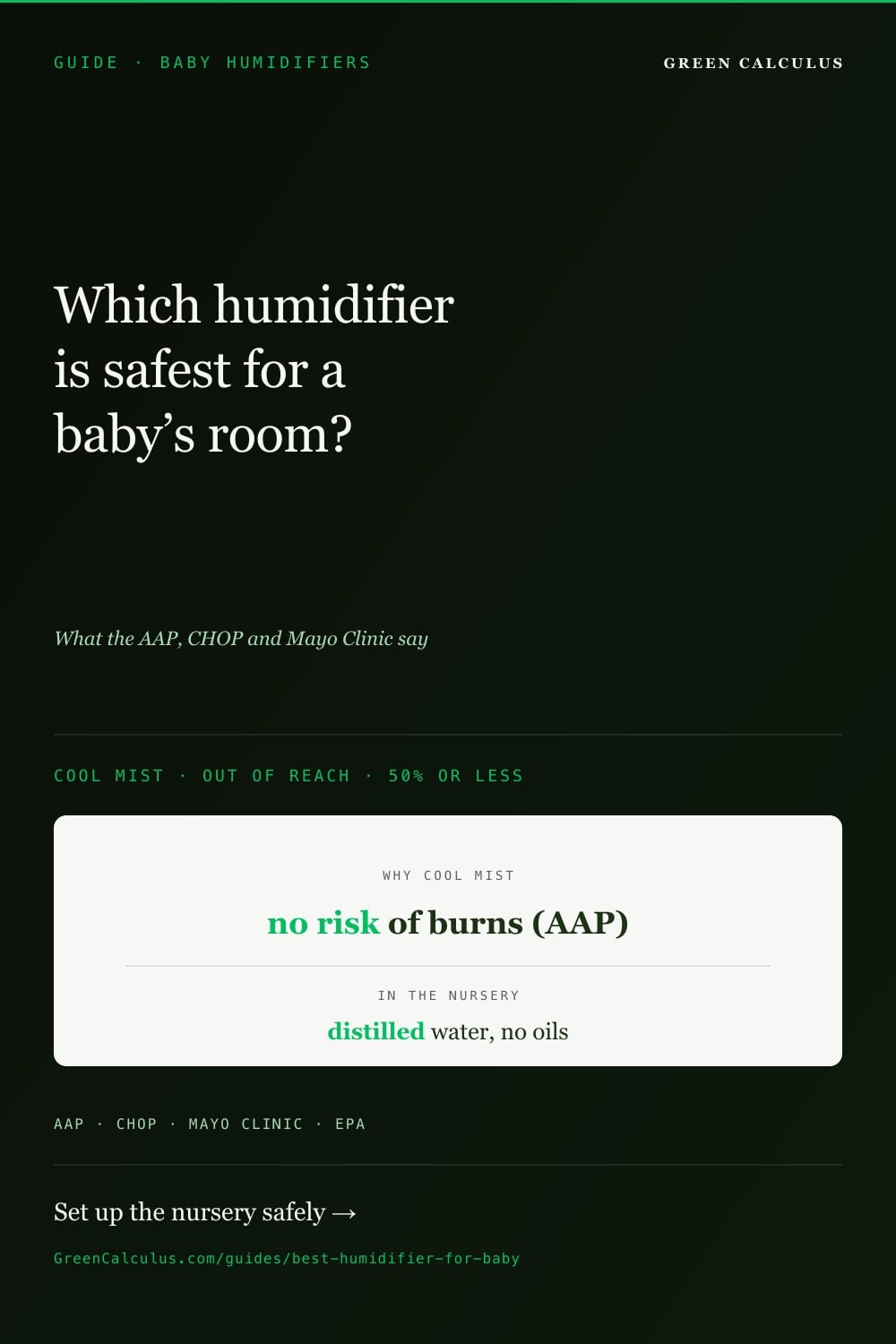
Use a cool-mist humidifier in a baby’s room: the American Academy of Pediatrics says cool mist is generally considered safer for young children than warm mist or a steam vaporizer, because there’s no risk of burns, and Mayo Clinic says to always use cool mist for children. Put it near the crib but out of your baby’s reach, cord included, fill it with distilled or filtered water, keep the room at or below 50% humidity, add no essential oils, and clean it every two to three days. Our pick for most nurseries is the Levoit Dual 200S: its auto mode stops misting above 50% humidity and it shuts off when empty, for about $1.57 a month at 12 hours a day.
- 24 W
- 107 to 290 sq ft (Levoit)
- 14.3 W
- Up to 260 sq ft (Vornado)
- 24 W (manual)
- Up to 500 sq ft (Crane)
Most “best baby humidifier” lists rank products. This guide starts with what pediatric and safety bodies actually say, the American Academy of Pediatrics, Children’s Hospital of Philadelphia, Mayo Clinic, EPA and Health Canada, turns it into a setup you can check in two minutes, and then picks humidifiers whose own manuals meet it. Where a listing and the manual disagree, we go by the manual.
This guide covers products and safe setup. It is not medical advice: if your baby is unwell, or has asthma or allergies, ask your pediatrician first.
Why cool mist
The American Academy of Pediatrics (AAP) puts it plainly: “Cool-mist humidifiers generally are considered safer for young children than warm-mist humidifiers or steam vaporizers. That’s because there’s no risk of burns.” Children’s Hospital of Philadelphia (CHOP) explains that humidifiers use cool water to make a fine mist, while vaporizers boil water and release the steam, and that “the American Academy of Pediatrics (AAP) recommends the use of a cool mist humidifier”. The reason is burns: a vaporizer can burn a child who gets too close to the steam or knocks over a unit full of hot water. Mayo Clinic gives the same advice: “For safety, always use cool-mist humidifiers for children.”
You give up nothing by choosing cool mist. Mayo Clinic says warm-mist and cool-mist humidifiers are equally effective at humidifying the air, because by the time the vapor reaches a child’s lower airways it is the same temperature either way.
Cool mist comes in two kinds. An ultrasonic humidifier makes mist with vibrations, and EPA says it can spread tap-water minerals into the air as white dust, so it needs distilled or low-mineral water. An evaporative humidifier blows air through a wet wick; EPA says this type generally puts less, if any, of those minerals into the air, but the wick needs replacing.
Setting it up in the nursery
- Size it to the room. CHOP: a humidifier that is too large for the room can create condensation, which can grow bacteria and mold. Check the maker’s rated room size against your nursery, or choose one with a humidistat that stops it at your setting.
- Near, but out of reach. The AAP says to place it near your child but out of their reach; in an AAP “Ask the Pediatrician” answer, Rachel Y. Moon, MD, FAAP, puts it close enough that the mist reaches your baby while they sleep. CHOP adds: not directly next to the crib, with around 3 feet between them.
- Cord out of reach. Health Canada’s nursery checklist: keep all cords from baby monitors, lamps, sound machines and other electronics out of your baby’s reach.
- Distilled or filtered water. CHOP and EPA both advise low-mineral water, which keeps minerals out of the air and slows scale, where microorganisms grow.
- At or below 50% humidity. EPA says not to go above 50%, because higher humidity can encourage mold; Mayo Clinic puts the ideal between 30% and 50%. A built-in humidistat or a cheap hygrometer keeps track.
- Automatic shut-off. CHOP suggests a model that turns off when the tank runs dry.
- Nothing in the water. Crane’s manual says not to add medication, essential oils or salt, and Mayo Clinic notes that humidifiers only add moisture: you can’t use them to breathe in products such as essential oils. If a model has an aroma pad, leave it empty.
Cleaning schedule
| When | What to do | Source |
|---|---|---|
| Every time you turn it off, and daily | Empty the tank, dry the inside surfaces and refill with fresh water | AAP (change the water every day); CHOP; EPA |
| Every two to three days | Clean the tank and every part the water touches | CHOP (every two to three days of use); EPA (every third day) |
| Before storing it for the season | Clean it and let every part dry | CHOP; EPA |
Follow your humidifier’s own cleaning instructions first; the AAP says an unclean humidifier can release mold, bacteria and minerals into the air, which can irritate the lungs. If it gives none, CHOP suggests soaking the parts in a 10% bleach solution (one part bleach to nine parts water) and EPA suggests a 3% hydrogen peroxide solution; either way, rinse thoroughly so nothing goes into the air. Crane’s manual, for its Drop, says to use white vinegar and water and no detergent on parts that hold water.
Will it help my baby’s cold?
It may ease symptoms; it won’t treat the cold. The AAP says keeping the air in your child’s space moist can help relieve a stuffy nose and dry coughs, and CHOP says adding moisture to the air can help ease congestion, calm a sore throat and soothe a cough. Mayo Clinic says cool-mist humidifiers may help ease coughing and congestion due to a cold, but that more research is needed. Mayo Clinic also advises anyone with allergies or asthma to talk to their doctor before using a humidifier.
What it costs to run
| Humidifier | Rated power | A month | 5 months a year |
|---|---|---|---|
| Vornado EV100, evaporative | 14.3 W | $0.94 | $4.68 |
| Levoit Dual 200S, ultrasonic | 24 W | $1.57 | $7.86 |
| Crane Drop, ultrasonic | 24 W (manual) | $1.57 | $7.86 |
All three cost under $2 a month at the US average price; the picker uses your state’s. The Crane’s Amazon listing says 45 W, but its manual says 24 W, and we use the manual.
Our picks
Cool-mist humidifiers from established brands whose manuals or listings state the power draw and room size, checked against the setup above, in stock on 10 October 2026.
- 24 W
- 107 to 290 sq ft (Levoit)
- 14.3 W
- Up to 260 sq ft (Vornado)
- 24 W (manual)
- Up to 500 sq ft (Crane)
Which suits you: the Levoit Dual 200S if you want it to hold the room at a safe humidity on its own; the Vornado EV100 if you would rather not buy distilled water, since an evaporative wick leaves no white dust; the Crane Drop if you want the simplest control, though it is rated for up to 500 sq ft with no humidistat, so in a small nursery run it on low and watch a hygrometer.
How these were chosen
We kept cool-mist humidifiers only, as the AAP and Mayo Clinic advise for children, from established brands whose manuals or Amazon listings state the power draw and room size, in stock on 10 October 2026. We then checked each against the nursery setup above: a humidistat or auto mode, shut-off when empty, and what its own manual says about water and additives. Where a listing and the manual disagree, we use the manual. Costs use each unit’s rated power and EIA’s residential electricity prices (January to July 2026).
Sources
- American Academy of Pediatrics (HealthyChildren.org), Cough & Cold Survival Kit (updated 10 December 2024)
- American Academy of Pediatrics (HealthyChildren.org), Ask the Pediatrician: My baby has a stuffy nose. How can I help them sleep safely? Rachel Y. Moon, MD, FAAP (updated 16 December 2025)
- Children’s Hospital of Philadelphia, Vaporizer or Humidifier: Which Is Best? (17 January 2022)
- Mayo Clinic, Warm-mist versus cool-mist humidifier: which is better for a cold?
- Mayo Clinic, Humidifiers: Ease skin, breathing symptoms (13 July 2026)
- U.S. Environmental Protection Agency, Use and Care of Home Humidifiers (updated 29 April 2026)
- Public Health Agency of Canada, Setting up a safe nursery
- Levoit, Dual 200S user manual (PDF): rated power, room size, auto mode and empty-tank shut-off
- Crane, EE-5301 Drop humidifier manual (PDF): wattage, room size, cleaning and additives
- U.S. Energy Information Administration, Electric Power Monthly, Table 5.6.B: average residential electricity price by state, January to July 2026 (year to date)
How we pick products for every buying guide: our buying guide standards.
Frequently asked questions
Cool mist. The American Academy of Pediatrics says cool-mist humidifiers are generally considered safer for young children because there’s no risk of burns, and Mayo Clinic says to always use cool mist for children, because hot water or steam from a warm-mist unit can burn. Mayo Clinic adds that the two types are equally effective at humidifying the air.
Near enough that the mist reaches your baby, but out of reach: that is the AAP’s advice. CHOP suggests around 3 feet, and not directly next to the crib. Keep the cord out of reach too, as Health Canada advises for every electronic device in a nursery.
Yes, or filtered water. CHOP says tap water contains minerals that can be a breeding ground for microorganisms in the humidifier, and EPA says ultrasonic humidifiers can spread those minerals into the air as white dust. An evaporative humidifier puts less, if any, of them into the air.
No. Crane’s manual says not to add medication, essential oils or salt to its humidifier, and Mayo Clinic notes that humidifiers only add moisture to the air and can’t be used to breathe in products such as essential oils. If yours has an aroma pad, leave it empty.
Between 30% and 50%, Mayo Clinic’s ideal range for a home. EPA says not to go above 50%, because higher humidity can encourage mold. A humidifier with a humidistat, or a hygrometer, keeps it in range.