
The Safest Space Heaters: The Features That Prevent Fires
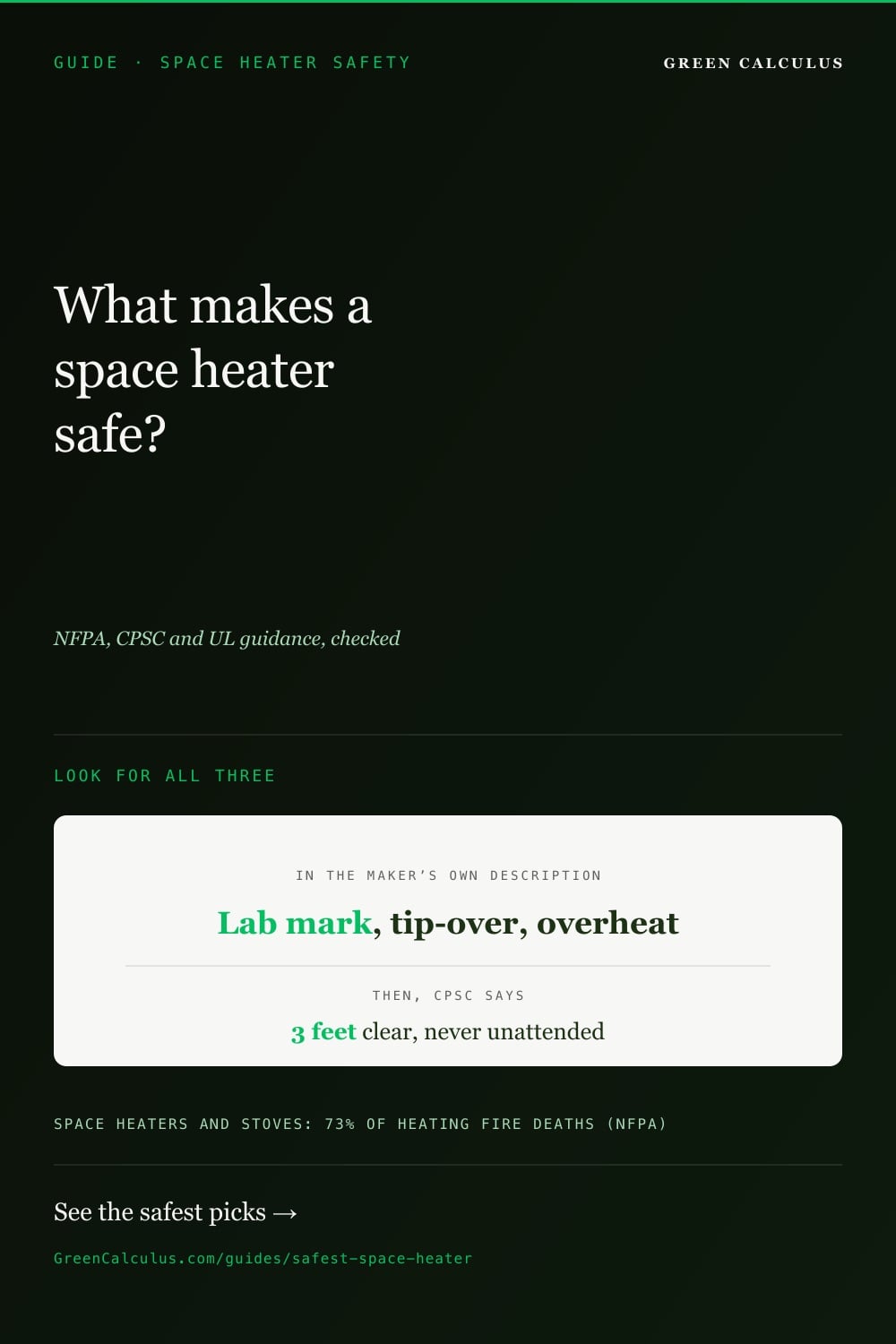
The safest space heater is an electric one certified by a recognized testing lab (a UL, ETL or CSA mark), with a tip-over switch and overheat protection that the listing names, used the way the Consumer Product Safety Commission advises: at least 3 feet from anything that can burn, plugged straight into a wall outlet, and never left on unattended or while you sleep. Space heaters and heating stoves cause 30% of home heating fires in the US but 73% of the deaths, according to NFPA. Our picks: the Lasko 754201 for small rooms, the Lasko 6101 infrared heater, the Dreo DR-HSH025 with a child lock, and the Amazon Basics oil-filled radiator.
Space heaters and heating stoves cause under a third of US home heating fires but nearly three quarters of the deaths, by NFPA’s count. The heater’s safety features and the way it is placed and used both matter. This guide sets out the safety features that matter, what each certification mark actually promises, how to use a heater the way CPSC and NFPA advise, and four heaters whose listings state every feature.
How big is the risk?
US fire departments responded to an average of 37,365 home fires a year involving heating equipment in 2020 to 2024, which caused an estimated 417 deaths and 1,260 injuries a year, according to the National Fire Protection Association. Space heaters and heating stoves were behind nearly a third (30%) of those fires but over seven in ten of the deaths (73%) and seven in ten of the injuries (70%).
The safety features that matter
| Feature | What it does | What to check |
|---|---|---|
| A testing-lab mark (UL, ETL or CSA) | Shows the heater was certified to the US safety standard for portable heaters, UL 1278. UL, Intertek (ETL) and CSA are all on OSHA’s list of Nationally Recognized Testing Laboratories. The Department of Energy advises buying a heater with a UL label. | The mark on the heater or its listing. |
| Tip-over switch | Cuts the power if the heater falls over. A listed heater must pass UL’s tip-over test, but a 2009 UL note says makers may pass it with temperature-limiting controls instead of a switch, so “listed” alone does not promise one. | The words “tip-over switch” or “tip-over protection” in the maker’s own description. |
| Overheat protection | Shuts the heater off if its internal temperature gets too high. | “Overheat protection” or “automatic shut-off”. |
| Cool-touch housing | Keeps the case cooler to the touch, which matters with children and pets. | “Cool-touch” in the description. |
| Thermostat and timer | Stop the heater running longer than needed. DOE recommends a thermostatically controlled heater. | An adjustable thermostat; an auto-off timer. |
Our picks
Each heater below states a tip-over switch or tip-over protection, overheat protection and an ETL certification in its own Amazon description, checked on 6 October 2026. We did not count features that appeared only in a product title or elsewhere on the page.
- 1,500 W
- Tabletop
- Digital thermostat
- 8-hour timer
- Child lock
- Timer
- 1,500 W
- 3 heat settings
| Heater | Tip-over | Overheat | Lab mark | Cool-touch | Thermostat or timer | Child lock |
|---|---|---|---|---|---|---|
| Lasko 754201 | ✓ | ✓ | ETL | ✓ | — | — |
| Lasko 6101 | ✓ | ✓ | ETL | ✓ | ✓ | — |
| Dreo DR-HSH025 | ✓ | ✓ | ETL | ✓ | Timer | ✓ |
| Amazon Basics NY1507-15K | ✓ | ✓ | ETL | — | — | — |
✓ = stated in the maker’s own description on the Amazon listing; — = not stated there, which does not mean the heater lacks it.
How to use a space heater safely
The Consumer Product Safety Commission’s seven habits for portable electric heaters:
- Keep all sides of the heater at least 3 feet from beds, clothes, curtains, papers, sofas and anything else that can catch fire.
- Never run the cord under rugs or carpet, and never power the heater with an extension cord or power strip.
- Keep it away from water, and never touch it if you are wet.
- Put it on a stable, level surface where it will not be knocked over.
- Never leave it running unattended or while you are sleeping.
- If the cord or plug is hot, disconnect the heater and contact an authorized repair person; if any part of the outlet is hot, call a certified electrician.
- Check SaferProducts.gov to see if your heater has been recalled.
NFPA adds a three-foot “kid-free zone” around space heaters and says to turn portable heaters off when you leave the room or go to bed. DOE’s guidance is to plug the heater directly into a wall outlet and to keep children and pets away from it. For warmth in bed, heated bedding avoids running a heater while you sleep; our guide to electric blankets and heated mattress pads covers CPSC’s rules for using one.
Electric or fuel-burning?
Choose electric for indoor use. DOE does not recommend unvented gas, propane or kerosene space heaters indoors, because of carbon monoxide, and advises a carbon monoxide detector if you use a combustion heater.
What it costs to run
Safety features do not change the running cost: every electric heater turns all its electricity into heat, so a 1,500 W heater costs about $65 a month at 8 hours a day at the US average price. Our guide to energy-efficient space heaters shows what lowers that, and the space heater cost calculator works it out for your state. For warming yourself at a desk, see low-wattage space heaters; to check whether a 1,500 W heater is enough for a room, use the BTU calculator.
How these were chosen
We looked for heaters whose own Amazon description names three things: a tip-over switch or tip-over protection, overheat protection or automatic shut-off, and a certification mark from a Nationally Recognized Testing Laboratory. Features that appeared only in a title, a comparison chart or an advert elsewhere on the page were not counted, and all four were in stock when checked on 6 October 2026. Sources: NFPA, Home Heating Safety (2020–2024 averages); CPSC, 7 Highly Effective Portable Heater Safety Habits; UL, Electric Heaters Tip-over Protection (The Code Authority, 2009); OSHA, Current List of NRTLs; DOE Energy Saver.
Sources
- NFPA, Home Heating Fires report
- NFPA, Safety with heating equipment
- U.S. Consumer Product Safety Commission, 7 Highly Effective Portable Heater Safety Habits (PDF)
- U.S. Occupational Safety and Health Administration, Current List of NRTLs
- U.S. Department of Energy, Energy Saver: Small Space Heaters (archived copy)
How we pick products for every buying guide: our buying guide standards.
Frequently asked questions
An electric heater rather than one that burns fuel, which DOE does not recommend indoors because of carbon monoxide. Among electric heaters, the safety features matter more than the type: look for a UL, ETL or CSA mark, a tip-over switch and overheat protection named in the maker’s description, then follow CPSC’s placement rules.
No. CPSC says never to leave a heater running unattended or while you are sleeping, and NFPA says to turn portable heaters off when you leave the room or go to bed.
CPSC says never to power a heater with an extension cord or power strip. DOE’s advice is to plug it directly into a wall outlet, and, if an extension cord is unavoidable, to use the shortest possible heavy-duty cord of 14-gauge wire or larger.
ETL is Intertek’s certification mark. Intertek, like UL and CSA, is on OSHA’s list of Nationally Recognized Testing Laboratories, which certify products to US safety standards; for portable electric heaters that standard is UL 1278.