
What It Costs to Run a Space Heater This Winter, in Every State
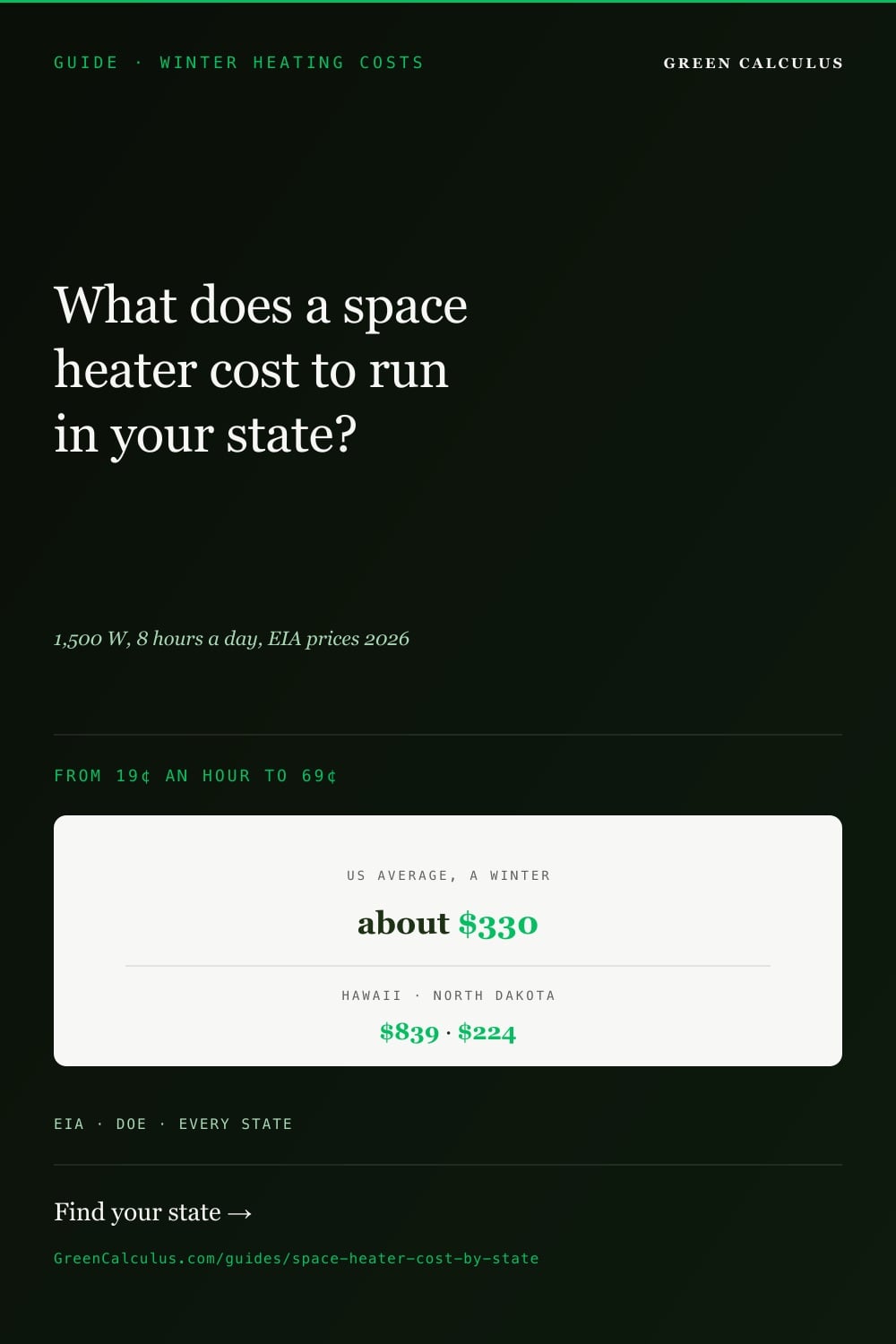
A 1,500 W space heater on high costs about $0.27 an hour at the US average electricity price, or about $330 for a winter of 8 hours a day from November to March. Where you live changes that more than which heater you buy: the same heater costs about $0.19 an hour in North Dakota and $0.69 in Hawaii, at January to July 2026 prices (EIA). A typical heat pump gives the same heat for about a third of the cost. The table below has every state, and the calculator works out yours for each heating appliance.
- 100 W
- 10 heat settings
Every electric space heater turns electricity into heat at the same rate, so a 1,500 W heater costs the same to run whatever brand it is. What changes the bill is the price of electricity where you live, and that varies almost fourfold across the US. This page puts every state side by side, updated from EIA’s price data, and prices the other ways to keep warm next to it.
Every state, most expensive first
| State and price | An hour | A month | Nov to Mar |
|---|---|---|---|
| 1. Hawaii 46.28¢ per kWh | $0.69 | $167 | $839 |
| 2. California 33.25¢ per kWh | $0.50 | $120 | $602 |
| 3. Massachusetts 30.14¢ per kWh | $0.45 | $109 | $546 |
| 4. Maine 29.99¢ per kWh | $0.45 | $108 | $543 |
| 5. New York 29.38¢ per kWh | $0.44 | $106 | $532 |
| 6. Rhode Island 29.22¢ per kWh | $0.44 | $105 | $529 |
| 7. Connecticut 27.97¢ per kWh | $0.42 | $101 | $507 |
| 8. Alaska 27.09¢ per kWh | $0.41 | $98 | $491 |
| 9. New Hampshire 26.79¢ per kWh | $0.40 | $96 | $485 |
| 10. District of Columbia 24.66¢ per kWh | $0.37 | $89 | $447 |
| 11. New Jersey 23.98¢ per kWh | $0.36 | $86 | $435 |
| 12. Vermont 23.95¢ per kWh | $0.36 | $86 | $434 |
| 13. Michigan 21.53¢ per kWh | $0.32 | $78 | $390 |
| 14. Maryland 21.30¢ per kWh | $0.32 | $77 | $386 |
| 15. Pennsylvania 21.04¢ per kWh | $0.32 | $76 | $381 |
| 16. Illinois 19.22¢ per kWh | $0.29 | $69 | $348 |
| 17. Wisconsin 19.00¢ per kWh | $0.29 | $68 | $344 |
| 18. Ohio 18.70¢ per kWh | $0.28 | $67 | $339 |
| 19. Delaware 17.86¢ per kWh | $0.27 | $64 | $324 |
| 20. Indiana 17.04¢ per kWh | $0.26 | $61 | $309 |
| 21. Virginia 16.83¢ per kWh | $0.25 | $61 | $305 |
| 22. Colorado 16.72¢ per kWh | $0.25 | $60 | $303 |
| 23. Alabama 16.54¢ per kWh | $0.25 | $60 | $300 |
| 24. Minnesota 16.25¢ per kWh | $0.24 | $59 | $294 |
| 25. Texas 16.06¢ per kWh | $0.24 | $58 | $291 |
| 26. South Carolina 15.93¢ per kWh | $0.24 | $57 | $289 |
| 27. West Virginia 15.47¢ per kWh | $0.23 | $56 | $280 |
| 28. Arizona 15.44¢ per kWh | $0.23 | $56 | $280 |
| 29. Georgia 15.40¢ per kWh | $0.23 | $55 | $279 |
| 30. Oregon 15.40¢ per kWh | $0.23 | $55 | $279 |
| 31. Florida 15.30¢ per kWh | $0.23 | $55 | $277 |
| 32. Kansas 15.21¢ per kWh | $0.23 | $55 | $276 |
| 33. Mississippi 15.19¢ per kWh | $0.23 | $55 | $275 |
| 34. New Mexico 15.08¢ per kWh | $0.23 | $54 | $273 |
| 35. North Carolina 14.94¢ per kWh | $0.22 | $54 | $271 |
| 36. South Dakota 14.50¢ per kWh | $0.22 | $52 | $263 |
| 37. Washington 14.40¢ per kWh | $0.22 | $52 | $261 |
| 38. Kentucky 14.27¢ per kWh | $0.21 | $51 | $259 |
| 39. Iowa 14.20¢ per kWh | $0.21 | $51 | $257 |
| 40. Missouri 13.96¢ per kWh | $0.21 | $50 | $253 |
| 41. Montana 13.95¢ per kWh | $0.21 | $50 | $253 |
| 42. Wyoming 13.95¢ per kWh | $0.21 | $50 | $253 |
| 43. Tennessee 13.87¢ per kWh | $0.21 | $50 | $251 |
| 44. Arkansas 13.61¢ per kWh | $0.20 | $49 | $247 |
| 45. Oklahoma 13.58¢ per kWh | $0.20 | $49 | $246 |
| 46. Nevada 13.53¢ per kWh | $0.20 | $49 | $245 |
| 47. Louisiana 13.35¢ per kWh | $0.20 | $48 | $242 |
| 48. Utah 13.16¢ per kWh | $0.20 | $47 | $238 |
| 49. Idaho 12.96¢ per kWh | $0.19 | $47 | $235 |
| 50. Nebraska 12.90¢ per kWh | $0.19 | $46 | $234 |
| 51. North Dakota 12.36¢ per kWh | $0.19 | $44 | $224 |
| US average 18.19¢ per kWh | $0.27 | $65 | $330 |
Why the cost varies so much
The heater is the same everywhere; the price per kilowatt-hour is not. DOE notes that electric resistance heating, which every space heater uses, converts all the electricity it uses into heat, so no brand or type of resistance heater does it more cheaply than another. A 1,500 W heater on high uses 1.5 kWh every hour, so its hourly cost is simply 1.5 times your price per kWh.
The other half of the bill is how long it runs. A heater with a thermostat cycles off once the room is warm, so a well-insulated room, a mild night or a lower setting all mean fewer hours at full power. The figures here assume it runs flat out for the hours you choose, which makes them the most it should cost.
Five ways to cut it
- Use fewer watts. A heater on its 750 W low setting costs half as much an hour. Our guide to low-wattage space heaters compares the options.
- Let a thermostat and a timer do the work. They stop the heater running at full power once the room is warm; see energy-efficient space heaters.
- Warm yourself, not the room. A 100 W heated blanket costs about a fifteenth as much an hour as a 1,500 W heater; see heated blankets and mattress pads.
- Stop the heat leaking out. Draft stoppers and window film are cheap; see draft stoppers and window insulation kits.
- Consider a heat pump. For heating more than one room through the winter, a heat pump gives the same heat for about a third of the electricity; the heat pump cost calculator works out the payback in your state.
Whatever you use, plug a space heater straight into a wall outlet and keep it 3 feet from anything that can burn; our guide to the safest space heaters has CPSC’s full advice.
Our picks: ways to spend less
Each of these cuts one of the numbers in the table: fewer watts, fewer hours at full power, less heat escaping, or warming you instead of the room. They are the picks from our guides, from established brands whose listings state the power and safety features, in stock on 10 October 2026.
| Best for | Pick | Key spec | Amazon |
|---|---|---|---|
| Cheapest heat | Westinghouse heated blanket, queen | 100 W | Check price |
| Thermostat and timer | Lasko ceramic tower heater | 1,500 W | Check price |
| Quiet, no fan | De’Longhi oil-filled radiator heater | 1,500 W | Check price |
| Lowest watts | Lasko MyHeat personal heater | 200 W | Check price |
| Keep the heat in | 3M Indoor Window Insulator Kit, 5 windows | Shrink film kit | Check price |
| Measure your heater | P3 Kill A Watt P4400 | 15 A, 1,875 VA | Check price |
- 100 W
- 10 heat settings
- 1,500 W
- 2 heat settings
- 1,500 W
- 3 heat settings
- 200 W
- Desk heater
- Shrink film kit
- 5 windows
- 15 A, 1,875 VA
- Accuracy within 0.2% (P3)
For more choices and how each was checked against its listing, see the guides to heated blankets, energy-efficient space heaters, the safest space heaters and draft stoppers and window kits.
How we calculated it
Cost an hour = the appliance’s rated watts ÷ 1,000 × your state’s average residential electricity price. A month is 30 days and a winter is 151 days (November to March), both at the hours a day you choose (8 in the table).
- Prices: each state’s average residential price for January to July 2026, from EIA’s Electric Power Monthly, Table 5.6.B. The table and calculator update when we load EIA’s next figures.
- Appliance power: the rated figures used in our guides: 1,500 W for a space heater on high or an electric fireplace with the heat on (the most a standard 120-volt plug-in heater draws), 750 W on low, at most 300 W for a fireplace’s flame alone (Dimplex’s published figure), 100 W for a heated blanket and 5,000 W for a 240-volt garage heater.
- Heat pump: the same heat as the 1,500 W heater, divided by a typical ducted heat pump’s heating efficiency: the mean HSPF2 of 9.2 for ducted heat pumps installed through Massachusetts programs in 2024, a coefficient of performance of about 2.7. Real performance falls in very cold weather.
These are the most each appliance should cost: thermostats, lower settings and shorter runs all bring the real figure down.
Using this data
Journalists, bloggers and energy advisers are welcome to quote these figures or republish the state table, with a link to this page. The electricity prices are EIA’s, which are in the public domain; the calculation is ours. Cite it as: GreenCalculus, “What It Costs to Run a Space Heater This Winter, in Every State”, using EIA residential electricity prices for January to July 2026.
Sources
- U.S. Energy Information Administration, Electric Power Monthly, Table 5.6.B: average price of electricity by state, year to date
- U.S. Department of Energy, Energy Saver: Electric Resistance Heating (archived copy)
- NMR Group for the Massachusetts Program Administrators and EEAC, 2024/2025 Residential Heat Pump Pricing Study (March 2026), Table 65: ducted heating efficiency (HSPF2)
- Dimplex, Electric fireplace technical support (flame power)
- U.S. Consumer Product Safety Commission, 7 Highly Effective Portable Heater Safety Habits (PDF)
How we pick products for every buying guide: our buying guide standards.
Frequently asked questions
A 1,500 W heater on high uses 1.5 kWh an hour: about $0.27 at the US average price of 18.19¢ per kWh (EIA, January to July 2026). On its 750 W low setting, about $0.14. Your state’s price is in the table above.
At 8 hours a day on high, a 1,500 W heater uses 360 kWh a month: about $65 at the US average price, from about $44 in North Dakota to about $167 in Hawaii. A thermostat brings that down once the room is warm.
Hawaii, at 46.28¢ per kWh, followed by California and Massachusetts, on EIA’s January to July 2026 averages. North Dakota, at 12.36¢, is the cheapest.
For the same heat, yes: a typical ducted heat pump (HSPF2 9.2, a coefficient of performance of about 2.7) uses roughly a third of the electricity of a space heater, so about $24 a month instead of $65 at 8 hours a day at the US average price. A space heater still makes sense for warming one room for a few hours.
Not per watt: DOE notes that electric resistance heaters convert all the electricity they use into heat, so ceramic, oil-filled and infrared heaters of the same wattage cost the same to run. A cheaper bill comes from fewer watts, fewer hours or a thermostat.