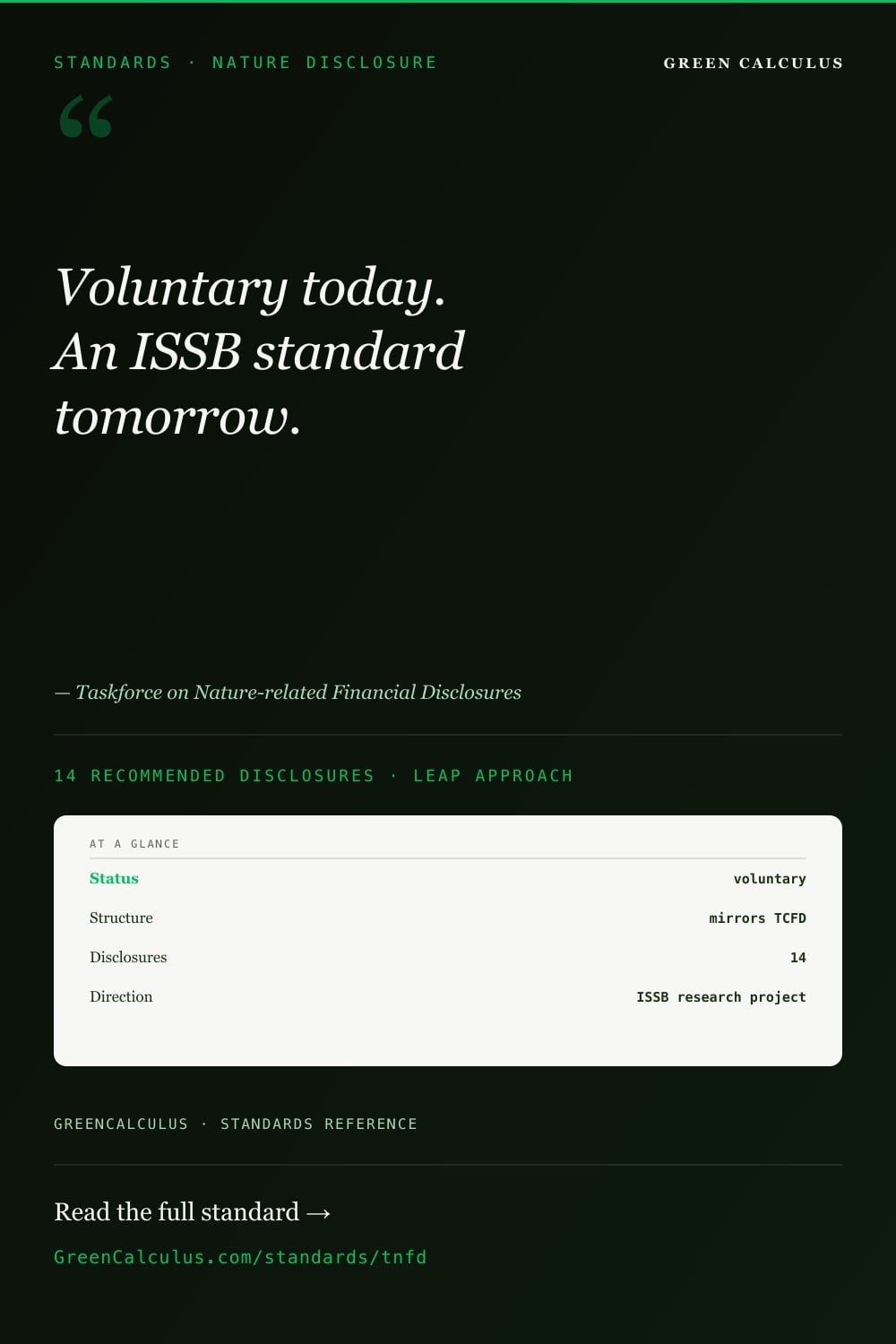
TNFD — Voluntary Today, an ISSB Standard Tomorrow

The TNFD is the nature counterpart to the TCFD, and it is on the same trajectory. Its recommendations were published in September 2023, several hundred organisations have committed to report against them, and the International Sustainability Standards Board has now said it will take on the Taskforce’s work once the in-progress technical output is finished in the third quarter of 2026.
That makes this a page about a framework in transit. Everything on it is voluntary today. The ISSB aims to publish an exposure draft of nature-related disclosure requirements by the Convention on Biological Diversity COP17 in October 2026 — a proposal, not a standard, and not yet named.
It is also the third time the same thing has happened. The TCFD was structurally absorbed into IFRS S2. The SASB Standards were adopted by the ISSB in 2022 and are still maintained by it. Nature is next.
1. What the TNFD is, and is not
Provider directory
Now it has to hold up all year.
See who does this work. Every listing names the standards it works to, and paid placements are labelled. Including Attain Zero and KERAMIDA.
Browse 6 carbon accounting & inventory providers →Do this work? A listing is US$390 a year. Get listed →
2. The handover to the ISSB
The Taskforce is not continuing indefinitely. The ISSB has stated it will take on the TNFD’s activities once the Taskforce completes the technical work currently in progress, which it expects by the third quarter of 2026. The ISSB aims to have an exposure draft of incremental disclosure requirements ready by CBD COP17 in October 2026, and has said it will draw on the TNFD’s recommendations, metrics and guidance, including the LEAP approach, as appropriate.
“Aims to” and “exposure draft” are both doing work in that sentence. An exposure draft is a consultation document: it is published for comment, it can change, and it binds nobody. There is at present no ISSB nature standard, it has no number, and the sensible planning assumption is that the TNFD recommendations remain the reference point for voluntary nature disclosure into 2027.
What the ISSB has signalled is direction rather than detail: that nature disclosure will end up inside the IFRS Sustainability Disclosure Standards architecture, alongside IFRS S1 and IFRS S2, and that the TNFD’s work will be the raw material rather than being discarded.
3. The 14 recommended disclosures — 11 borrowed, 3 new
The TNFD did not invent a reporting architecture. It took the eleven TCFD recommended disclosures, recast them for nature, and added three. That was a deliberate design decision, and it is the single most useful fact for anyone who already reports against TCFD or IFRS S2: the shape is familiar, and the work is extension rather than replacement.
| Pillar | What it asks |
|---|---|
| Governance | Board oversight and management’s role in nature-related dependencies, impacts, risks and opportunities — plus human rights policies and engagement with affected stakeholders, including Indigenous Peoples and local communities. |
| Strategy | The effects on business model, strategy and financial planning, including resilience, and the locations of assets and activities in sensitive places. |
| Risk and Impact Management | How dependencies, impacts, risks and opportunities are identified, assessed, prioritised and monitored — and how that process integrates with overall risk management. |
| Metrics and Targets | The metrics used to assess and manage material nature-related matters, and performance against targets. |
4. The word that changed, and why it matters
The TCFD’s third pillar is “Risk Management”. The TNFD’s is “Risk and Impact Management”. That inserted word is the whole conceptual difference between climate disclosure as it was first framed and nature disclosure as the TNFD frames it.
The TNFD organises this around four things, and the vocabulary is worth learning because the ISSB has said it will draw on it:
The causal chain runs left to right and back again. Dependencies and impacts are the underlying reality; risks and opportunities are how that reality reaches the accounts. A disclosure that reports risks without the dependencies underneath has skipped the part that explains it.
5. LEAP — the assessment approach
LEAP is the TNFD’s method for working out what to disclose, and it is the piece the ISSB has explicitly said it will draw on. It is not itself a disclosure requirement; it is how you get to one.
Climate reporting can be done from an accounting system: buy this much fuel, apply this factor, report the result. Nature reporting cannot. It requires knowing where your operations and your suppliers physically are, and whether those places are ecologically sensitive — which for most organisations means location data they have never had to assemble. If a nature programme stalls, it usually stalls here, and it stalls on data availability rather than on method.
6. Nature is local, and that changes the data problem
This is the structural difference from greenhouse gas accounting, and it is worth stating plainly because it defeats the instinct to reuse the climate playbook.
| Greenhouse gases | Nature | |
|---|---|---|
| Does location matter? | No, for the atmospheric effect. A tonne is a tonne. | Yes. The same abstraction, discharge or land use has completely different consequences in different places. |
| Unit of account | One — CO2e | Many, and not commensurable. Water, land, species, soil, pollutants. |
| Can you aggregate? | Yes, across the whole organisation | Only with care. A global total can hide the site that matters. |
| Primary data need | Activity data — volumes, spend, distances | Activity data and geolocation, including in the value chain |
| Where it usually fails | Scope 3 coverage | Knowing where suppliers physically operate |
The practical consequence: a mature greenhouse gas inventory gets you further with ESRS E1 than it does with nature. The governance and process work transfers; the data does not.
7. Adoption
The TNFD maintains a public register of adopters — organisations that have committed to publish TNFD-aligned disclosures. As of late 2025 that register had passed 730 organisations, with reported assets under management in the region of USD 22 trillion, weighted towards financial institutions and concentrated in Asia more than most Western readers expect.
That number is given with the period it was true for, and it will be out of date before the ISSB exposure draft lands. It is included to convey scale — several hundred organisations rather than a handful — not as a current statistic. The TNFD publishes periodic status reports; check those rather than this page for a live count.
Adoption matters for a reason beyond the number. A framework with several hundred committed reporters produces a body of practice, and that practice is what the ISSB has to build on. The exposure draft expected at COP17 will be informed by what those organisations found workable.
8. TNFD alongside the frameworks that do bind
| Framework | Relationship to TNFD | Binding? |
|---|---|---|
| ESRS E4 (biodiversity) | The European mandatory counterpart. Where CSRD applies and biodiversity is material, E4 is a requirement; TNFD is not. The two ask overlapping questions and TNFD work is usable as input. | Yes, under CSRD |
| IFRS S1 | Requires disclosure of material sustainability-related risks and opportunities generally — which can include nature — without a nature-specific standard yet existing. | Where adopted |
| GRI | Impact reporting to a broad stakeholder audience, with its own biodiversity standard. Different audience from TNFD’s investor framing, overlapping subject matter. | Voluntary |
| TCFD | The architectural parent. TNFD borrowed eleven of its disclosures and its four-pillar structure. | Absorbed into IFRS S2 |
| CSDDD and the EU Deforestation Regulation | Not disclosure regimes but due-diligence ones. They ask about the same value-chain locations TNFD’s Locate step identifies. | Yes, in scope |
The pattern is the one running through this whole part of the corpus: the voluntary framework arrives first, gets adopted, and is then either absorbed by a standard-setter or overtaken by a regulator. TNFD is at the absorption point now.
9. What to do while the handover happens
- Start with Locate, whatever framework wins. Knowing where your operations and suppliers physically are is required by TNFD, by ESRS E4, by deforestation due diligence, and by any nature standard the ISSB writes. It is the one investment that cannot be wasted.
- Do not wait for the exposure draft. It is a proposal, it will consult, and a final standard will follow it by some distance. The data work takes longer than the standard-setting.
- Reuse the TCFD or IFRS S2 governance you already have. Eleven of the fourteen disclosures are the ones you are already answering, recast. The board oversight and process descriptions transfer with editing, not rebuilding.
- If CSRD reaches you, ESRS E4 is the binding obligation. Treat TNFD as the method that helps you answer it, not as an alternative to it.
- Record what you assessed and concluded. A nature assessment that found little is a finding; one that was never made is a gap, and the distinction only exists if it is documented.
10. How GreenCalculus implements this
Our corpus is strongest on the greenhouse gas side of nature-related reporting, and honest about where that stops.
- FLAG emissions methodology — forest, land and agriculture emissions, where climate accounting and land-use change meet.
- GHG Protocol Land Sector and Removals Standard — the accounting standard for land-based emissions and removals.
- SBTi FLAG guidance — target setting for land-intensive sectors.
What we do not hold is biodiversity or ecosystem-condition data. A nature assessment needs spatial and ecological inputs that are not emission factors, and this page should not imply otherwise. Where a TNFD or ESRS E4 assessment produces a greenhouse gas number, the factors behind it carry their edition and provenance in the MasterBrain; the rest of the assessment comes from elsewhere.
11. Frequently Asked Questions
No. The TNFD is a voluntary framework published by a market-led taskforce, not a standard issued by a standard-setter, and no regulator requires it. Organisations adopt it by public commitment. Where nature reporting is mandatory the requirement comes from somewhere else — ESRS E4 under the CSRD, for example — and not from the TNFD itself.
Its work is being taken on rather than discarded. The ISSB has said it will take up the Taskforce’s activities once the TNFD completes the technical work in progress, expected in the third quarter of 2026, and that it will draw on the TNFD’s recommendations, metrics and guidance including the LEAP approach. It is the same pattern as the TCFD, which was absorbed into IFRS S2, and the SASB Standards, which the ISSB adopted in 2022 and still maintains.
No. The ISSB aims to publish an exposure draft of incremental nature-related disclosure requirements by the Convention on Biological Diversity COP17 in October 2026. An exposure draft is a consultation document: it is issued for comment, it can change, and it binds nobody. There is currently no ISSB nature standard and it has no number.
Directly and deliberately. The TNFD adopted the TCFD’s four-pillar structure and recast its eleven recommended disclosures for nature, then added three more covering nature-specific matters including stakeholder engagement. If you already report against TCFD or IFRS S2, the architecture is familiar and the work is extension rather than replacement — though the underlying data is a different problem.
Locate, Evaluate, Assess, Prepare — the TNFD’s method for working out what to disclose. Locate finds your interface with nature and which of those places are ecologically sensitive; Evaluate identifies dependencies and impacts there; Assess turns those into risks and opportunities and sizes them; Prepare decides the response, targets and disclosure. It is not itself a disclosure requirement, and the ISSB has said it will draw on it.
Because location matters. A tonne of CO2 has the same atmospheric effect wherever it is emitted, so a carbon inventory can be built from an accounting system. The same water abstraction or land conversion has entirely different consequences in different places, so nature assessment needs to know where operations and suppliers physically are — data most organisations have never had to assemble. There is also no single unit: water, land, species and pollutants are not commensurable the way greenhouse gases are.
If the CSRD reaches you and biodiversity is material, ESRS E4 is the obligation and TNFD is not an alternative to it. The useful framing is that TNFD supplies a method — particularly LEAP — for producing the assessment that E4 requires you to report. Many organisations run the TNFD process and report the results through whichever regime binds them.
The location work, because every route requires it. Knowing where your operations and value chain physically sit is needed by the TNFD, by ESRS E4, by deforestation due diligence and by any nature standard the ISSB writes. It is also the part that takes longest and the point at which most nature programmes stall. The governance and process descriptions you already have for TCFD or IFRS S2 transfer with editing; the location data does not exist until you build it.
Related References
- TCFD — the architectural parent, absorbed into IFRS S2
- IFRS S2 — where climate disclosure landed
- SASB Standards — the ISSB’s earlier adoption, and how it went
- CSRD / ESRS E1 — the European regime that contains E4
- GHG Protocol Land Sector and Removals — land-based emissions and removals
- FLAG emissions — forest, land and agriculture accounting