ISSA 5000 — The Standard Behind Every Sustainability Assurance Report
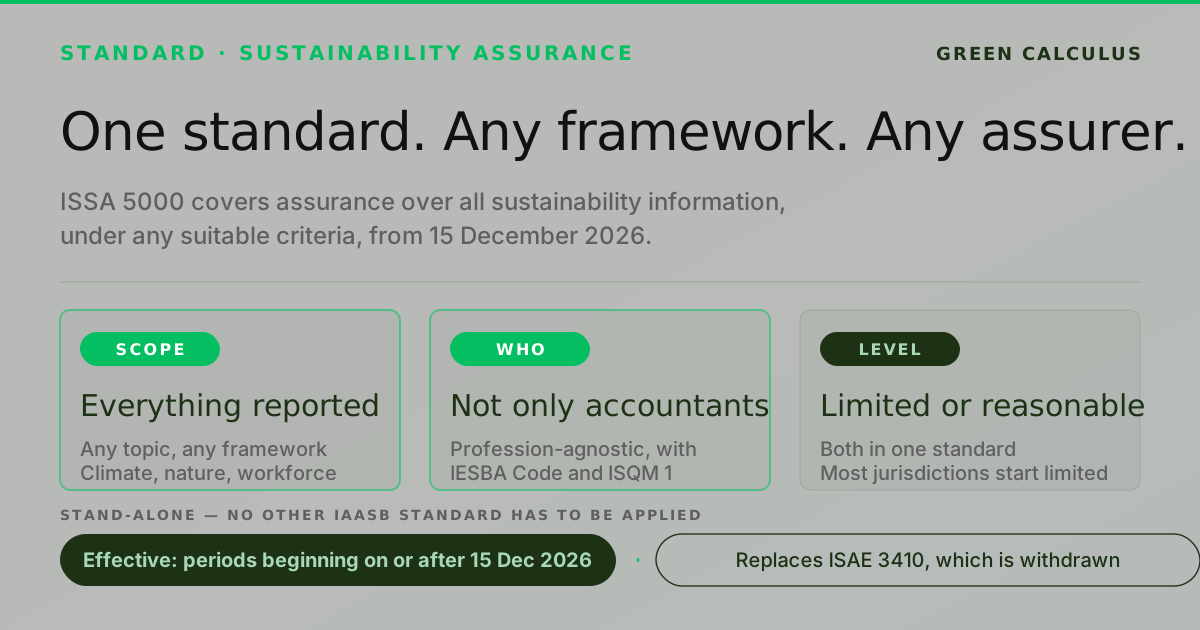
ISSA 5000 is the standard that will sit behind almost every sustainability assurance report issued from 2027 onwards. It was published by the IAASB in November 2024, and it does something none of its predecessors attempted: it covers assurance over all sustainability information — climate, nature, human rights, labour practices, whatever a framework asks for — reported under any suitable criteria, by any qualifying practitioner.
It replaces a landscape of specialist standards with one general one. ISAE 3410, written for greenhouse gas statements, is withdrawn on the day ISSA 5000 takes effect. That transition — and the arithmetic of which reporting period falls under which standard — is covered on that page. This page is about what ISSA 5000 actually requires.
1. What ISSA 5000 is
It is an assurance standard: a set of requirements for the practitioner who examines sustainability information and expresses a conclusion on it. The purpose, in the IAASB’s terms, is for the practitioner to obtain sufficient appropriate evidence to express a conclusion designed to enhance the confidence of intended users that the information is relevant and reliable.
Three design decisions define it, and each is a departure from what came before.
Provider directory
Now you have to defend it.
See who does this work. Every listing names the standards it works to, and paid placements are labelled. Including First Environment and Bureau Veritas UK.
Browse 4 assurance & verification providers →Do this work? A listing is US$390 a year. Get listed →
2. It is not a reporting standard
This is the misunderstanding worth clearing first, because it is common and it inverts the standard’s purpose. ISSA 5000 requires no disclosure of anything by anyone. The IAASB is explicit:
It was deliberately built so that an entity continues to decide what information is decision-relevant to its stakeholders. Nothing in it tells you to report a Scope 3 category, a biodiversity metric or a transition plan. Those duties come from ESRS, IFRS S2, a regulator or a stakeholder — and ISSA 5000 governs only the assurance of whatever results.
3. When it applies
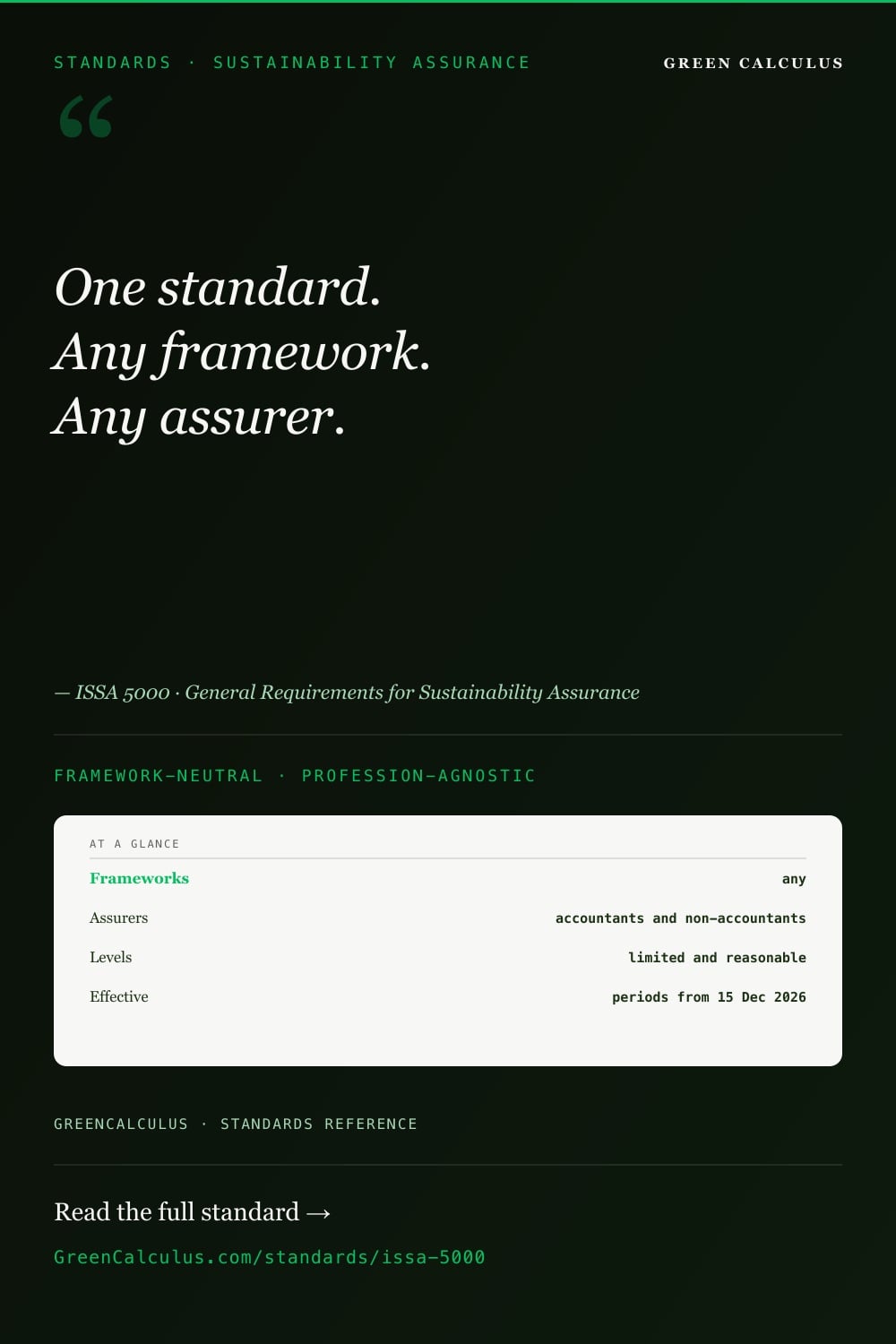
ISSA 5000 is effective for assurance engagements on sustainability information reported for periods beginning on or after 15 December 2026, or reported as at a specific date on or after that day.
This catches people out. It is not “engagements starting after December 2026”. For a calendar-year reporter the first period squarely inside ISSA 5000 is FY2027, assured during 2028 — a full reporting cycle later than the headline date suggests. The corollary is a transition window for earlier periods, which is set out in full on the ISAE 3410 page rather than repeated here.
Whether assurance is required at all is a separate question, and not one the IAASB answers. Its standards are adopted at jurisdictional level, and each jurisdiction decides whether sustainability reporting and assurance are mandatory, for which entities, and who may perform the work.
4. Suitable criteria — the precondition most likely to bite
An assurance engagement cannot proceed unless its preconditions are present, and the one that fails most often is the criteria. The entity must have used suitable criteria to prepare the information. The IAASB defines those as criteria that result in sustainability information which is:
| Attribute | What it asks of the information |
|---|---|
| Relevant | It bears on the decisions the intended users are making. |
| Complete | Nothing is omitted that would change how a user reads it. |
| Reliable | It can be measured or evaluated consistently by another competent practitioner. |
| Neutral | It is free from bias in what it presents and how. |
| Understandable | A user can follow what it says without specialist reconstruction. |
An established framework from an authorised or recognised body will normally satisfy this — IFRS S1 and S2 do, and the ISSB was consulted during development specifically to ensure compatibility. A bespoke internal methodology may not, and that is where engagements stall: not on the numbers, but on whether the basis for producing them is capable of being assured at all.
The second precondition is equally practical: the practitioner must expect to be able to obtain the evidence needed to support the conclusion. Where information cannot be evidenced — commonly deep in a value chain — that expectation may not hold.
5. Limited and reasonable assurance, in one standard
ISSA 5000 provides for both levels, and the distinction is not a matter of thoroughness alone. It changes the form of the conclusion you receive.
| Limited assurance | Reasonable assurance | |
|---|---|---|
| The conclusion | Whether anything has come to the practitioner’s attention causing them to believe the information is not prepared, in all material respects, in accordance with the criteria | An opinion on whether the information is prepared, in all material respects, in accordance with the criteria |
| Level obtained | Substantially lower — but still meaningful to users | High, though never absolute |
| Procedures | Vary in nature and timing from, and are less in extent than, reasonable assurance | More extensive in nature, timing and extent |
| Financial-reporting analogue | A review of financial statements | An audit of financial statements |
That phasing matters for how a limited conclusion should be read. It is not a weaker version of an audit opinion; it is a differently shaped statement. And because most investors are accustomed to audited financial statements, some will expect the confidence of reasonable assurance from a report that does not provide it.
6. The engagement, end to end
The IAASB’s Implementation Guide organises an ISSA 5000 engagement into eight parts. They are worth knowing as a client, because they tell you when in the process you will be asked for what.
The standard treats a misstatement as qualitative or quantitative, and as including omitted information and information that obscures or misleads. A figure can be arithmetically correct and still be a misstatement if its presentation misleads. That is a wider test than most reporters expect, and it is the reason narrative disclosures are assurable at all.
7. Value chain, and using the work of others
The Implementation Guide gives the value chain a part of its own, alongside group engagements, and it is the structural difference between assuring sustainability information and assuring financial statements. A great deal of what an entity reports — Scope 3 above all — describes activity it does not control and data it did not produce.
Two consequences follow for anyone preparing for an engagement.
- Evidence has to be obtainable, not merely asserted. The precondition in §4 requires the practitioner to expect they can obtain evidence supporting the conclusion. Value-chain data that cannot be evidenced puts that expectation under strain before the engagement begins.
- Using someone else’s work is governed, not assumed. Where the practitioner relies on the work of others, ISSA 5000 addresses how — a supplier’s own assurance, a scheme certificate or a data provider’s figure is not automatically evidence in your engagement.
Our Emission Factor Gap Register and spend-based methodology deal with the same problem from the reporting side: where a value-chain figure comes from, and how much weight it can carry.
8. Materiality, including double materiality
Materiality in an assurance engagement has two sides that are easy to conflate. The entity applies materiality in deciding what to report; the practitioner applies it in planning and performing the engagement and in evaluating misstatements. ISSA 5000 addresses both, and the Implementation Guide devotes attention to the relationship.
The standard is written to accommodate frameworks that use double materiality — where an entity considers both how sustainability matters affect it and how it affects the environment, society and the economy — as well as frameworks that do not. That is a necessary consequence of being framework neutral: ESRS applies double materiality, IFRS S1 and S2 do not, and one assurance standard has to work over both.
A common expectation is that the assurer will decide what is material and test that. They do not. The entity’s management determines what is decision-relevant under its chosen criteria; the practitioner assesses whether the resulting information is materially misstated against those criteria. If your materiality process is undocumented, the engagement runs into that early — not because the practitioner disagrees with your conclusions, but because there is nothing to assess them against.
9. Who may perform an ISSA 5000 engagement
ISSA 5000 is profession-agnostic. Any assurance practitioner can use it, subject to two conditions — with a third route that is frequently left out of summaries.
The third route is what makes profession-agnosticism real rather than nominal. Without it, only firms already inside the accountancy infrastructure could qualify. With it, a jurisdiction can recognise an equivalent regime for engineering, certification or verification bodies — and those bodies can perform ISSA 5000 engagements.
Jurisdictions retain the final say. Law, regulation or local professional requirements may impose further limits on who may perform sustainability assurance in a particular market.
10. Stand-alone: no other IAASB standard required
ISSA 5000 does not require any other IAASB auditing or assurance standard to be applied alongside it. This is a deliberate design choice with a specific purpose: practitioners unfamiliar with the ISAs or the ISAEs can use it effectively without first learning them.
It is the technical counterpart to profession-agnosticism. A standard that could only be applied by someone fluent in the international auditing standards would be open to non-accountants in principle and closed to them in practice.
11. What it replaces, and what survives
The transition is narrower than it is often described, and the distinction matters if you also buy non-sustainability assurance.
| Standard | What happens |
|---|---|
| ISAE 3410 GHG statements |
Withdrawn with effect from 15 December 2026. ISSA 5000 covers GHG information, so a separate standard was judged unnecessary. |
| ISAE 3000 (Revised) Other than audits or reviews |
Survives — but no longer for sustainability. It continues to be used for assurance engagements other than audits or reviews of historical financial information or assurance engagements on sustainability information. |
| ISO 14064-3 ISO verification |
Unaffected — a different standard-setter entirely. An IAASB withdrawal reaches only IAASB pronouncements. |
This is the easy mistake, and it is worth stating plainly because a lot of commentary blurs it. Only ISAE 3410 is withdrawn. ISAE 3000 (Revised) remains a live standard for the many assurance engagements that are neither an audit nor a review of historical financial information nor about sustainability — it simply stops being the vehicle for sustainability work.
12. Adoption is a jurisdictional decision
The IAASB sets the standard; it does not require anyone to use it. Adoption and implementation happen at jurisdictional level, and policymakers, standard-setters and regulators in each market decide when ISSA 5000 is required, whether additional local requirements are needed, and who is allowed to conduct the engagements.
Two practical consequences. A jurisdiction may adopt on a different timetable from the international effective date — which is what creates the route described on the ISAE 3410 page for practitioners in markets that have not yet adopted. And even where no regulator mandates assurance, entities frequently obtain it anyway, because investors and capital providers ask for it.
13. Interaction with the frameworks you report under
| Framework | How ISSA 5000 meets it |
|---|---|
| IFRS S1 and IFRS S2 | Confirmed by the IAASB as providing suitable criteria that can be assured under ISSA 5000. The ISSB was among the standard-setters consulted during development to ensure compatibility. |
| CSRD / ESRS | Assurance covers the sustainability statement as a whole, which suits a general standard better than a GHG-specific one. European assurance standards are also under development and may take precedence locally. |
| GRI | Framework neutrality means a GRI-based report can be assured under ISSA 5000 provided the criteria are suitable for the information reported. |
| GHG Protocol | The criteria most GHG statements are prepared against. ISSA 5000 assures the statement; the GHG Protocol governs how it was built. |
| A voluntary or bespoke framework | Assurable only if the criteria are suitable — relevant, complete, reliable, neutral and understandable. This is where bespoke methodologies fail. See §4. |
14. What this means for your emission factors
Nothing in ISSA 5000 imposes a factor-provenance test on the practitioner — the same position as under ISAE 3410 and ISO 14064-3. What changes is the surface area: a standard covering all sustainability information across a value chain asks the evidence question about far more of your reporting than a GHG-only standard did.
Every factor in the MasterBrain carries its edition, publication and retrieval provenance, and historical values stay addressable by version, so that question has an answer that predates the engagement. Our Assurance Readiness Checker tests the gap between what the assurer examines and what remains your duty to hold.
15. Frequently Asked Questions
ISSA 5000, General Requirements for Sustainability Assurance Engagements, is the IAASB’s standard for assurance over sustainability information. Issued in November 2024, it applies to all assurance engagements on sustainability information — any topic, any suitable reporting criteria, any type or size of entity — and supports both limited and reasonable assurance. It is effective for periods beginning on or after 15 December 2026.
No. It is an assurance standard, not a reporting standard, and it imposes no disclosure requirement on any entity. Preparing and reporting sustainability information is management’s responsibility under whatever framework or criteria apply. ISSA 5000 governs only the work of the practitioner who assures that information.
Periods beginning on or after 15 December 2026, or information as at a specific date on or after that day. The test is the reporting period, not the date the engagement is accepted — so for a calendar-year reporter the first period squarely inside ISSA 5000 is FY2027, assured during 2028. Earlier periods sit in a transition window covered on our ISAE 3410 page.
Yes. The standard is deliberately profession-agnostic. The practitioner must comply with the IESBA Code including its independence requirements, and belong to a firm that applies ISQM 1 — or follow professional requirements, or requirements in law or regulation, that an appropriate authority has determined to be at least as demanding as those two. That third route is what makes the standard genuinely open beyond the accountancy profession. Local law may still restrict who can perform the work in a given market.
Yes. The IAASB confirms that S1 and S2 are among the frameworks providing suitable criteria that can be assured under ISSA 5000, and the ISSB was one of the standard-setters consulted during its development to ensure compatibility. The standard is framework neutral, so it works with any criteria that are suitable — meaning they produce information that is relevant, complete, reliable, neutral and understandable.
No. ISSA 5000 is a stand-alone standard and does not require any other IAASB auditing or assurance standard to be applied. That is deliberate: it allows practitioners who are not familiar with the ISAs or ISAEs to use it effectively. The exceptions are the ethical and quality-management requirements — the IESBA Code and ISQM 1, or an equivalent regime — which are conditions of using it at all.
No — only ISAE 3410 is withdrawn. ISAE 3000 (Revised) continues to be used for assurance engagements other than audits or reviews of historical financial information or assurance engagements on sustainability information. In other words it survives as a standard, but stops being the vehicle for sustainability assurance once ISSA 5000 is effective.
It depends who is reading. A limited assurance conclusion states whether anything came to the practitioner’s attention causing them to believe the information is not prepared in accordance with the criteria — a different shape of statement from an opinion, on substantially less work. A majority of jurisdictions moving to mandatory assurance are starting with limited and plan to move to reasonable over time, but some investors accustomed to audited financial statements will expect the higher level sooner.
Related References
- ISAE 3410 — the withdrawn GHG assurance standard and the transition arithmetic
- ISO 14064-3 — the ISO verification route, unaffected by this transition
- ISO 14064-1 — the inventory standard assurance is performed over
- CSRD / ESRS E1 — assurance over the whole sustainability statement
- IFRS S2 — suitable criteria, with assurance left to jurisdictions
- GHG Protocol Corporate Standard — how the statement was built
- Assurance Readiness Checker — what the assurer tests, and what stays yours