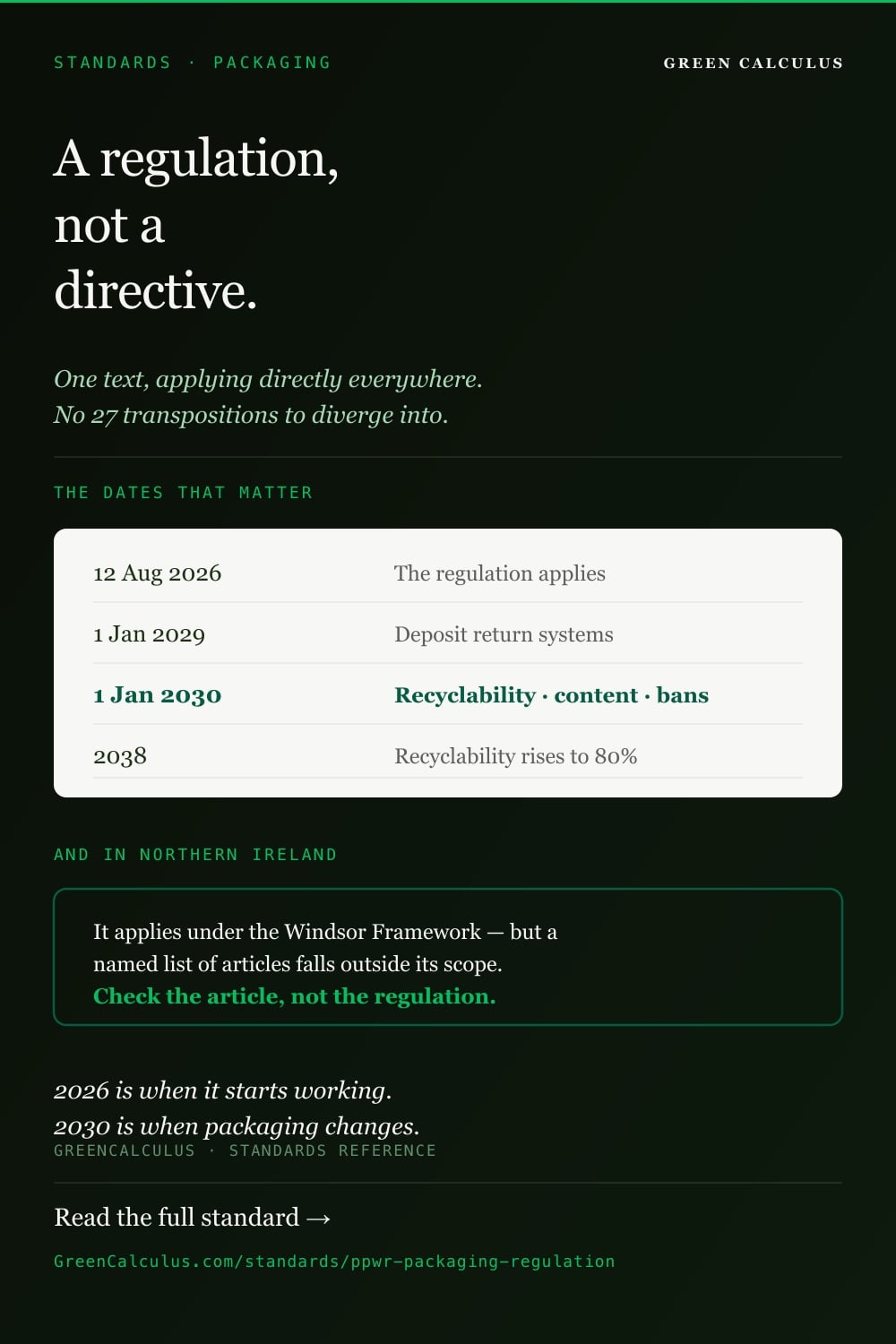
PPWR — A Regulation, Not a Directive, and in Northern Ireland Not All of It
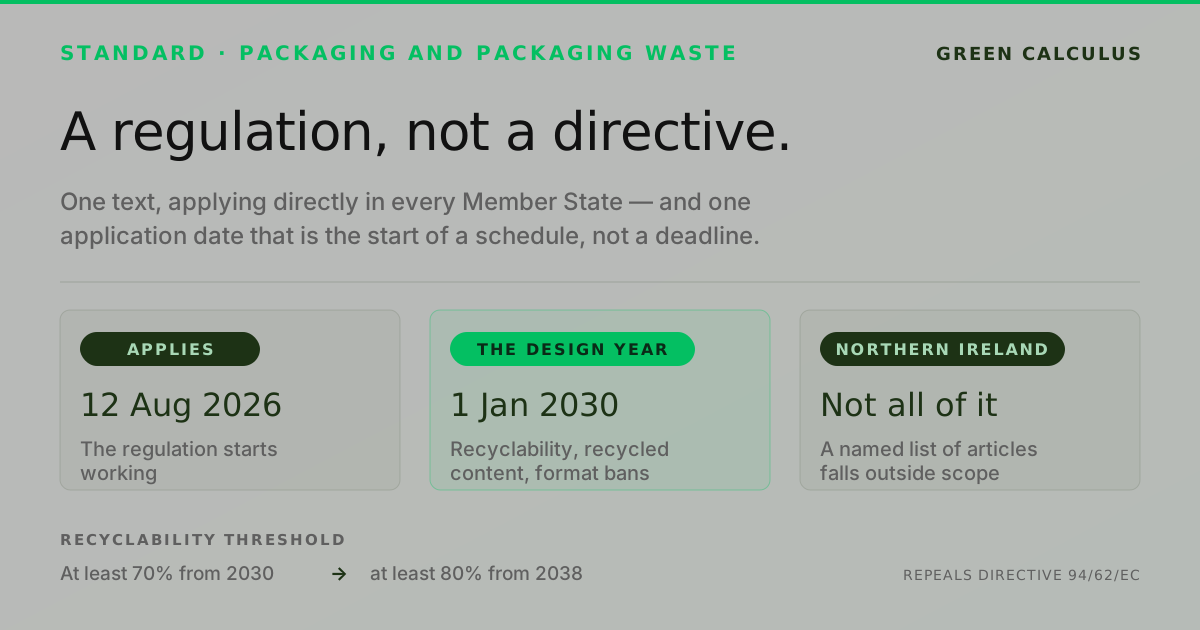
For thirty years packaging in Europe was governed by a directive, which meant twenty-seven national transpositions and twenty-seven slightly different answers to the same question. Regulation (EU) 2025/40 repeals that directive and replaces it with a regulation. A regulation applies directly, in the same words, in every Member State, and there is no national implementation for it to diverge into.
That is the change, and most of the commentary about PPWR is downstream of it. The recycled-content rules and the format bans are the visible content; the structural point is that a manufacturer selling into several Member States now has one text to comply with rather than a matrix.
Two things complicate that. The regulation has many application dates rather than one, so “applies from 12 August 2026” is the start of a schedule and not a deadline. And in Northern Ireland it is genuinely not one regulation: a named list of articles falls outside the Windsor Framework and does not apply there at all. §7 lists them, because almost nothing else does.
1. What replaced what
Regulation (EU) 2025/40 was adopted by the Council on 16 December 2024, published in the Official Journal on 22 January 2025, and entered into force on 11 February 2025. It repeals Directive 94/62/EC in full, and it amends two neighbouring instruments rather than sitting alongside them: Regulation (EU) 2019/1020 on market surveillance, and Directive (EU) 2019/904, the Single-Use Plastics Directive.
Provider directory
Now it has to hold up all year.
See who does this work. Every listing names the standards it works to, and paid placements are labelled. Including Anthesis Group and Attain Zero.
Browse 6 carbon accounting & inventory providers →Do this work? A listing is US$390 a year. Get listed →
2. One application date, many obligations
The regulation applies from 12 August 2026. That date is when the instrument becomes operative; it is not when everything in it bites. Individual obligations are staged from three months after entry into force through to 2040, and treating the application date as the compliance deadline is the commonest planning error on this file.
3. Recyclability, and what “recyclable” now means
The regulation replaces a loose, self-assessed notion of recyclability with a graded one. From 2030, packaging must be at least 70% recyclable to be placed on the market; from 2038 the threshold rises to at least 80%. Packaging that grades below the threshold is not treated as recyclable and cannot be sold, whatever a label or a consumer-facing claim says about it.
Three consequences follow that are easy to miss.
4. Recycled content, and the mirror clause
From 2030, plastic packaging must contain minimum shares of recycled material. The minimums are category-specific and are set out in the regulation and its annexes: they differ between contact-sensitive packaging and everything else, between PET and other polymers, and for single-use plastic beverage bottles, and they rise again in 2040.
This page deliberately does not reproduce the full table. The figures are category-dependent and widely misquoted, and a single number applied to the wrong category is a compliance answer that is confidently wrong. What we can state from the UK government’s own explanatory memorandum on the regulation is one anchor: single-use plastic bottles must contain 30% recycled material from 2030 — the same threshold the UK Plastic Packaging Tax has used since 2022.
The provision that changes the commercial picture is the mirror clause. Imported plastic must meet the same environmental standards as plastic placed on the market from within the EU, including the minimum recycled-content requirements. A non-EU manufacturer cannot supply the EU market with packaging built to a lower standard, and an EU brand cannot solve a recycled-content problem by sourcing the pack elsewhere.
If you are modelling what a recycled-content minimum does to a footprint before committing to it, our plastics packaging embodied carbon calculator maps directly onto these categories.
5. What is banned, and from when
Article 25, with Annex V, prohibits named single-use plastic formats from 1 January 2030. The list is specific rather than general:
| Format | Where it bites |
|---|---|
| Single-use plastic packaging for pre-packed fresh fruit and vegetables below 1.5 kg | Grocery retail and produce packing |
| Single-use plastic packaging for foods and beverages filled and consumed on the premises | Hotels, restaurants, cafés and similar |
| Single-use plastic packaging for individual portions of condiments, preserves, sauces, coffee creamer, sugar and seasoning | The same sector, and its suppliers |
| Single-use plastic packaging for cosmetic, hygiene and toiletry products in accommodation | Hotel miniatures |
| Very lightweight plastic carrier bags below 15 microns wall thickness | Retail generally |
| Single-use plastic grouped packaging, such as film and rings around cans and bottles | Beverage and multipack production |
Two carve-outs matter. Member States may grant exemptions where necessary for hygiene, food safety or environmental reasons. And composite packaging whose plastic content is 5% or less by weight sits outside these particular bans — a scope rule rather than a general safe harbour, and one worth checking against an actual bill of materials rather than an assumption.
The UK government’s explanatory memorandum on this regulation, submitted to the Northern Ireland Assembly, dates these bans to 1 January 2040. The regulation applies them from 1 January 2030, and Article 25 with Annex V is the operative provision. We record the discrepancy because the memorandum is otherwise a careful and useful document, and a reader who takes the date from it will plan a decade late. Where a secondary source and the instrument disagree, the instrument governs.
6. Producer responsibility, deposits and labelling
Three operational regimes sit behind the design rules, and each has its own clock.
The registration point is the one that catches distributors and non-EU sellers. It is a precondition on placing packaging on a market, not an administrative follow-up, and it is per Member State.
7. Northern Ireland — which articles do not apply
This section is the reason this page exists in the form it does. Northern Ireland applies certain EU packaging rules to preserve dual access to the UK internal market and the EU single market, and PPWR applies there under Article 13(3) of the Windsor Framework, subject to the democratic scrutiny mechanisms in Schedule 6B of the Northern Ireland Act 1998.
But not all of it. Several provisions fall outside the scope of the Windsor Framework, broadly the waste-management parts, and therefore do not apply in Northern Ireland:
| Articles outside scope | Subject |
|---|---|
| Article 34 | Per capita plastic carrier bag consumption targets — unless Northern Ireland opts to take measures under Article 34(1), in which case Article 34 and Article 56(1)(b) apply |
| Article 43 | Packaging waste generation targets |
| Articles 29–33 | Re-use targets and associated measures, including re-use reporting and measures on reusable takeaway packaging |
| Articles 44–47 | Harmonised extended producer responsibility requirements |
| Articles 48–49 | Return and collection systems |
| Article 50 (and Article 12 for deposit-scheme labelling) | Deposit and return systems |
| Articles 51–54 | Recycling targets, calculation rules, and promotion of re-use, refill and recycling |
| Article 63 | Green public procurement measures |
| Articles 23, 41, 42, 55, 56(1) and 56(6), 57 | Certain waste-management reporting and information requirements |
Articles not on that list are subject to the Article 13(3) process insofar as they do not relate to waste management. The practical effect is that the product rules — what packaging must be made of and how it must be designed — reach Northern Ireland, while much of the system around collection, deposits and targets is UK domestic policy instead.
“PPWR applies in Northern Ireland” and “PPWR does not apply in Northern Ireland” are both wrong, and the second is the more expensive error for a manufacturer. The design and composition rules reach NI-placed packaging; the waste-system articles do not. Check the article, not the regulation.
8. Where PPWR sits against the UK regime
Great Britain is building comparable machinery through its own instruments, on its own timetable, and the two are converging in substance rather than in text.
| EU — PPWR | UK | |
|---|---|---|
| Recycled content | Category-specific minimums for plastic packaging from 2030, rising in 2040 | Plastic Packaging Tax since April 2022 on packaging below 30% recycled content, £217.85 per tonne from 1 April 2024 |
| Producer responsibility | Harmonised EPR with a producer register and registration as a precondition | pEPR for packaging from 1 January 2025 |
| Deposit return | Systems required by 1 January 2029 | Scheme launching in England, Scotland and Northern Ireland in October 2027; Wales on its own timetable |
| Collection | Return and collection systems, Member State duty | Simpler Recycling, aligning collected streams across households and non-household premises |
| Design rules | Recyclability thresholds and format bans as market-access conditions | No direct equivalent yet; the UK has stated an intention to consult on equivalent measures |
The tax is the clearest illustration of the same aim reached differently. The UK prices packaging below 30% recycled content; the EU prohibits placing it on the market below the required minimum. One is a levy you can pay, the other is a condition you must meet.
9. What PPWR does not do
It does not require anybody to calculate a carbon footprint. PPWR is a circularity instrument, not a greenhouse gas one. Packaging carbon is disclosed under other regimes and quantified with other methods — see our packaging product carbon footprint methodology — and meeting a recycled-content minimum is not the same as reducing an emissions figure, though it usually does.
It does not set a single recycled-content number. The minimums are category-specific by design, and any summary quoting one percentage for “plastic packaging” is compressing a table.
It does not exempt small businesses generally. There are de minimis easements for micro businesses, defined by employee count and turnover, covering things such as re-use targets and certain deposit obligations. They are targeted exemptions from named provisions, not a general carve-out.
And it does not finish the job itself. A substantial amount of technical detail — recyclability criteria, labelling formats, calculation rules — arrives through implementing and delegated acts. A page, or a compliance plan, written as though the regulation is complete on its own face will need revisiting as those land.
Frequently asked questions
12 August 2026. That is when the regulation becomes operative, and it is the start of a schedule rather than a deadline: individual obligations land from three months after entry into force through to 2040. The date that reshapes most packaging is 1 January 2030, when recyclability requirements, minimum recycled content and the Article 25 format bans all take effect. Planning to the 2026 date alone produces a register rather than a redesign.
A directive obliges each Member State to achieve a result and leaves the form to national law, which produced 27 transpositions of Directive 94/62/EC and 27 sets of detail. A regulation applies directly and in the same words everywhere. For a business selling across the EU that removes the national-variation matrix from most of the compliance question, and moves the remaining detail into implementing and delegated acts adopted centrally — so the thing to watch is the Commission rather than 27 ministries.
It depends on the category, which is why a single figure is usually wrong. The minimums differ between contact-sensitive packaging and everything else, between PET and other polymers, and for single-use plastic beverage bottles, and they rise again in 2040. One anchor we can state from the UK government’s explanatory memorandum: single-use plastic bottles must contain 30% recycled material from 2030 — the same threshold the UK Plastic Packaging Tax has used since 2022. Take your own figure from the regulation by category.
Partly, and answering yes or no both mislead. It applies under Article 13(3) of the Windsor Framework, subject to Schedule 6B of the Northern Ireland Act 1998 — but a named list of articles falls outside scope, broadly the waste-management ones: plastic bag consumption targets, waste generation targets, re-use targets, harmonised EPR, return and collection systems, deposit return systems, recycling targets and calculation rules, green public procurement, and certain reporting. The product rules reach NI-placed packaging; much of the system around it is UK domestic policy.
No. PPWR contains a mirror clause: imported plastic must meet the same environmental standards as plastic placed on the market from within the EU, including minimum recycled content. That closes the obvious route around a recycled-content requirement and means the obligation follows the packaging rather than the manufacturer’s location. It also means a non-EU supplier’s specification is your compliance problem, which is a procurement conversation rather than a design one.
2030. Article 25 with Annex V prohibits the named single-use plastic formats from 1 January 2030. We flag this because the UK government’s explanatory memorandum on the regulation dates them to 2040, and it is otherwise a careful document that a UK reader is likely to encounter. Where a secondary source and the instrument disagree, the instrument governs — and a decade is an expensive amount to be wrong by in either direction.
Composite packaging whose plastic content is 5% or less by weight sits outside these particular bans. That is a scope rule for Article 25, not a general safe harbour from the regulation — recyclability, recycled content and producer responsibility are unaffected by it. It is also a figure worth checking against an actual bill of materials rather than assuming, because films, liners, laminates and closures accumulate faster than most specifications suggest.
No. PPWR is a circularity instrument and asks about materials, recyclability, recycled content and end-of-life systems, not about greenhouse gases. Packaging emissions are disclosed under reporting regimes such as CSRD and quantified with product carbon footprint methods. The two interact in a useful direction — raising recycled content usually lowers embodied carbon — but meeting a PPWR minimum evidences nothing about an emissions figure, and neither discharges the other.
Related references